Open letter to Executive Vice-President Timmermans on European climate law
Broad cross-sectorial coalition of stakeholders calls for EU climate law to recognize the role of energy efficiency and renewables to reach climate neutrality by 2050

Dear Executive Vice-President Timmermans,

The European Green Deal  is a particularly positive beginning for the new European Commission. We welcome the Commission pledge to address the climate crisis and, by doing so, shape the future of Europe’s economy and society and lead by example worldwide.

We have come together as stakeholders representing energy efficiency and renewable technologies, local governments, regional organizations, think tanks and non-for profit organizations to express the need for climate law to orient the action of the EU towards what is the fastest and most cost-effective way to reduce emissions: the recognition of the Energy Efficiency First principle, which is a prerequisite for the much needed deployment of a 100% renewable-based energy supply.  This will boost the European economy by creating new opportunities and jobs and reduce our dependence on energy imports.

As such, we recommend to:

  • Recognize Energy Efficiency First as an overarching principle of the EU Climate Law governance
  • Include an intermediate GHG emissions reduction target of at least 55% by 2030.
  • Mainstream policy coherence with increased and mandatory energy efficiencyrenewable energy and carbon emissions targets.

We ask you to consider these recommendations and bring forward a climate law proposal which will recognise the role of energy efficiency as a potent and critical catalyst to the massive scale-up of renewables in a resource-constrained planet.

We look forward to cooperating with you to make Europe the first climate neutral continent.


List of undersigning stakeholders:
Follow us


Privacy Policy

© All right reserved

EU-ASE response to European Commission consultation on climate law

According to the Commission LTS, the EU must halve its energy consumption by 2050. Energy efficiency therefore must play a central role in achieving net-zero GHG emissions by 2050. Considering that the world economy will triple by 2050 and that global population will increase by nearly 2.3 billion by 2050, energy efficiency is the most cost-effective way to decouple economic growth from emissions. Significant reductions in overall energy demand will come from energy use in buildings. Residential and commercial buildings currently account for 40 % of EU energy consumption – with 75 % of these buildings being built before energy performance standards existed – 36% of emissions and 50% of the total mineral resources extracted from the planet. Most of the housing stock of 2050 already exists and will need to be renovated. Our building stock needs to become net zero carbon, which involves ramping up the rate and depth of renovation and ensuring efficient and decarbonised energy supply in the building sector. The “Renovation Wave” needs to build from the implementation of the Long Term Renovation Strategies, but also explore new drivers and triggers, including regulation, in order to scale up what has worked well in some countries.  
Full text available via the link below
 

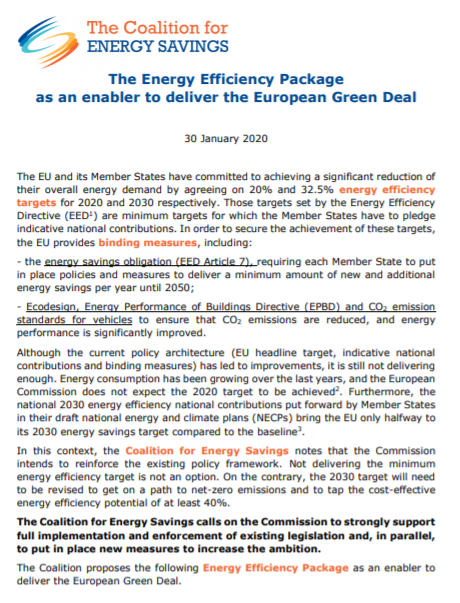
EU-ASE contributes to Coalition’s Energy Efficiency package for the European Green Deal

The EU and its Member States have committed to achieving a significant reduction of their overall energy demand by agreeing on 20% and 32.5% energy efficiency targets for 2020 and 2030 respectively. Those targets set by the Energy Efficiency Directive (EED) are minimum targets for which the Member States have to pledge indicative national contributions. In order to secure the achievement of these targets, the EU provides binding measures, including:

  • the energy savings obligation (EED Article 7), requiring each Member State to put in place policies and measures to deliver a minimum amount of new and additional energy savings per year until 2050;
  • Ecodesign, Energy Performance of Buildings Directive (EPBD) and CO2 emission standards for vehicles to ensure that CO2 emissions are reduced, and energy performance is significantly improved.

Although the current policy architecture (EU headline target, indicative national contributions and binding measures) has led to improvements, it is still not delivering enough. Energy consumption has been growing over the last years, and the European Commission does not expect the 2020 target to be achieved. Furthermore, the national 2030 energy efficiency national contributions put forward by Member States in their draft national energy and climate plans (NECPs) bring the EU only halfway to its 2030 energy savings target compared to the baseline.

In this context, the Coalition for Energy Savings notes that the Commission intends to reinforce the existing policy framework. Not delivering the minimum energy efficiency target is not an option. On the contrary, the 2030 target will need
to be revised to get on a path to net-zero emissions and to tap the cost-effective energy efficiency potential of at least 40%.

The Coalition for Energy Savings calls on the Commission to strongly support full implementation and enforcement of existing legislation and, in parallel, to put in place new measures to increase the ambition.

The Coalition proposes the following Energy Efficiency Package as an enabler to deliver the European Green Deal.

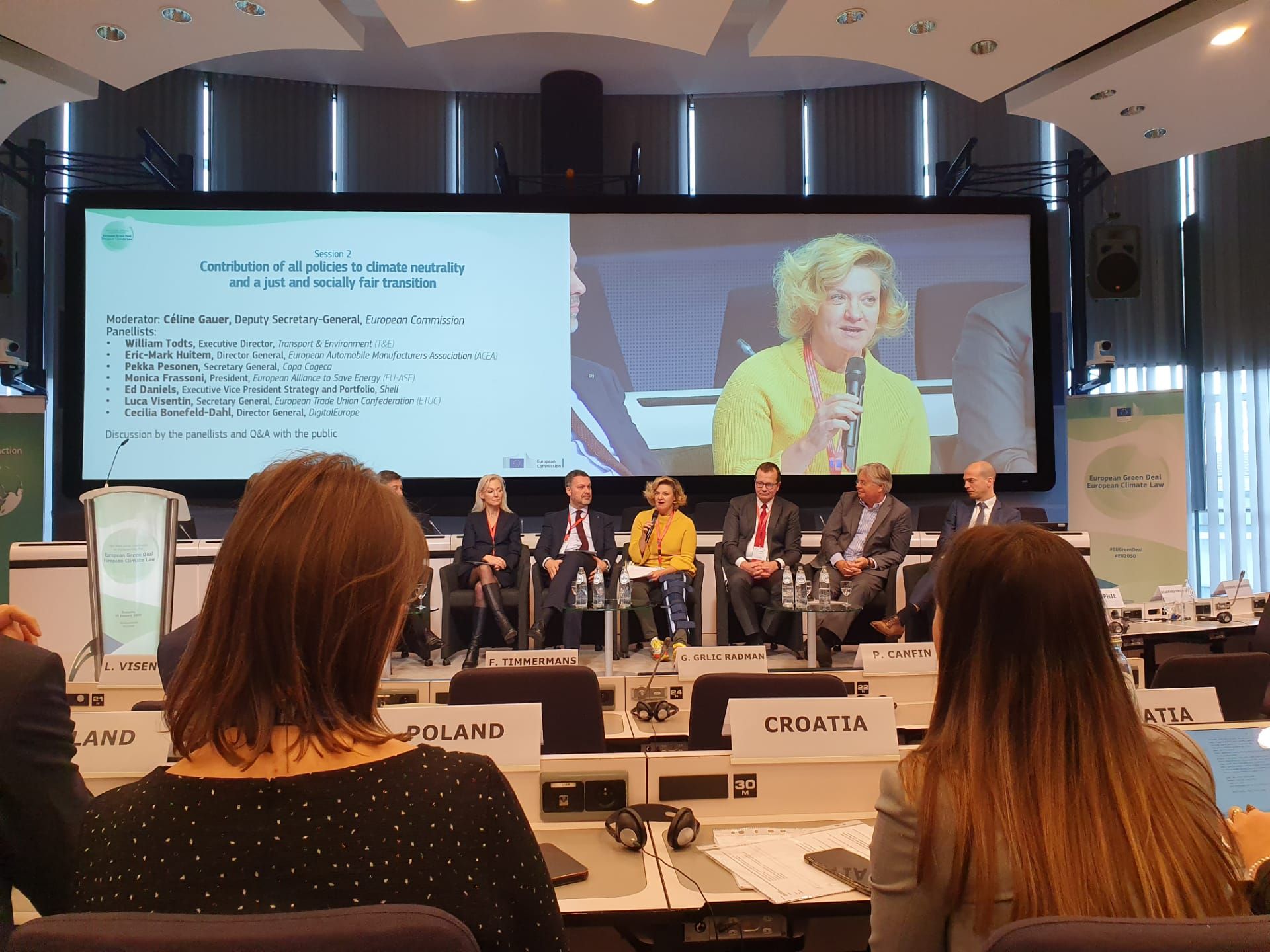
At Climate law conference Monica Frassoni highlights importance of energy efficiency to decarbonise Europe

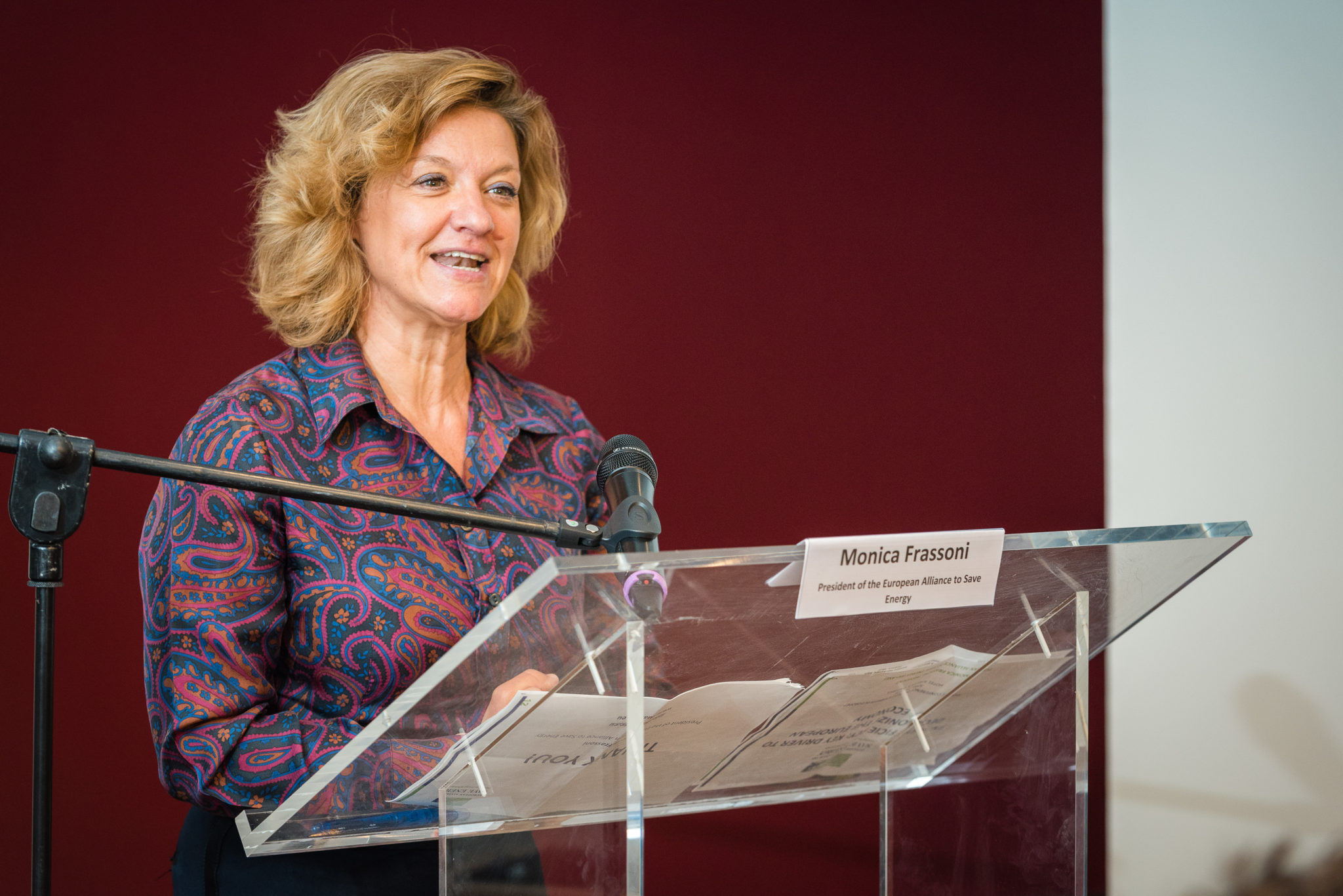
Speech by EU-ASE president Monica Frassoni at High-level public conference on implementing the European Green Deal and Climate Law

Brussels, Tuesday 28 January 2020

“The production and use of energy across economic sectors account for more than 75% of the EU’s greenhouse gas emissions. Energy efficiency (EE) must be prioritised. If we all want to go towards electrification, digitalisation and all the necessary elements that a successful and just transition entails, we need to cut radically our energy demand, by half by 2050 in comparison to 2005, says the Commission.

In other words, we need to fully implement EE FIRST in the decision making and planning of EU energy infrastructure including facilities for generation, transmission, distribution and end-use consumption. This should be addressed in the review of TEN-E, PCI list and in the design of the EU decarbonization package.

We are not yet there I am afraid. EE is still the Cinderella of the energy debate.

Considering the little time we have ahead of us to fully decarbonize and decouple growth from energy consumption, it strikes me how much more attractive seem to be to run incredible risks like investing billions in tax-payers money in not yet fully working technologies like trying to “recycle” gas infrastructures or to capture CO2, instead than rushing to make our houses more comfortable and smart or our industries and transport systems less dependent on the moods of foreign leaders.

Technologies are there, numbers are clear. The building sector impacts 20 million jobs and 92% of companies are SMEs. According to the EC Impact Assessment, for every 1% extra energy savings by 2030:  EU gas imports fall by 4%, GHG emissions decrease by 0.7%, Employment increases by 336,000 jobs. How many other sectors have a better business case in terms of job creation?

Let’s face it. If we need to be fully decarbonized by 2050 or earlier, all public efforts must go to energy efficiency and renewables. And no public money should go to activities that go against this landmark objective. Climate law should be very clear to help us avoid doing like Penelope, who undid in the night what she wove in the day.”

Energy efficiency in new EU Commission proposals on Green Deal Investment Plan and Just Transition Fund good first step towards greater ambition

Statement

Brussels (14 Jan 2020) – Today, the European Commission unveiled its communication on the European Green Deal Investment Plan (EGDIP) and its proposal for a regulation establishing a Just Transition Fund (JTF), which is part of a broader Just Transition Mechanism (JTM). The two tools are part of a package aimed to finance the EU’s bid to become climate neutral by 2050, while supporting coal-dependent regions to take the necessary steps to transition towards a decarbonized economy.

“We welcome these initiatives, which come at a crucial moment in Europe’s decarbonization process”said Monica Frassoni, President of the European Alliance to Save Energy (EU-ASE). “As one of the main cross-sectorial business associations in Europe advocating for energy efficiency, we are pleased to see that in both the European Green Deal Investment Plan and the Just Transition Fund there is a clear reference to energy efficiency. We also welcome the proposal to revise State Aid rules to give Member States more scope to invest in the energy efficiency of buildings.”

“With regards to the JTF, we expect it to be financed with fresh, additional resources whose access should be conditioned to serious commitments towards climate neutrality by the beneficiary countries.”

“We will follow with keen interest the debate around these proposals – Monica Frassoni concluded – and we look forward to providing our input to make energy efficiency’s role even more prominent, in line with the ‘energy efficiency first’ principle. This with the aim to make full advantage of the economic, environmental and social benefits that energy efficiency can bring to citizens and businesses.”