Joint Letter on Water Resilience Initiative
The European Alliance to Save Energy (EU-ASE), part of a broad coalition of European organisations, calls on the European Commission to deliver the Water Resilience Initiative as soon as possible as a first step towards an ambitious water strategy for Europe. 

March 11, Brussels – Today, a diverse coalition of European organisations has joined forces to call upon the European Commission to deliver the Water Resilience Initiative as soon as possible, marking a crucial first step towards an ambitious water strategy for Europe.

In an open letter addressed to the European Commission, the coalition emphasises the indispensable need for a water-resilient Europe in light of the escalating pressures on the continent’s freshwater resources, intensified by the impacts of climate change. The coalition stresses that water stands at the centre of the economic, societal, and environmental sustainability of Europe. As such, the Water Resilience Initiative is seen as imperative to provide European socio-economic actors with a competitive edge, while ensuring the availability of water resources of the highest quality at the right time.

Over the past five years, European institutions have diligently updated the European water acquis to confront emerging challenges head-on. A consensus has emerged among European Member States and institutions, highlighting the urgent need for a cohesive and comprehensive water strategy. Notably, resolutions from the European Council in 2021 and 2023 underscored the strategic significance of water and the imperative for decisive action. Bold commitments on water were submitted to the UN 2023 Water Conference, demonstrating Europe’s dedication to global leadership in water management.

These cannot be delivered without the Water Resilience Initiative that was announced in the State of the Union speech in September 2023. With Europe positioned to lead by example, the coalition urges the European Commission to stick to its commitment and swiftly deliver the Water Resilience Initiative, making water a top priority for the next mandate of the European Commission.

 

 Read the full letter here.

Follow us


Privacy Policy

© All right reserved

Solving Europe’s water challenges means getting it right on energy

From strict emergency measures being introduced in Catalonia, to memories of nuclear plants shutting down in France due to drought and low water supply, one thing is clear, and that is Europe’s water sector is under pressure, says Bonaldi da Costa of Danfoss in Foresight Climate and Energy.

Are we on the cusp of a water crisis in Europe or are we already in the midst of one?

Climate change-induced volatile weather patterns, in combination with poor water management and increased water demand in the agricultural, energy and industrial sectors have proven a lethal combination piling on additional stress to an increasingly strained supply.

But when it comes to water, the stakes are too high to ignore. On top of the social and health implications for local communities, failure to find a sustainable resolution to the water crisis is an issue which will undoubtedly jeopardise the EU’s competitiveness and ability to develop strategic sectors such as the hydrogen economy.

Yet in rethinking a European approach to our water challenges, we cannot forget to put a heavy emphasis on solving the closely interlinked energy issue. The mutual dependence between water and energy is clear to see: energy generation accounts for 44% of the EU’s water consumption, while the water sector accounts for around 3% of the EU’s total electricity demand. For comparison, that is a figure comfortably larger than Belgium’s electricity consumption.


Read the full article in Foresight Climate & Energy.


Follow us


Privacy Policy

© All right reserved

Coalition for Higher Ambition Rallies Broad Support for a Science-Based 2040 Climate Target

Today, the European Alliance to Save Energy (EU-ASE), as a part of the Coalition for higher Ambition (HAC), co-signed a letter addressed to the Presidents of the three main institutions of the EU and Ministers of the Belgian Presidency. The letter calls for the proposal of a EU 2040 climate target of at least 90% net emission reductions, compared to 1990 levels, aligning with the European Scientific Advisory Board on Climate Change’s (ESABCC) advice to achieve a net emission reduction of 90% to 95% by 2040.

Current plans from countries to reduce emissions mark an alarming global ambition gap 2 to meet the 1.5°C goal of the Paris Agreement, and all Parties need to step up their efforts, in view of their respective historical responsibility in causing the climate crisis and their capacity to act upon it. The outcome of COP28 signals that the direction of travel is moving away from fossil fuels; it is now up to countries to translate this commitment into national targets and measures aligned with science that deliver on the 1.5°C temperature goal in an equitable manner.

“The diversity, size and collective expertise of the coalition calling for a science-based target is telling,” says Chiara Martinelli, Director, CAN Europe. “High ambition now can bring about a green and just transformation across sectors – resulting in job creation, economic opportunities, improved public health, poverty reduction, social protections, natural resource preservation and energy security, well before 2040”.

Monica Frassoni, President of EU-ASE, states:
‘As the champions of the energy efficiency ecosystem, we fully support the call for a more ambitious EU emission reduction goal. Urging the Commission to keep up its ambition, we echo the advice of the European Scientific Advisory Board on Climate Change to reduce emissions by 90% by 2040. Let’s infuse every corner of industry with the ‘Energy Efficiency First’ vibe – it’s the EU’s time to make a splash!’

Read the full letter here.

Follow us


Privacy Policy

© All right reserved

EU-ASE signs joint statement on the Urban Wastewater Treatment Directive

The European Alliance to Save Energy (EU-ASE) has co-signed a letter urging the EU institutions to adopt an ambitious Urban Wastewater Treatment Directive (UWWTD)! The UWWTD, after three decades of dormancy, makes a step towards a collective commitment to a sustainable and resilient future.

We call the policy-makers upon for:

  • Ensuring coherent rules across the EU without exemptions for selected Member States or regions, avoiding further delays for coastal regions;
  • Maintaining 100,000 p.e. as the threshold for intermediary targets for tertiary and quaternary treatment and ensure that quaternary treatment is installed by 2035;
  • Ensuring a timely introduction of integrated urban wastewater management plans that prioritise green and blue infrastructure to climate-proof cities and reduce pollution from urban wastewaters and runoffs;
  • Setting up an obligation to communicate in real time any information on the risk of pollution that could have an impact on aquaculture farmers, drinking water suppliers and other legitimate users;
  • Establish an obligation to make publicly available the Integrated Urban Wastewater Management Plans and the results of the risk assessments;
  • A return to the Commission’s proposal (as amended by the EP and Council) that the wastewater sector produces renewable energy on or offsite, to be consumed on or offsite that cover by 2040 100% of this sector’s energy consumption, to ensure that the EU reaches climateneutrality by 2050;
  • The new Directive must be a signal and a tool to implement the circular economy for water,
    energy and materials throughout EU territories.

In collaboration with 18 organisations, we call for an ambitious agreement on UWWTD during the upcoming trilogue meeting on 29 January!


Read the full letter here.


Follow us


Privacy Policy

© All right reserved

IEA’s Energy Efficiency 2023 Report Seminar (EU-ASE & IEA event)

On Thursday, 14 December 2023, the European Alliance to Save Energy (EU-ASE) alongside the International Energy Agency (IEA) hosted an event presenting the IEA’s Energy Efficiency 2023 report. 

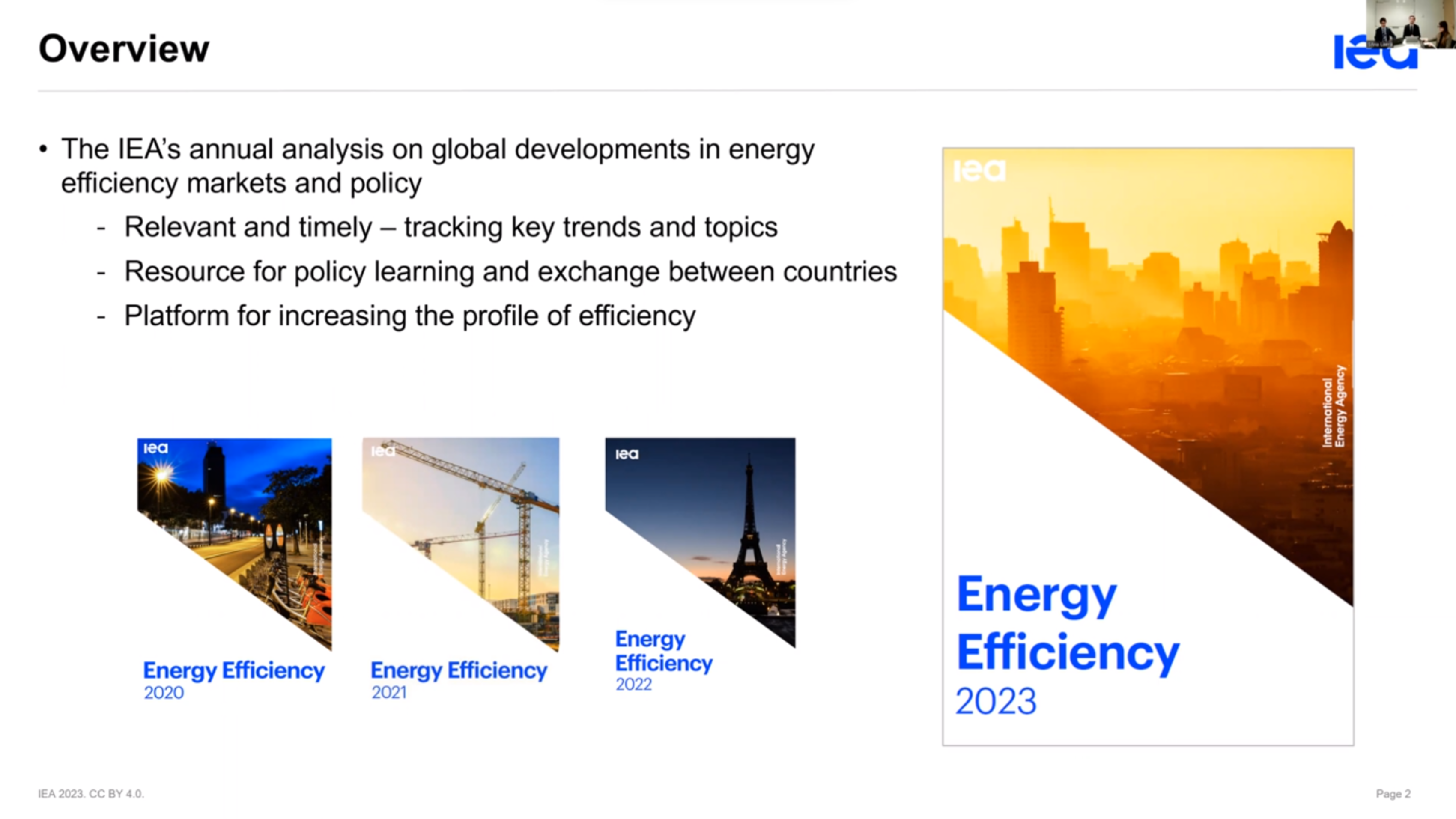
Energy Efficiency 2023 serves as the IEA’s primary annual analysis on global developments in energy efficiency markets and policy. The report explores recent trends in energy intensity, demand, and efficiency-related investment, encompassing policy and technology aspects.

This is the tenth edition, and it includes new highlights, mostly focusing on key issues facing policymakers. Notably, the report outlines the proposed global target to double energy efficiency progress and articulates the potential gains from achieving this target.

Amidst the ongoing energy and climate crises, 2023’s global energy efficiency progress, as measured by primary energy intensity, is expected to be slightly below the long-term trend, signaling a slowdown from 2022. Despite this, the report highlights a deep transformation in energy efficiency and clean energy. Governments globally are introducing or reinforcing policies and energy-saving programs, leading to the faster deployment of efficient technologies. These efforts contribute to the expected peaking of fossil fuel demand in the coming years.

Read the full report here. 

Watch the full seminar right here or on the EU-ASE YouTube channel.


Follow us


Privacy Policy

© All right reserved