EU-ASE Workshop on Smart Energy, ICT and Energy Efficiency

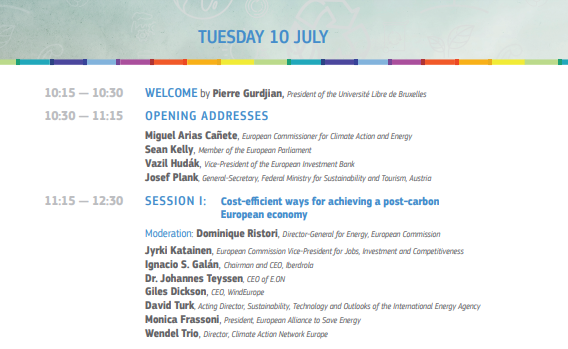
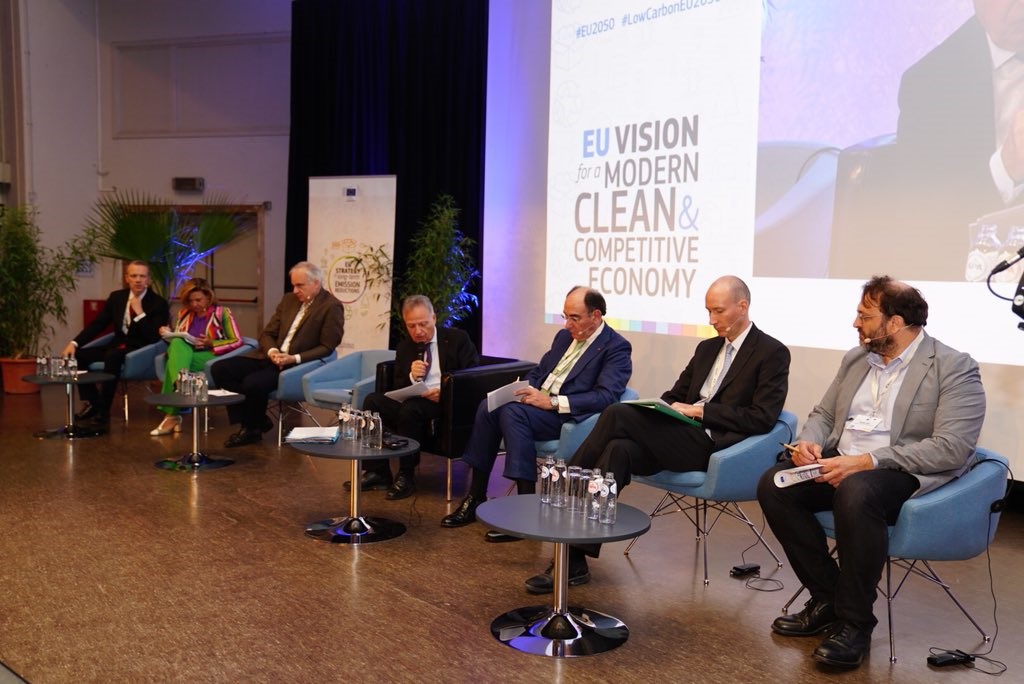
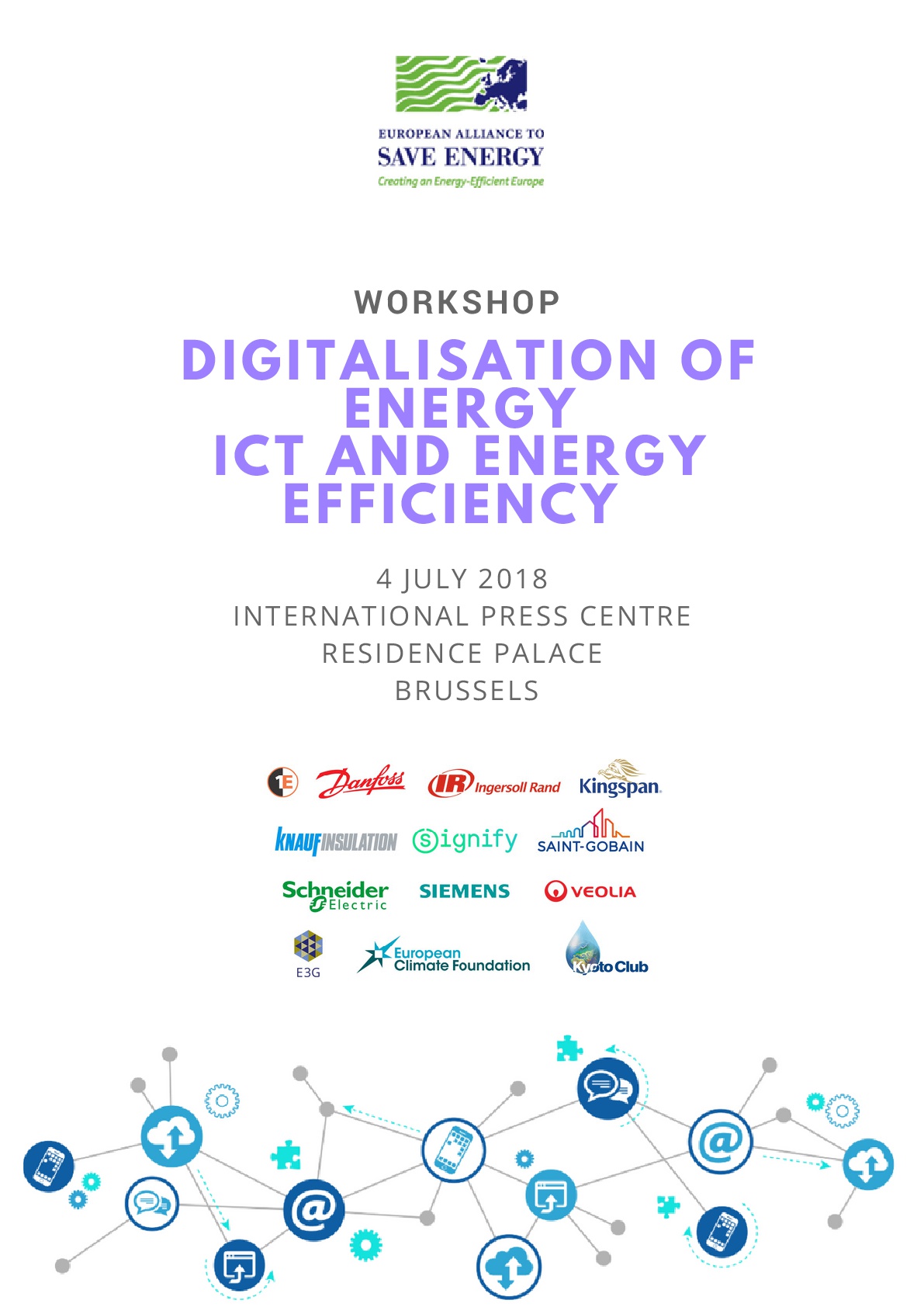
Last 4th of July, EU-ASE held in Brussels the fourth of a series of workshops on the interrelations between energy efficiency and other actors and forces of the clean energy transition.

The aim of this fourth and last workshop was to better understand the impact of digitisation on energy efficiency through the whole value chain and how digitisation is and will contribute to the European transition towards a low carbon economy. The findings of the workshop will help EU-ASE to define new potential areas of interest and assess new strategic partnerships in the years to come.

For more information and a detailed programme of the workshop click here. For further insights on how the workshop went, please refer to our Twitter page.

Follow us


Privacy Policy

© All right reserved

Deals on Energy Efficiency Directive and Governance of the Energy Union Regulation fail to untap European Energy Efficiency cost-effective potential

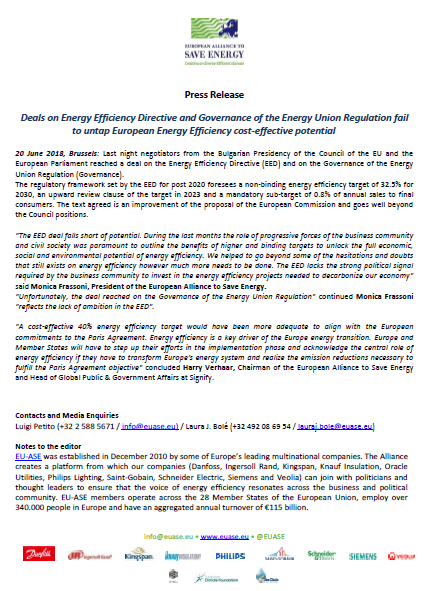
20 June 2018, Brussels. Last night negotiators from the Bulgarian Presidency of the Council of the EU and the European Parliament reached a deal on the Energy Efficiency Directive (EED) and on the Governance of the Energy Union Regulation (Governance).

The regulatory framework set by the EED for post 2020 foresees a non-binding energy efficiency target of 32.5% for 2030, an upward review clause of the target in 2023 and a mandatory sub-target of 0.8% of annual sales to final consumers. The text agreed is an improvement of the proposal of the European Commission and goes well beyond the Council positions.  

“The EED deal falls short of potential. During the last months the role of progressive forces of the business community and civil society was paramount to outline the benefits of higher and binding targets to unlock the full economic, social and environmental potential of energy efficiency. We helped to go beyond some of the hesitations and doubts that still exists on energy efficiency however much more needs to be done. The EED lacks the strong political signal required by the business community to invest in the energy efficiency projects needed to decarbonize our economy” said Monica Frassoni, President of the European Alliance to Save Energy.

“Unfortunately, the deal reached on the Governance of the Energy Union Regulation” continued Monica Frassoni “reflects the lack of ambition in the EED”.

“A cost-effective 40% energy efficiency target would have been more adequate to align with the European commitments to the Paris Agreement. Energy efficiency is a key driver of the Europe energy transition. Europe and Member States will have to step up their efforts in the implementation phase and acknowledge the central role of energy efficiency if they have to transform Europe’s energy system and realize the emission reductions necessary to fulfill the Paris Agreement objective” concluded Harry Verhaar, Chairman of the European Alliance to Save Energy and Head of Global Public & Government Affairs at Signify.

Contacts and Media Enquiries

Luigi Petito (+32 2 588 5671 / info@euase.eu) / Laura J. Bolé (+32 492 08 69 54 / lauraj.bole@euase.eu)

Follow us


Privacy Policy

© All right reserved

Op-ed: Energy Efficiency – let’s do it!

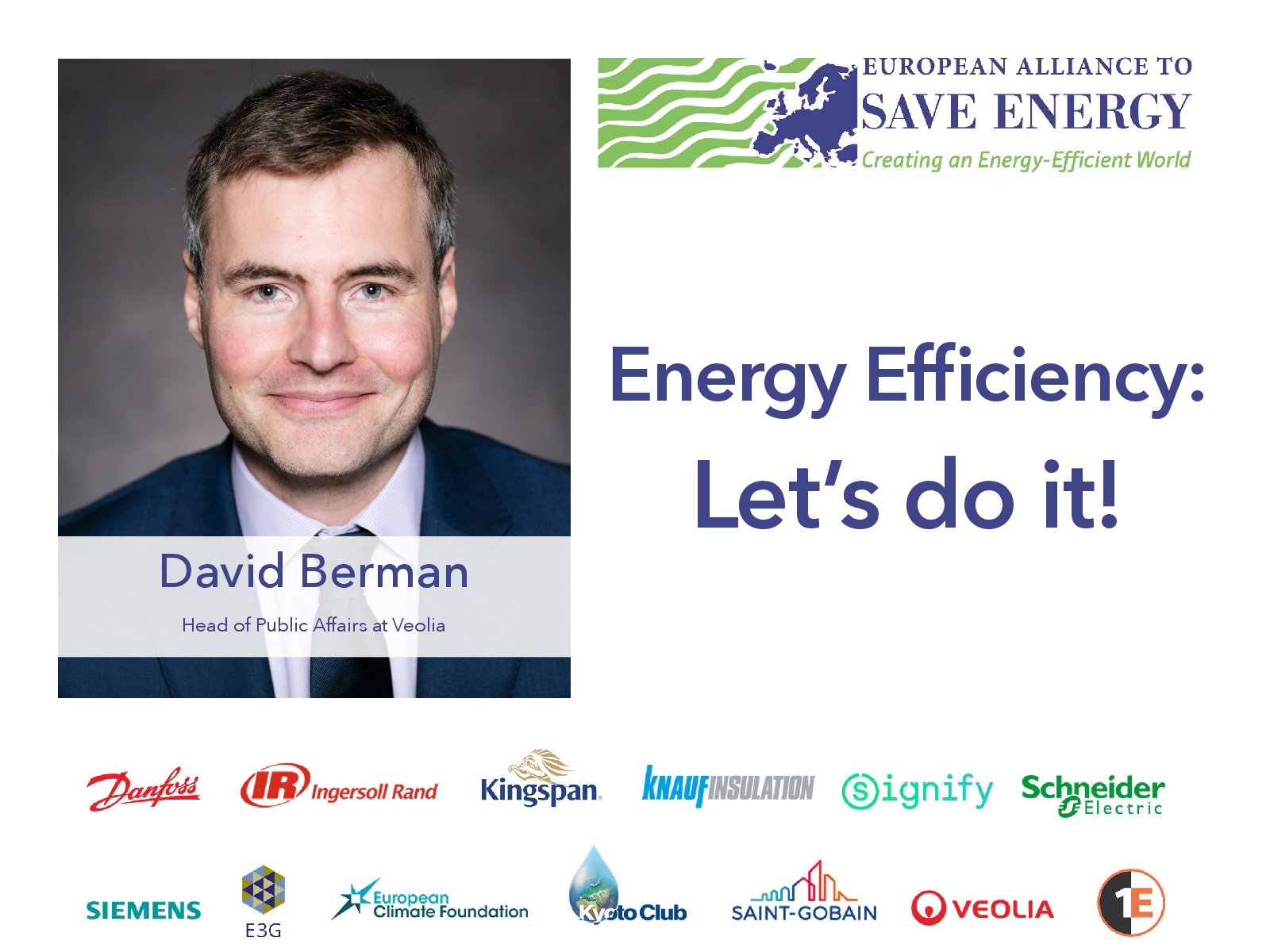
David Berman, Head of Public Affairs at Veolia

David Berman is the Head of Group Public Affairs at Veolia.

French-German lawyer by training, he has been following the development of European environmental and energy regulatory frameworks for the last 10 years.

The need for putting our efforts into increased energy efficiency is more urgent than ever: the European Union is struggling to reach its own climate and energy objectives; it has to adjust its short term and long-term policy to be compatible with the Paris agreement; it aims at strengthening its energy security.

At the eve of the final negotiations on the ‘Clean Energy package for all’, Member States have the responsibility to make sure the EU gets on a path towards decarbonisation.

This opportunity should not be missed. We see have a unique take on the importance of energy efficiency not only for our activities[1] but for its wider societal, economic and environmental benefits. Energy efficiency is a resource to be harvested across the entire energy chain from generation through transmission and distribution to consumption.

For these reasons, together with a group of 75 leading businesses and associations, Veolia has recently signed a call for a cost-effective energy efficiency target of 40% by 2030 with an extension of 1.5% cumulative annual energy savings obligations beyond 2020 (with a 2050 perspective) to be inscribed in the final text of the Energy Efficiency Directive. Member States have in their best interest to accept the Parliament’s option of a 34% and ideally binding energy efficiency target for 2030. These objectives would radically strengthen investor confidence and channel private investments towards large-scale renovation and conservation projects. They would also provide a guarantee to EU citizens that right policies will be eventually put in place to help EU dwindle down its CO2 emissions.

Targets are quintessential, but in case of energy efficiency they are optimal only if expressed both in primary and final energy. So far, any sort of public debate on energy efficiency has systematically been focused on savings made by the end-users, whether in buildings or in consumer products like TV sets. While it is essential to reduce final energy consumption, in order to achieve the actual energy efficiency, we should imperatively be looking at ways to limit losses that occur before energy (heat and/electricity) is delivered to customers. This is about optimizing the way we generate, extract, convert, distribute and transmit energy, in order to reduce to maximum energy losses. To give an example, the amount of energy lost in the production and distribution of electricity reaches an average of 60%. The EU project Heat Roadmap Europe estimates that there is more heat wasted during electricity generation than is required to heat all buildings on our continent. In order to help improve energy efficiency across the entire energy chain, we support the European Parliament to express the EU energy efficiency targets in both primary and final energy (leaving the Member States the choice between those two options would not allow for proper benchmark and results analysis).

Last but not least, we need to make everyone aware of the dangers that the ‘energy efficiency first’ principle remains just a slogan. Energy efficiency first is actually a simple rule that when consistently applied, will ensure that all investing and planning decisions are based on cost-benefit analysis, that all options available are carefully weighed, and that those solutions that will avoid stranded assets and excess of energy capacities will be privileged. It is nothing more than common sense and application of a basic economic matrix and should not be considered a constraint to Member States’ future choices. Not only we need the ‘Energy Efficiency first’ principle to structure the Energy Efficiency Directive up to 2030, but we also have to have it applied across the entire Clean Energy Package. Enshrining this principle in both the Energy Union Governance Regulation and the Renewables Directive will enable countries to maximise their energy gains while fostering a growing integration of renewable energy sources such as wind, solar and hydro, reaping all the benefits of an integrated approach to energy planning and an effective sector coupling.

Before the final discussions on the EU Clean Energy Package are over, we have a once-in-a-decade window of opportunity to make Energy Efficiency a centrepiece of a successful transition towards decarbonized future in Europe. Let’s do it!

[1] For years now, Veolia has been providing resource (water, materials and energy) optimization solutions for municipalities and industries across Europe. The group carries energy efficiency at the heart of its activities, as a part of its circular economy paradigm. Through energy performance contracts, we commit to optimize our clients’ production efficiency, energy consumption, and energy mix, deriving part of the agreed remuneration on results-based standards. We work both on the energy supply side of buildings, with our boiler and cogeneration installations, and on the demand side, through tailor-made solutions enhancing the way buildings operate. Committed to its core missions, we stand ready to help industries, cities and people achieve an optimized decarbonisation of the European economy through increased energy savings.

Follow us


Privacy Policy

© All right reserved

EU-ASE joins European businesses, local authorities and NGOs urging EU leaders to step up climate action

Today, 12 June, a unique gathering of businesses, investor groups, local and regional authorities, and civil society groups, standing together as the Coalition for Higher Ambition, are calling upon EU leaders to accelerate the transition to a zero-carbon Europe and thus limit climate impacts and allow for improvements to public health, greater competitiveness for businesses, and an increase in good quality jobs.

EU-ASE believes that the current EU climate commitments need to be raised in order to keep the Paris Agreement goals within reach. The stakeholders urge EU leaders to:

  • Ensure the finalisation of the EU’s energy legislation for 2030 in line with the ambition levels adopted by the European Parliament.
  • Ensure that the new EU long-term climate strategy sets Europe on a pathway that delivers on the 1.5°C objective of the Paris Agreement, which must include a net-zero emissions target by 2050 at the latest.
  • Ensure a timely revision of the 2030 greenhouse gas emissions reduction target so as to allow the EU to resubmit its Paris pledge to the UN by 2020, as agreed in Paris.

The statement comes prior to the High-Level EU Talanoa Dialogue where key decision makers and stakeholders will be discussing ways to step up climate action; and the final round of negotiations on the EU’s energy legislation for 2030, both taking place on 13 June.

Follow us


Privacy Policy

© All right reserved

EU-ASE joins European businesses, local authorities and NGOs urging EU leaders to step up climate action

To: EU Heads of State and Government
Cc: EU Environment and Energy Ministers

Brussels, 12 June 2018

We are writing to you on behalf of a unique coalition of businesses, associations, investor groups, local and regional authorities, and civil society organisations. In 2015, European leadership helped deliver the Paris Agreement.

Since then, the EU has focussed on implementing the pre-Paris pledge into climate and energy legislation. Today we welcome growing political momentum to go beyond this effort, in particular:

  • the European Parliament’s position to increase the EU’s 2030 renewable energy and energy efficiency targets,
  • the March European Council conclusions calling for a Paris-consistent long-term strategy,
  • and the call from seven Member States to align EU climate ambition with the Paris Agreement. The EU is widely acknowledged for its long-standing commitment to tackling climate change through robust policy-making.

However, the current level of ambition is insufficient and hampering Europe’s chances of reaching the Paris goals. An enhanced level of ambition is critical to the ability of our organisations, businesses, cities, regions, and community-led initiatives to accelerate the transition to a zero-carbon Europe.

On 13 June, key European stakeholders will be discussing ways to step up EU ambition on climate action at the High-Level EU Talanoa Dialogue. This is an important milestone ahead of the European Council in June where you will be discussing the bloc’s climate and energy frameworks of the future, in light of COP24 in Katowice.

We need Europe to transition to a sustainable society and economy as soon as possible, to allow for improvements to public health, greater competitiveness for businesses, and an increase in good quality jobs. This will allow all of us to reap the benefits from the decarbonization of Europe.

To deliver on this, Europe needs to stimulate rapid and long-term investments in the energy transition, particularly in efficiency and renewables. At the same time the EU should incentivise transformational change in the transport and agricultural sector, protect and restore our natural ecosystems and support the transition of local economies through local action.

Such an approach will be more credible and influential on the global stage, regaining its status as a committed leader on climate action and in the energy transition. By stepping up its commitments, the EU can limit the extent of climate impacts, abroad and domestically thereby significantly reducing the economic damage from climate change which would otherwise amount to hundreds of billions of euros every year .

Therefore, we call upon you to:

  • Ensure the finalisation of the EED, RES and Governance files in line with the ambition levels adopted by the European Parliament.
  • Ensure that the long-term strategy under development sets Europe on a pathway that delivers on the 1.5°C objective of the Paris Agreement, which must include a net-zero emissions target by 2050 at the latest, as supported by the European Parliament.
  • Ensure that on the basis of this long-term strategy, a timely revision takes place of the 2030 greenhouse gas emissions reduction target so as to allow the EU to lead by example and resubmit its new Nationally Determined Contribution (NDC) well in time for the 2020 deadline agreed in Paris.

More than ever, we stand ready to play our part in support of the objectives of the Paris Agreement. To realise our potential, we need EU leaders to deliver on their part: a commitment to more ambitious climate action and a rapid energy transition. The urgency has never been greater, but neither have the opportunities.

Signatories:

Follow us


Privacy Policy

© All right reserved