Fostering a green recovery with energy efficiency at its core – 2020 in review

The Activity Report 2020 contains an overview of the activities carried out by the European Alliance to Save Energy (EU-ASE) throughout the year. Despite the challenges posed by the Covid-19 global pandemic, EU-ASE successfully contributed to boosting energy efficiency in EU legislation. We did so while underlining energy efficiency’s paramount role to achieve sustainable economic recovery across Europe.

EU-ASE remains the most influential business led organisation on energy efficiency in Brussels. The Alliance’s active participation in debates and high-level conferences happening at national, European and international level has been remarkable.


Read the full report

Follow us


Privacy Policy

© All right reserved

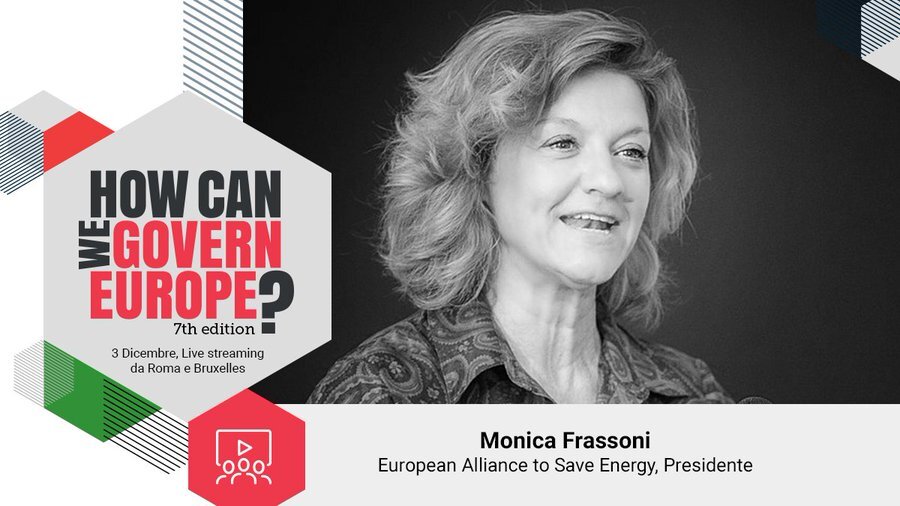
EU-ASE at How Can We Govern Europe? (Italy)

On 3 December 2020 EU-ASE president Monica Frassoni participated in the 7th edition of How can we govern Europe?, the annual conference hosted by the Italian EU affairs media Eunews. This years’ edition was held as an online discussion.

In her intervention, Monica Frassoni discussed how to advance energy efficiency as a key tool to achieve climate neutrality both at European and national level, as well as how Italy can boost a green recovery from the Covid-19 pandemic through its Recovery and Resiliency Plan.

Speakers included representatives of the Italian government, the European Commission and the European Parliament.


The recording of the webinar is available here (in Italian)


Follow us


Privacy Policy

© All right reserved

EU-ASE welcomes strong reference to ‘Efficiency first’ in Energy System Integration Strategy, calls for limited role of green hydrogen in hard-to-decarbonise sectors

Brussels, 8 July 2020 – Today the European Commission presented its proposals for the EU strategies for energy system integration and hydrogen.

The Energy System Integration Strategy sets out a vision on how to accelerate the transition towards a more integrated energy strategy, supporting full decarbonisation at the least cost across sectors.

The proposal puts first a more “circular” energy system, with energy efficiency at its core. Moreover, the Strategy calls for the application of the energy efficiency first principle consistently across the whole energy system, including through further measures to reflect the life cycle energy use and GHG footprint of the different energy carriers to be able to make an accurate comparison between demand and supply-side solutions. The Commission will issue guidance to Member States to make the efficiency first principle operational across the energy system, by 2021, and promote it in future methodologies and legislative revisions.

The European Alliance to Save Energy (EU-ASE) welcomes this proposal and is glad that it highlights the importance of mainstreaming energy efficiency first across the energy system.

We are pleased by the Strategy’s strong reference to energy efficiency as a key enabler of the decarbonisation of Europe’s energy system”, said EU-ASE President Monica Frassoni. “We also welcome the suggested actions to better enshrine efficiency first, and the commitment to further promote this principle in the TEN-E revision.” “Regarding hydrogen”, Ms Frassoni added, “we would like to stress that while green hydrogen could play a role in hard-to-decarbonise sectors such as primary industry and heavy-road transport, for buildings, there are more cost-effective and ready-to-use solutions”. “In this light, technologies for direct electrification are already available and their deployment should be accelerated,” Ms Frassoni concluded.

More information on EU-ASE position on Energy System Integration can be found here

About EU-ASE
The European Alliance to Save Energy (EU-ASE) was established in December 2010 by some of Europe’s leading multinational companies. The Alliance creates a platform from which companies can ensure that the voice of energy efficiency is heard from across the business and political community. EU-ASE members have operations across the 27 Member States of the European Union, employ over 340.000 people in Europe and have an aggregated annual turnover of €115 billion.

Media contact:
Matteo Guidi
+32 493 37 21 42
matteo.guidi@euase.eu

Download the press release here (PDF)

Follow us


Privacy Policy

© All right reserved

German Council presidency should straighten out its energy priorities and include building renovations

Today the German Government unveiled its EU Council Presidency priorities which lack a clear reference to the building renovation. As businesses and investors having energy efficiency and energy demand reduction at the heart of our activities, we believe that the German government lost a great opportunity to prioritise a sector which, more than any other, can deliver economic growth, local jobs creation and GHG emission reduction.

“We welcome the German government pledge to learn from the current crisis to be better prepared for the future and the focus on climate change and digitisation. At the same time, we strongly encourage the inclusion of the construction sector and in particular the renovation of the European building stock among the Council presidency priorities” – said Monica Frassoni, President of the European Alliance to Save Energy (EU-ASE).

“For every million invested in the renovation of our homes we can create an average of 18 jobs. All the economic stimulus measures across the world address buildings. Finally the European Union is working on a flagship Renovation Wave initiative to trigger investments and accelerate the transformation of European society and economy towards climate neutrality. Therefore, it’s difficult to understand the decision to exclude buildings from the presidency’s priorities.”

“We have a lot of work to do to recover from the Covid-19 crisis and buildings must be at the centre of any rational energy, industrial and environmental strategy. With this in mind, we wish the German Government a successful presidency and look forward to constructive cooperation” – concluded Monica Frassoni.


Download the press release here (PDF)

Follow us


Privacy Policy

© All right reserved

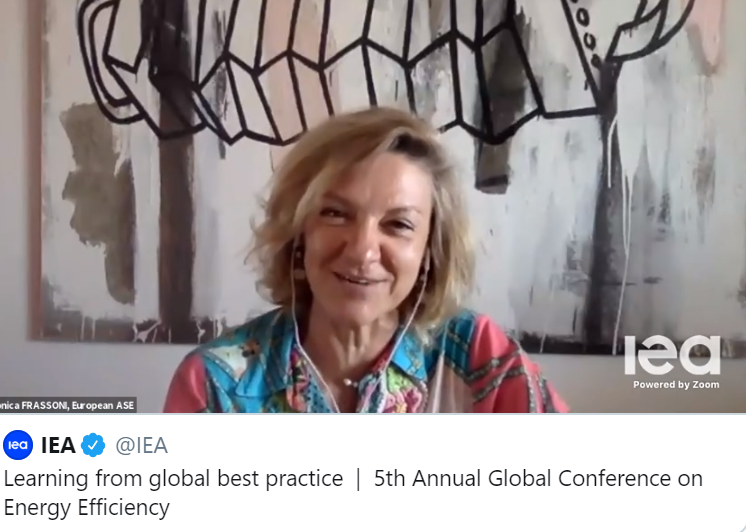
EU-ASE at IEA’s 5th Annual Global Conference on Energy Efficiency

On 23 June 2020 EU-ASE president Monica Frassoni participated in the online panel debate “Learning from global best practice” as part of the International Energy Agency’s 5th Annual Global Conference on Energy Efficiency. Here is her full speech

I would like to thank the IEA for your excellent work to make the energy efficiency (EE) agenda credible at global level. About 10 years ago it gave a major global push to show the role and the amazing potential of EE in buildings, transport, and industry and this was a major help for all the EE business and social community in the EU. As EU-ASE we have often used this work to make our agenda stronger, as our work focuses mostly on the EU legislation, at a supranational level.

Referring to what Mr Mathur said before – that EE is like a plane and it takes effort for a plane to take off – well in the EU we are still in the middle of the take-off effort. We cannot say that we are tapping the great potential of energy efficiency to contribute to the clean energy transition and to climate neutrality. We will not be able to overcome the Covid-19 shock and reach climate neutrality without additional financial and legislative measures and a better implementation of the current legislation.

The EU is tight together by common political, legal, and financial instruments, expressed in regulations, targets, subsidies and incentives. This is the case also for EE.

Today, as a result of the current crisis, we are at a decisive moment There is a lot of political work at all levels, intense discussions and work within the EU institutions, Member States, businesses, and the NGO community to make sure that the recovery measures will take the right direction.

A lot of things still ne to be done to mainstream energy efficiency in EU policies. Still, I would like to mention three EU “best practices” that are relevant globally, even if we are still far away from having a clear picture of how successful these will be.

The European Green Deal, in which energy efficiency has a key role to play, is important because it is a deal, it is green, and it is European. The Green Deal works as a framework for the implementation of the current rules and sets a direction for the next EU legislation.

In terms of energy efficiency there are three policy initiatives which are crucial to accelerate EE in the coming years. One is the Sector integration strategy, to be published in July. The second one is the Renovation wave initiative, that for us is key. Many speakers already mentioned the importance of renovating buildings, well, for the EU, the Renovation Wave is a major instrument to reduce emissions by 2050 to make the EU climate neutral. Increasing the current rate of renovation by three times is the main challenge we have in front of us.

Moreover, there is an upcoming review of the Energy Efficiency Directive (EED), which needs to be revised to make it up to the climate targets. We would like to see that the EU sets a GHG target of at least 55% by 2030 to achieve the climate neutrality goal by 2050.

Another very important element which was mentioned by Minister Claude Turmes this morning concerns the EU budget and the Recovery plan. We believe there should be a clear earmarking of EU funds not only to climate activities but also to the renovation of buildings. There is still a huge risk that the Recovery Plan will put resources to activities which are not in line with the EU climate goals.

We also call to increase the “climate action quota” to 40% for the entire EU Budget. And to explicitly exclude from all EU funds any fossil fuel activities. Finally, a small note concerning hydrogen and the hopes that it is raising in the public debate. We see a lot of space for hydrogen in hard-to-decarbonise sectors, namely in transport, but the main solution in buildings remains energy efficiency.

To conclude, I can say that in the EU we have the framework, we have some best practices, but we still have a lot of work ahead to deliver the policies needed in the next 20 to 30 years.


The recording of the full panel is available here

 

Follow us


Privacy Policy

© All right reserved