Open letter from the Coalition for Higher Ambition on Cohesion Policy
24 January 2020

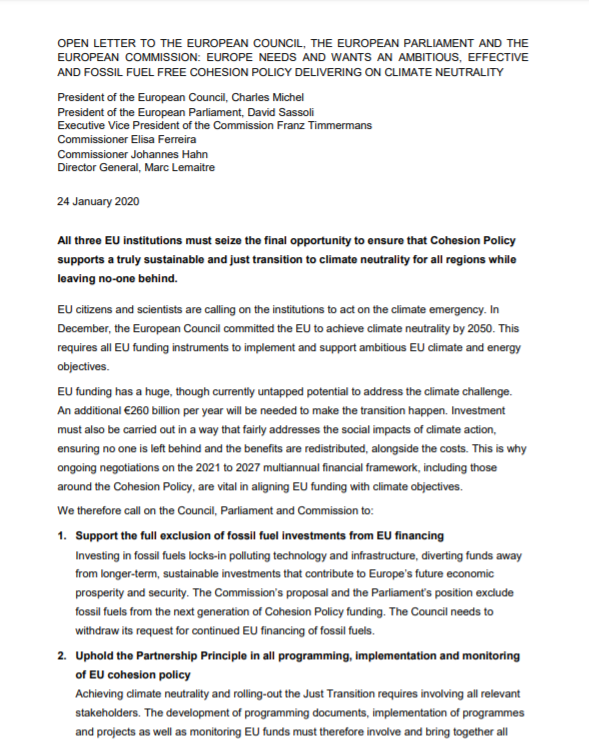
OPEN LETTER TO THE EUROPEAN COUNCIL, THE EUROPEAN PARLIAMENT AND THE EUROPEAN COMMISSION: EUROPE NEEDS AND WANTS AN AMBITIOUS, EFFECTIVE AND FOSSIL FUEL FREE COHESION POLICY DELIVERING ON CLIMATE NEUTRALITY

President of the European Council, Charles Michel

President of the European Parliament, David Sassoli

Executive Vice President of the Commission Frans Timmermans

Commissioner Elisa Ferreira

Commissioner Johannes Hahn

Director General, Marc Lemaitre

All three EU institutions must seize the final opportunity to ensure that Cohesion Policy supports a truly sustainable and just transition to climate neutrality for all regions while leaving no-one behind.

EU citizens and scientists are calling on the institutions to act on the climate emergency. In December, the European Council committed the EU to achieve climate neutrality by 2050. This requires all EU funding instruments to implement and support ambitious EU climate and energy objectives. 

EU funding has a huge, though currently untapped potential to address the climate challenge. An additional €260 billion per year will be needed to make the transition happen. Investment must also be carried out in a way that fairly addresses the social impacts of climate action, ensuring no one is left behind and the benefits are redistributed, alongside the costs. This is why ongoing negotiations on the 2021 to 2027 multiannual financial framework, including those around the Cohesion Policy, are vital in aligning EU funding with climate objectives.

We therefore call on the Council, Parliament and Commission to: 

  1. Support the full exclusion of fossil fuel investments from EU financing
    Investing in fossil fuels locks-in polluting technology and infrastructure, diverting funds away from longer-term, sustainable investments that contribute to Europe’s future economic prosperity and security. The Commission’s proposal and the Parliament’s position exclude fossil fuels from the next generation of Cohesion Policy funding. The Council needs to withdraw its request for continued EU financing of fossil fuel.
  2. Uphold the Partnership Principle in all programming, implementation and monitoring of EU cohesion policy
    Achieving climate neutrality and rolling-out the Just Transition requires involving all relevant stakeholders. The development of programming documents, implementation of programmes and projects as well as monitoring EU funds must therefore involve and bring together all relevant partners from the local and national levels. Both Member States and the Commission have to ensure the full involvement of partners from the onset of the new programming process, both in legislative provisions and in practice, in order to guarantee EU funds genuinely benefit climate action in all EU’s regions.
  3. Support strong climate mainstreaming and ensure that all EU funding programmes and projects are embedded in strategies that support climate objectives
    The Commission proposal highlights the important role Cohesion Policy will play in addressing climate change in a socially fair way. To deliver on the transition, a binding 40 per cent earmarking for climate and environment across all Cohesion Policy funding has to be adopted, and climate neutrality compatibility and objectives must be embedded in all future spending plans. 

The Parliament’s position on the European Regional Development Fund, Cohesion Fund and the Common Provisions Regulation is close to bringing EU funds in line with the goals of the Paris Agreement. However, it is the responsibility of all three EU institutions to realise the full potential of the €374 billion to deliver on the just transition towards climate neutrality, as demanded by European citizens.

The EU is at a critical moment. The next decade of EU funding will be crucial if Member States are to set off down a pathway that is consistent with the international commitments under the Paris Agreement and if they are to promote a transition that is socially fair, sustainable and advantageous to their citizens and their economies.

The undersigned organisations urge you to accept these recommendations and negotiate a Cohesion Policy fit to achieve the joint objectives of addressing climate change and supporting regional territorial cohesion.

Ester Asin   Wendel Trio   Huub Scheele
Director   Director   Interim Executive Director
WWF European Policy Office   Climate Action Network (CAN) Europe   CEE Bankwatch Network


List of undersigning stakeholders:
Follow us


Privacy Policy

© All right reserved

Energy efficiency in new EU Commission proposals on Green Deal Investment Plan and Just Transition Fund good first step towards greater ambition

Statement

Brussels (14 Jan 2020) – Today, the European Commission unveiled its communication on the European Green Deal Investment Plan (EGDIP) and its proposal for a regulation establishing a Just Transition Fund (JTF), which is part of a broader Just Transition Mechanism (JTM). The two tools are part of a package aimed to finance the EU’s bid to become climate neutral by 2050, while supporting coal-dependent regions to take the necessary steps to transition towards a decarbonized economy.

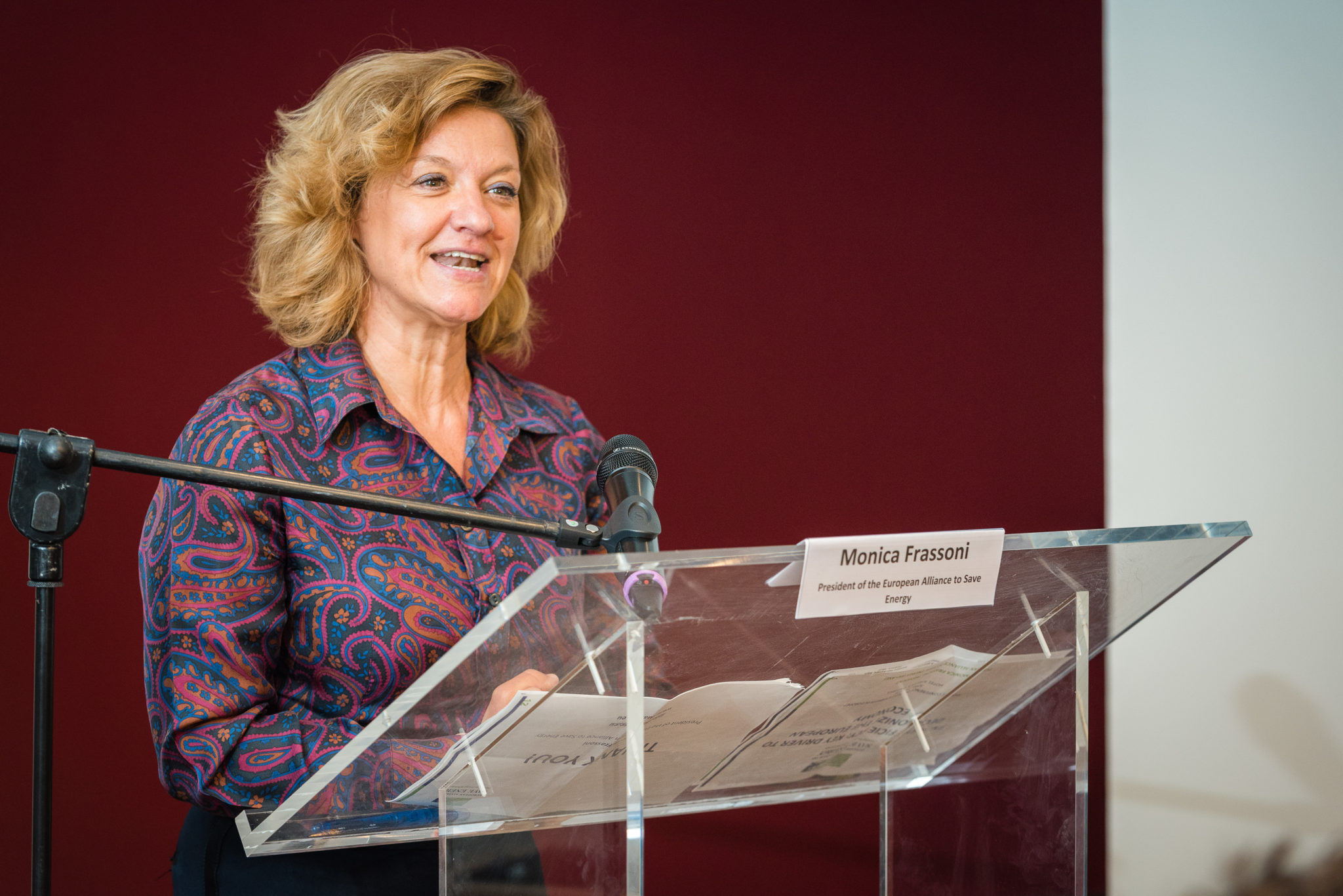
“We welcome these initiatives, which come at a crucial moment in Europe’s decarbonization process”said Monica Frassoni, President of the European Alliance to Save Energy (EU-ASE). “As one of the main cross-sectorial business associations in Europe advocating for energy efficiency, we are pleased to see that in both the European Green Deal Investment Plan and the Just Transition Fund there is a clear reference to energy efficiency. We also welcome the proposal to revise State Aid rules to give Member States more scope to invest in the energy efficiency of buildings.”

“With regards to the JTF, we expect it to be financed with fresh, additional resources whose access should be conditioned to serious commitments towards climate neutrality by the beneficiary countries.”

“We will follow with keen interest the debate around these proposals – Monica Frassoni concluded – and we look forward to providing our input to make energy efficiency’s role even more prominent, in line with the ‘energy efficiency first’ principle. This with the aim to make full advantage of the economic, environmental and social benefits that energy efficiency can bring to citizens and businesses.”


10 priorities for transformative policies under the European Green Deal

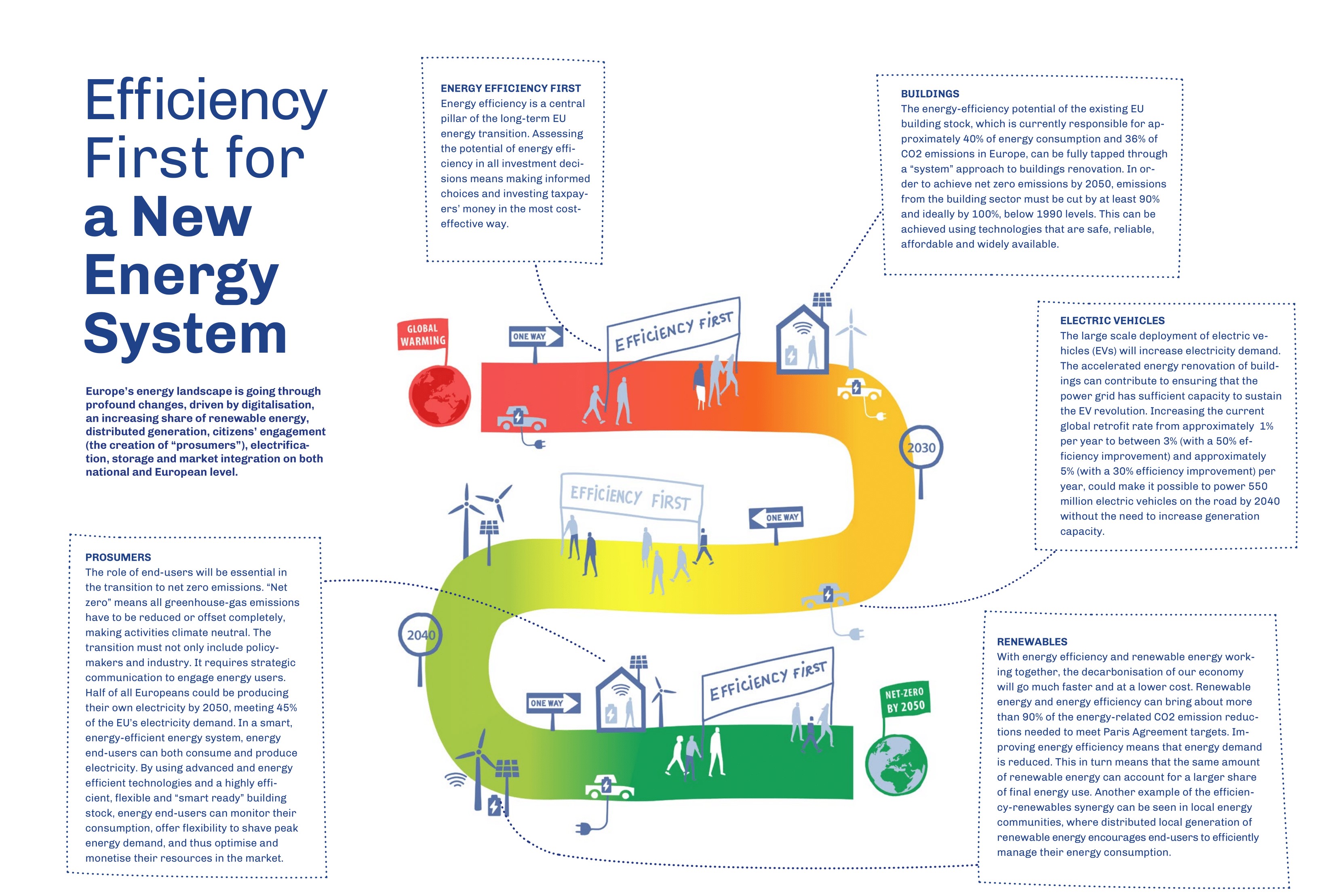
The European Green Deal Communication acknowledges that in the effort to reduce GHG emissions and achieve climate neutrality by 2050, energy efficiency must be prioritised. At EUASE, we have set out 10 priorities to make sure that the policies under the EGD fully apply the Energy Efficiency First principle.

On December 11, the European Commission presented an outline of its European Green Deal.  According to the proposed timeline, the increase of the EU 2030 climate target – the flagship initiative of the package – will be presented by summer 2020. This timeline will require Member States to agree on a much higher 2030 target at the European Council in June 2020, which will be key to enable the EU to lead the way towards bold climate ambition internationally.

The EGD Communication acknowledges that in the effort to reduce GHG emissions and achieve climate neutrality by 2050, energy efficiency must be prioritised, however the Communication lacks a specific reference to the Energy Efficiency First principle and the commitment to increase the 2030 energy efficiency target.

Here are our 10 priorities to make sure that the policies under the European Green Deal fully apply this principle:

  1. Accelerate the implementation of the Clean Energy Package by strengthening
    and facilitating monitoring, evaluation and exchange of good practices
  2. Reopen the Clean Energy Package in order to align it with increased ambition
    by 2030 and climate neutrality by 2050
  3. Apply the energy efficiency first principle to all energy planning and
    investments
  4. Lead by example ensuring that 100% of public (central, regional and local)
    buildings are nearly-zero energy (NZEB) by 2030
  5. Boost the renovation of existing residential and commercial buildings and
    mobilize resources to eradicate energy poverty
  6. Fully exploit water-energy nexus and introduce energy performance
    objectives in all current and future water policies and regulations
  7. Prioritize finance for energy efficiency in all EU funding programmes post
    2020 and improve access to technical assistance
  8. Remove all existing barriers to the full functioning of energy performance
    contracting
  9. Raise awareness about the multiple economic, social and environmental
    benefits of energy efficiency for citizens, cities and businesses
  10. Promote digitalization as a driver of greater efficiency

To read the full publication click on the link below.

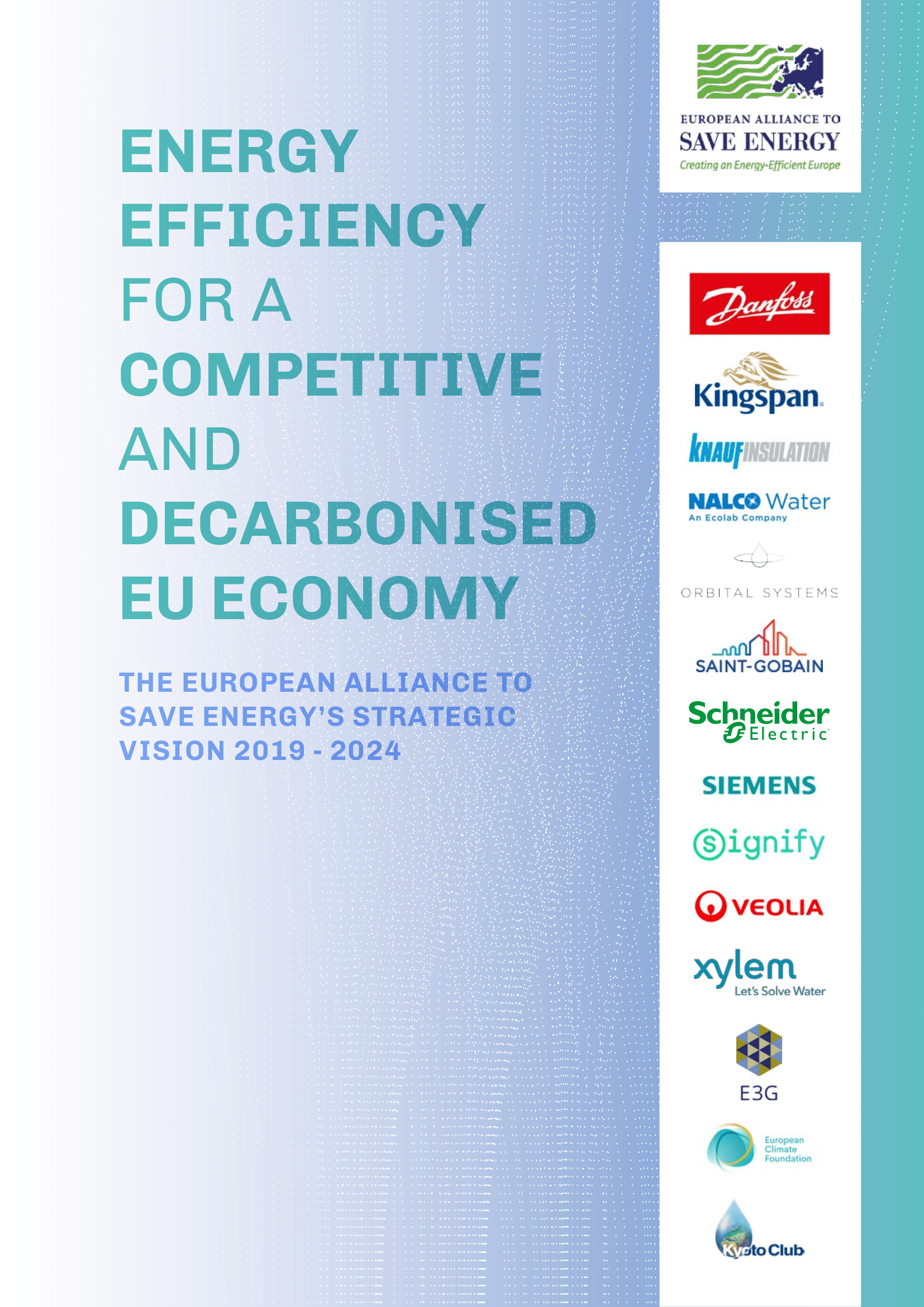
Energy Efficiency for a competitive and decarbonised EU economy


The European Alliance to Save Energy (EU-ASE) is known to be a leading business voice in a growing, diverse and increasingly well-organised energy efficiency community in Brussels. Since our foundation in 2010, we have helped put energy efficiency high on the agenda of EU decision makers.

Together with other Brussels-based and national stakeholders we developed and promoted the Energy Efficiency First (EE1) principle, which is now a concept used across all the EU institutions and was recently introduced in the European legislative framework. We are convinced that through prompt implementation of EU legislation, together with suitable public and private financing, energy efficiency can play a much bigger role in the transition towards a decarbonised Europe.

Our focus on measuring global success by GDP growth has trapped us in a linear view of society, with carbon increasingly becoming a constraint to current and future improvements in prosperity.

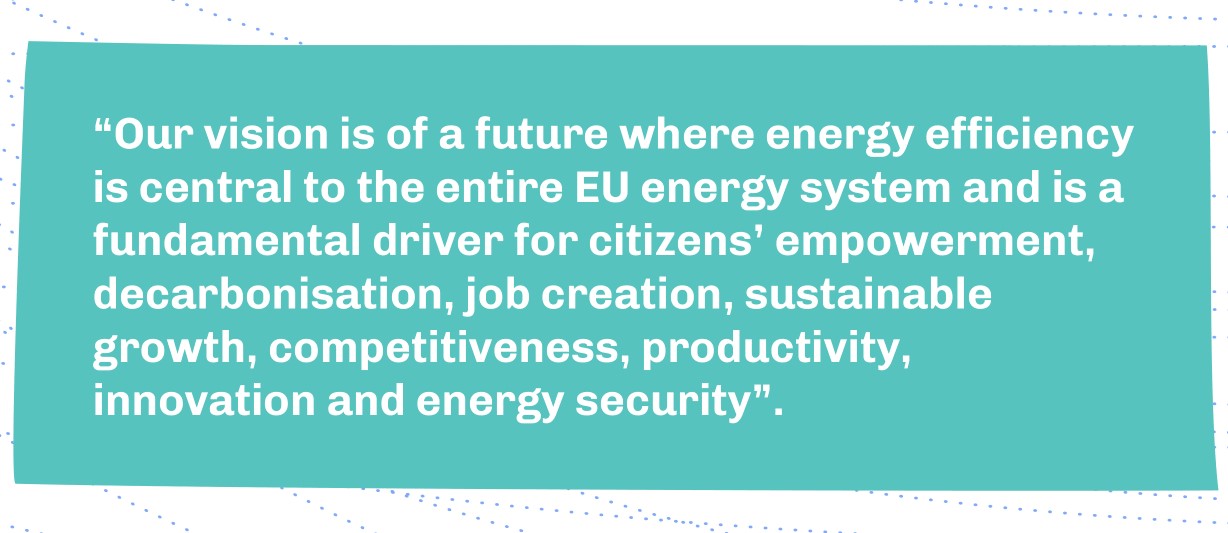
We need to become much smarter and more resource efficient. We need to transition toward an approach in which long term quality of life becomes the most important metric. In this context, overall energy efficiency improvements across all sectors are key to arriving at a climate neutral world by 2050. An energy efficient Europe will foster competitiveness and growth through innovations in a range of sectors, each of these contributing to the prosperity, health and wellbeing of Europe’s citizens.


Harry Verhaar – Chair of the Board of Directors

Moving forward EU-ASE will:

  • Further contribute to policy makers’ and consumers’ understanding of the importance and benefits of energy efficiency
  • Promote the need for a strong EU role in the global fight against climate change
  • Put energy efficiency at the centre of EU and international long-term decarbonisation strategies
  • Make energy efficiency in buildings a strategic priority for addressing energy infrastructure needs
  • Support the development of relevant EU legislation and its swift implementation at national and regional level
  • Improve use of public resources and help design innovative financing schemes, to unlock private investments in cost-effective energy-efficiency programmes across Europe

We must take bold actions to limit global warming. If we want to achieve net zero emissions by 2050, we need to put the energy efficiency first principle at the heart of the transition and of the future energy system. We need to act now, starting from increasing the level of ambition for 2030. People, governments and businesses must work together to fully realise the energy efficiency potential across industrial sectors, regions and cities. This will allow us to reap the tangible social, economic and environmental benefits of energy efficiency. Time is running short, we need a shared sense of urgency that will drive better implementation, the adoption of adequate rules, investments and the use of available resources.


Monica Frassoni – President

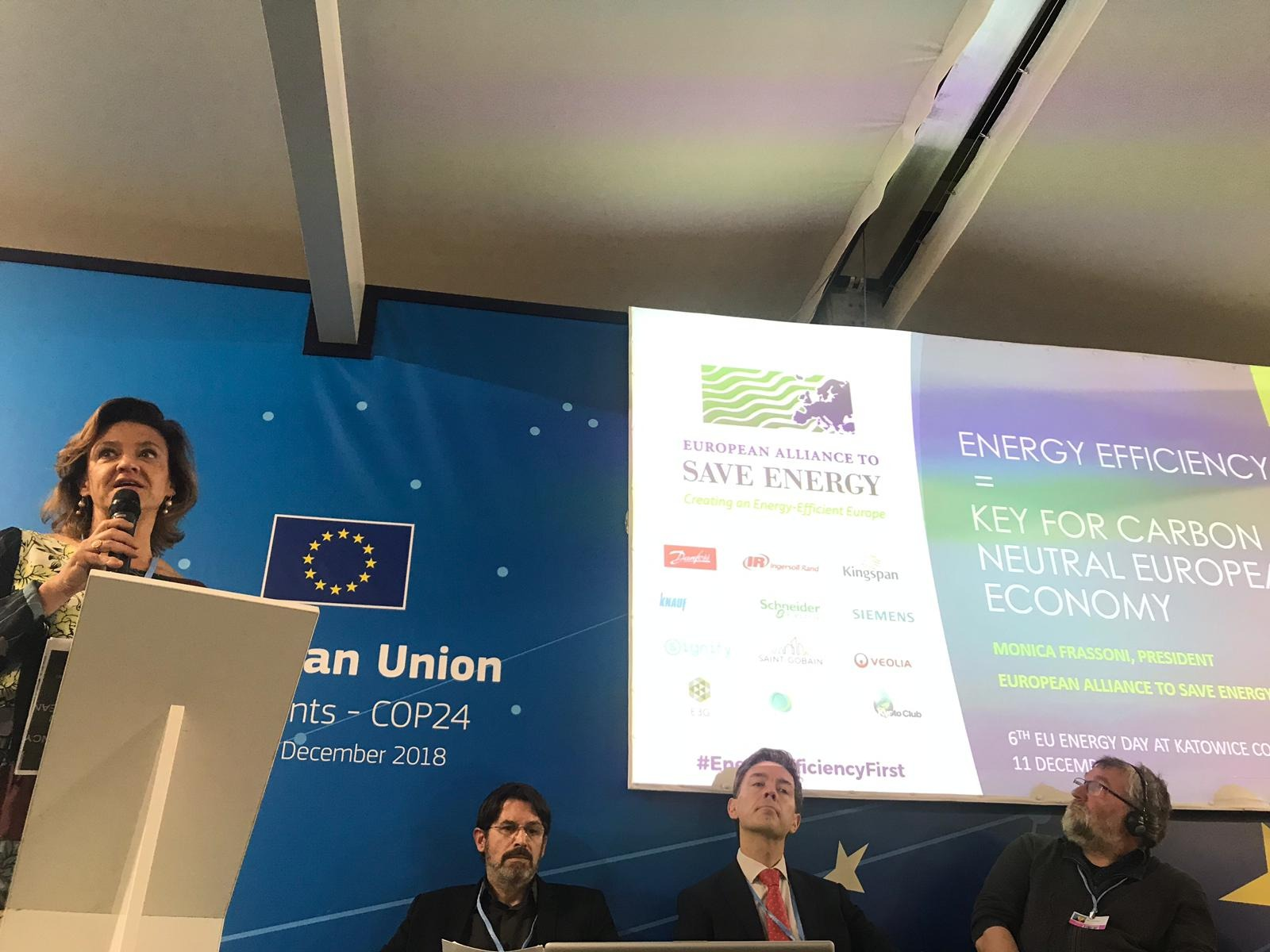
At COP24, President underlines that Energy Efficiency comes first, but needs to work in synergy

EU-ASE President Monica Frassoni took part to the EU Energy Day, a long-day session organised by the European Commission on the framework of COP24 in Katowice, where she participated in the panel “Renewables, decentralisation and democracy: transforming energy systems”.

One of the very few energy efficiency voices present in the panel, during her intervention Frassoni underlined that Energy Efficiency First must indeed be central to all future planning, but that it needs to work in synergy with other actors of the energy transition, with especial emphasis on renewables. Citizens, which are at the heart of the change, must be included as active participants in the climate and energy discussions, she said.

After her intervention at the panel, Monica was interviewed by EU-ASE Member Danfoss on the back seat of a Tesla car. On this innovative, different setting, she addressed the untapped potential of energy efficiency and said it is “the golden bullet in our hands”.

Follow us


Privacy Policy

© All right reserved