MEPS paramount to address high energy prices and achieve the EU decarbonisation goals
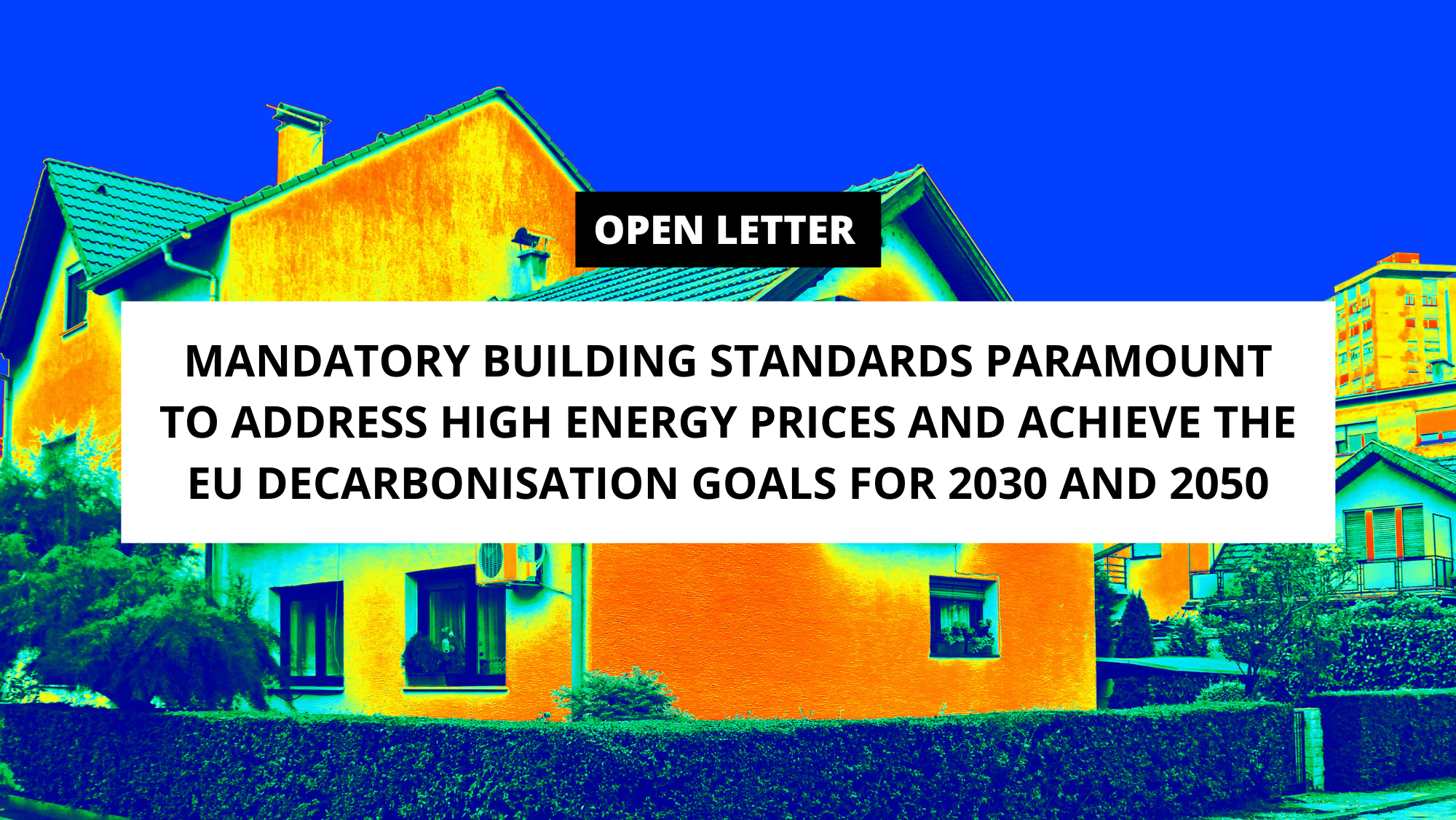
Business organisations call for the introduction of mandatory Minimum Energy Performance Standards for the renovation of the buildings sector in the revision of the Energy Performance of Buildings Directive.

Today, together with major business organisations advocating for energy efficiency solutions in Europe, we addressed a letter to energy Commissioner Kadri Simson regarding the incoming revision of the EPBD.

The EU building stock must undergo a profound renovation to make it energy efficient and cut emissions. The Renovation Wave strategy foresees that the rate of building renovations must at least double to achieve our climate objectives. Renovating buildings is also the best medium and long-term solution to maintain energy prices low for consumers.

The introduction of mandatory minimum energy performance standards for all buildings is essential for the EU to deliver on its promises to make the European Green Deal as Europe’s growth strategy.

These standards can create the necessary regulatory framework to attract public and private investments, boosting the construction value chain and making the sector attractive to fill the skills gap.
Read the full letter here

Follow us


Privacy Policy

© All right reserved

In a fast-changing political and economic environment, 2025 was a year of continued efforts to strengthen security, stability, and competitiveness for European businesses.

Throughout the year, our work demonstrated that energy efficiency is not only essential to achieving climate goals, but also a key driver of innovation, energy independence and sustainable long-term growth across Europe.

Strong engagement with policymakers, combined with the successful organisation of the 4th European Energy Efficiency Day, highlighted the importance of collaboration and dialogue in advancing shared objectives. Partnerships across sectors and institutions remained central to delivering impact and shaping effective energy policies.

Looking ahead to 2026, we will intensify our efforts to secure the regulatory certainty that can accelerate the energy transition, while providing businesses with the investment confidence they need and strengthening Europe’s  competitiveness.

Read the full Activity Report here

Key energy stakeholders call for an ambitious revision of the EPBD

Together with 12 leading energy associations, the European Alliance to Save Energy calls on the European Commission to boost the decarbonisation of the EU building stock through an ambitious revision of the Energy Performance of Buildings Directive. 

Buildings are a key part of the energy system, but most of them are energy inefficient and 75% of buildings’ energy consumption is still based on fossil fuels. The revision of the Energy Performance of Buildings Directive (EPBD) is “make or break” occasion to decarbonise a sector that has to cut its emissions by 60% by 2030. 

In a joint letter addressed to Kadri Simson, EU Commissioner for Energy, and to Frans Timmermans, First Executive Vice-President of the European Commission, the European Alliance to Save Energy (EU-ASE) calls on the Commission to ensure that the EPBD revision leads the way to make our buildings energy efficient, renewables-based, flexible and integrated in the energy system. 

To support this objective, together with the co-signatories, EU-ASE recommends including the following provisions in the EPBD: 

  • Apply the Energy Efficiency First Principle to stimulate renovations aiming at highly energy efficient, renewable-based and flexible buildings integrated in the increasingly variable energy system. 
  • Ensure all new buildings are both highly efficient and renewable-based from 2025 onwards. 
  • Introduce a binding target on EU Member States to reach annual integrated renovations of at least 3% per year. 
  • Introduce mandatory Minimum Energy Performance Standards (MEPS) for all existing buildings to accelerate the rate and depth of renovations.  
  • Accompany MEPS with easily accessible support measures targeting lower-income households and businesses.  
  • Strengthen and harmonise Energy Performance Certificates (EPC) to become a reliable instrument to support the uptake of building renovations and drive the deployment of clean energy solutions. 
  • Include recommendations in EPCs on how to improve a building’s energy performance through energy efficiency measures and the deployment of digital and decentralised energy resources. 
  • Support the cost-effective integration of the increasingly electrified building and transport sectors by strengthening the existing e-mobility provisions . 
  • Provide better technical assistance, including to local and regional authorities, on the use of available funds and build capacity to increase demand and reduce hurdles. 

Read the full letter here

Follow us


Privacy Policy

© All right reserved

In a fast-changing political and economic environment, 2025 was a year of continued efforts to strengthen security, stability, and competitiveness for European businesses.

Throughout the year, our work demonstrated that energy efficiency is not only essential to achieving climate goals, but also a key driver of innovation, energy independence and sustainable long-term growth across Europe.

Strong engagement with policymakers, combined with the successful organisation of the 4th European Energy Efficiency Day, highlighted the importance of collaboration and dialogue in advancing shared objectives. Partnerships across sectors and institutions remained central to delivering impact and shaping effective energy policies.

Looking ahead to 2026, we will intensify our efforts to secure the regulatory certainty that can accelerate the energy transition, while providing businesses with the investment confidence they need and strengthening Europe’s  competitiveness.

Read the full Activity Report here

Response to the Public Consultation on the EPBD revision

The European Alliance to Save Energy (EU-ASE) welcomes the opportunity to provide feedback to the European Commission’s Public Consultation procedure regarding the revision of the Energy Performance of Buildings Directive (EPBD).

Our contribution touched upon planning and policy instruments, information provision and energy performance certificates, as well as enabling more accessible and affordable financing for building renovation.

Download the full response

Follow us


Privacy Policy

© All right reserved

In a fast-changing political and economic environment, 2025 was a year of continued efforts to strengthen security, stability, and competitiveness for European businesses.

Throughout the year, our work demonstrated that energy efficiency is not only essential to achieving climate goals, but also a key driver of innovation, energy independence and sustainable long-term growth across Europe.

Strong engagement with policymakers, combined with the successful organisation of the 4th European Energy Efficiency Day, highlighted the importance of collaboration and dialogue in advancing shared objectives. Partnerships across sectors and institutions remained central to delivering impact and shaping effective energy policies.

Looking ahead to 2026, we will intensify our efforts to secure the regulatory certainty that can accelerate the energy transition, while providing businesses with the investment confidence they need and strengthening Europe’s  competitiveness.

Read the full Activity Report here

New EU buildings rules are crucial to deliver on climate targets

The Energy Performance of Buildings Directive (EPBD) must recognise that buildings are a crucial energy infrastructure for Europe, writes Monica Frassoni, president of the European Alliance to Save Energy. By being highly efficient, they can reduce energy demand but also manage, store, and generate renewable energy, she argues.

Through the agreement on the European Climate Law, the European Union and Member States have committed to become a net-zero economy by 2050 and, on the way, to reduce greenhouse gas emissions by at least 55% by 2030. Even if science says that the EU should go towards 65% GHG emissions reductions and the European Parliament had asked for 60%, the agreement is a step forward.

But can we deliver? Sure, but we need to be serious and unafraid to take the necessary step to abate emission in key sectors such as buildings.

I am not a number cruncher, but a couple of figures says it all. 75% of the current building stock is not efficient, and most of today’s buildings will still be in use in 30 years. Currently only 1% of the building stock undergoes energy renovations each year, so there is a tremendous gap between today’s reality and the EU’s climate ambitions.

In other words, we are lagging behind, and overcoming this problem implies making fundamental regulatory changes in EU energy legislation.

This is where the review of the Energy Performance of Buildings Directive (EPBD) comes in. The EPBD is, in the European Commission plans, one of the legislative pillars to address energy performance and emission of the EU building stock.

Frans Timmermans, Executive Vice-President for the Green Deal, said in October 2020 that “at the present rate of restructuring and refurbishing our housing, we will not achieve the (EU climate) goals, we need to double that and that is what we want to do with the Renovation Strategy”, thus putting buildings at the centre of the European Green Deal.


Read the full article on EURACTIV

Follow us


Privacy Policy

© All right reserved

In a fast-changing political and economic environment, 2025 was a year of continued efforts to strengthen security, stability, and competitiveness for European businesses.

Throughout the year, our work demonstrated that energy efficiency is not only essential to achieving climate goals, but also a key driver of innovation, energy independence and sustainable long-term growth across Europe.

Strong engagement with policymakers, combined with the successful organisation of the 4th European Energy Efficiency Day, highlighted the importance of collaboration and dialogue in advancing shared objectives. Partnerships across sectors and institutions remained central to delivering impact and shaping effective energy policies.

Looking ahead to 2026, we will intensify our efforts to secure the regulatory certainty that can accelerate the energy transition, while providing businesses with the investment confidence they need and strengthening Europe’s  competitiveness.

Read the full Activity Report here

Response to the Roadmap on the EPBD revision

The European Alliance to Save Energy (EU-ASE) welcomes the opportunity to provide feedback to the European Commission’s publication of an inception impact assessment on the revision of the Energy Performance of Buildings Directive (EPBD). The Alliance brings together businesses, think thanks and Members of the European Parliament to ensure that the voice of energy efficiency is heard across the business and political community.

The EU has committed to a net-zero economy by 2050, and to reach at least -55% GHG reductions by 2030. To get there, this decade must be witness of an unprecedented wave of renovations resulting in buildings emissions reduction by 60% by 2030. Reducing energy demand and increasing energy efficiency in the buildings sector is a prerequisite for achieving the EU ’s energy and climate objectives. Currently around 75% of the building stock is energy inefficient yet almost 85-95% of today`s buildings will still be in use in 2050 . Only 1% of European buildings undergo energy renovations each year and on average the energy saved through renovations is just 9% in homes and 16% in commercial and industrial buildings. The yearly deep energy efficiency renovation rate barely reaches 0,2% for both residential and non-residential buildings.

At this pace, cutting carbon emissions from the building sector to net-zero would require centuries. Last but not least, 75% of buildings energy consumption is still based on fossil fuels. The renovation rate is therefore far too low considering the environmental challenges and the economic opportunities that lie ahead. The Renovation Wave acknowledges this problem and the need to increase the rate and the depth of renovations setting the objective of at least doubling the annual energy renovation rate by 2030 in view of reducing GHG emissions of buildings by at least 60%. EU-ASE believes that the review of the EPBD is a unique opportunity to increase energy savings, optimise energy consumption and reduce GHG emissions from the buildings sector. In this respect, the ongoing revision of the EPBD is key to introduce new policy signals to stimulate a minimum of a 3% renovation rate per year combined with an average energy efficiency improvement of 75% across Europe. This will help the EU to reach its environmental goals while contributing to fast economic recovery, local job creation and delivering of multiple benefits to citizens .

Other measures designed for the decarbonization of the building stock, such as carbon pricing, can be part of this effort, yet we believe it should not replace impactful regulatory measures such as the EPBD which drives energy savings necessary to meet climate neutrality. In our view, policies related to the building sector, including the EPBD, should be kept in the Effort Sharing Regulation sectoral scope with increased ambition.

Download the full response

Follow us


Privacy Policy

© All right reserved

In a fast-changing political and economic environment, 2025 was a year of continued efforts to strengthen security, stability, and competitiveness for European businesses.

Throughout the year, our work demonstrated that energy efficiency is not only essential to achieving climate goals, but also a key driver of innovation, energy independence and sustainable long-term growth across Europe.

Strong engagement with policymakers, combined with the successful organisation of the 4th European Energy Efficiency Day, highlighted the importance of collaboration and dialogue in advancing shared objectives. Partnerships across sectors and institutions remained central to delivering impact and shaping effective energy policies.

Looking ahead to 2026, we will intensify our efforts to secure the regulatory certainty that can accelerate the energy transition, while providing businesses with the investment confidence they need and strengthening Europe’s  competitiveness.

Read the full Activity Report here