Europe powered by skills and workforce development

Stakeholders Call on EU Policymakers to Prioritize Skills and Workforce Development in the Next EU Institutional Term

The European Alliance to Save Energy and a diverse group of stakeholders have signed an open letter urging EU and national policymakers to place skills and workforce development at the forefront of their agenda for the new EU institutional term. This call to action emphasizes the critical role of a skilled and adaptable workforce in enabling Europe’s transition toward a sustainable, energy-efficient, and digitalized economy.

The letter highlights the pressing need to address systemic skills gaps and labour shortages, which threaten to hinder Europe’s ability to meet its ambitious energy and climate goals. It states:

“Policymakers must address systemic skills and labour shortages as a top priority for Europe’s transformation, so that the labour market is an enabler rather than an obstacle to realize the objectives set in Europe for the past five years.”

This requires not only implementing existing provisions but also taking a forward-looking approach to education, training, and labour market reform.

Read the full letter here.


Follow us


Privacy Policy

© All right reserved

Confirm the Green Deal as a Priority in the next EU Mandate

EU-ASE and Over 400 Organizations Urge EU Leaders to Uphold the Green Deal as a Strategic Priority

The European Alliance to Save Energy (EU-ASE), in collaboration with more than 400 cross-sector organizations, has issued a strong call to EU leaders: reaffirm the European Green Deal as a cornerstone of the next EU mandate. This collective appeal underscores the critical importance of the Green Deal in shaping a competitive, secure, and energy-efficient future for Europe.

The joint statement, signed by organizations representing diverse economic sectors, highlights the Green Deal as the foundation for driving Europe’s economic prosperity and global leadership in sustainability. It emphasizes that advancing the Green Deal will provide much-needed clarity and stability for businesses and citizens alike, fostering an environment of innovation, resilience, and inclusivity.

Read here the full statement.


Follow us


Privacy Policy

© All right reserved

Civil Society, businesses, cities, and regions urge EU leaders to prioritise a socially fair and green climate transition in the Strategic Agenda

The European Alliance to Save Energy (EU-ASE) Calls for a Socially Fair and Green Climate Transition in the EU Strategic Agenda

EU-ASE, in collaboration with a diverse coalition of civil society organizations, businesses, cities, and regional authorities, has taken a  step toward advocating for a socially fair and sustainable future. Together, we have signed an open letter addressed to EU leaders, urging them to prioritize a socially just and green climate transition in the upcoming Strategic Agenda.

This letter lays out a comprehensive set of recommendations aimed at ensuring the well-being of all Europeans while advancing the EU’s economic competitiveness, energy security, and global leadership. It underscores the urgent need to make energy efficiency and the phase-out of fossil fuels central pillars of the EU’s strategy to achieve net-zero emissions.

Key proposals in the letter include:

  • Accelerating the implementation of energy efficiency measures across all sectors.
  • Prioritizing investments in clean and renewable energy technologies.
  • Ensuring a socially fair transition that leaves no one behind, with targeted support for vulnerable communities and regions.
  • Strengthening the EU’s leadership role in international climate action, setting an example for other nations to follow.

As the EU prepares to shape its Strategic Agenda, this letter serves as a critical reminder of the importance of aligning policy decisions with the pressing needs of the climate crisis and societal well-being. We call on EU leaders to act boldly and decisively, making energy efficiency and sustainability the foundation of Europe’s future.

Read the full letter and explore its recommendations here

Follow us


Privacy Policy

© All right reserved

Action on energy efficiency requires both technological and social change

Although sometimes overlooked in the race to devise innovative solutions to the climate crisis, energy efficiency remains crucially important. Energy efficiency has contributed to greater savings in primary energy and faster reductions in emissions compared to the transition to renewable energy resources. While the growth in global energy consumption dropped by 2.1% during the pandemic year of 2022, the growth rate remains higher than the average rate measured from 2010 to 2019. What can we do to slow this rate of growth, or even reverse it?

One of the best ways to take immediate and effective action is to transition from conventional lighting to energy-efficient LED lighting. LED light sources consume less than half the energy consumed by incandescent and fluorescent light sources, and up to 80% less energy when managed in a connected system. An individual light bulb or luminaire consumes a small amount of energy, but since lighting is everywhere that people are, the global lighting footprint is significant.

This means that transitioning to energy-efficient lighting solutions can have a significant effect. Since economic growth results in global increases in the use of artificial lighting, inaction will result in a significant increase in global energy consumption for lighting by 2030. While the global transition to energy-efficient LED lighting is moving very quickly—approximately 85% of lighting sales at Signify are LED today, for example—there are still significant benefits that can be gained by accelerating the depletion of the installed base of conventional lighting, which still accounts for almost 50% of all light points in the EU and the US. In fact, the worldwide switch to LED and connected LED could decrease global energy demand for electricity by 30%, while at the same time reducing carbon emissions by 1.4 billion metric tons a year. The switch is easy and relatively inexpensive to make, in both residential and commercial built environments.

It is important to keep in mind that making the transition to energy-efficient lighting involves not just technological change but also social change. People should be willing to make the switch. Individuals have to understand the positive effects of well-managed LED lighting on comfort and well-being. Businesses and cities have to understand its advantages not only in terms of energy and emissions reductions but also in terms of improvements to operations and quality of life.

A sense of urgency is appropriate. But fearmongering and finger-pointing will not bring about the necessary social change. Instead, the emphasis has to be on taking effective energy-efficiency action and improving the quality of life, work, and the economy. With the right approach, we can have our cake and eat it too.


Harry Verhaar
Global Head of Brand, Communication & Marketing
Signify

Follow us


Privacy Policy

© All right reserved

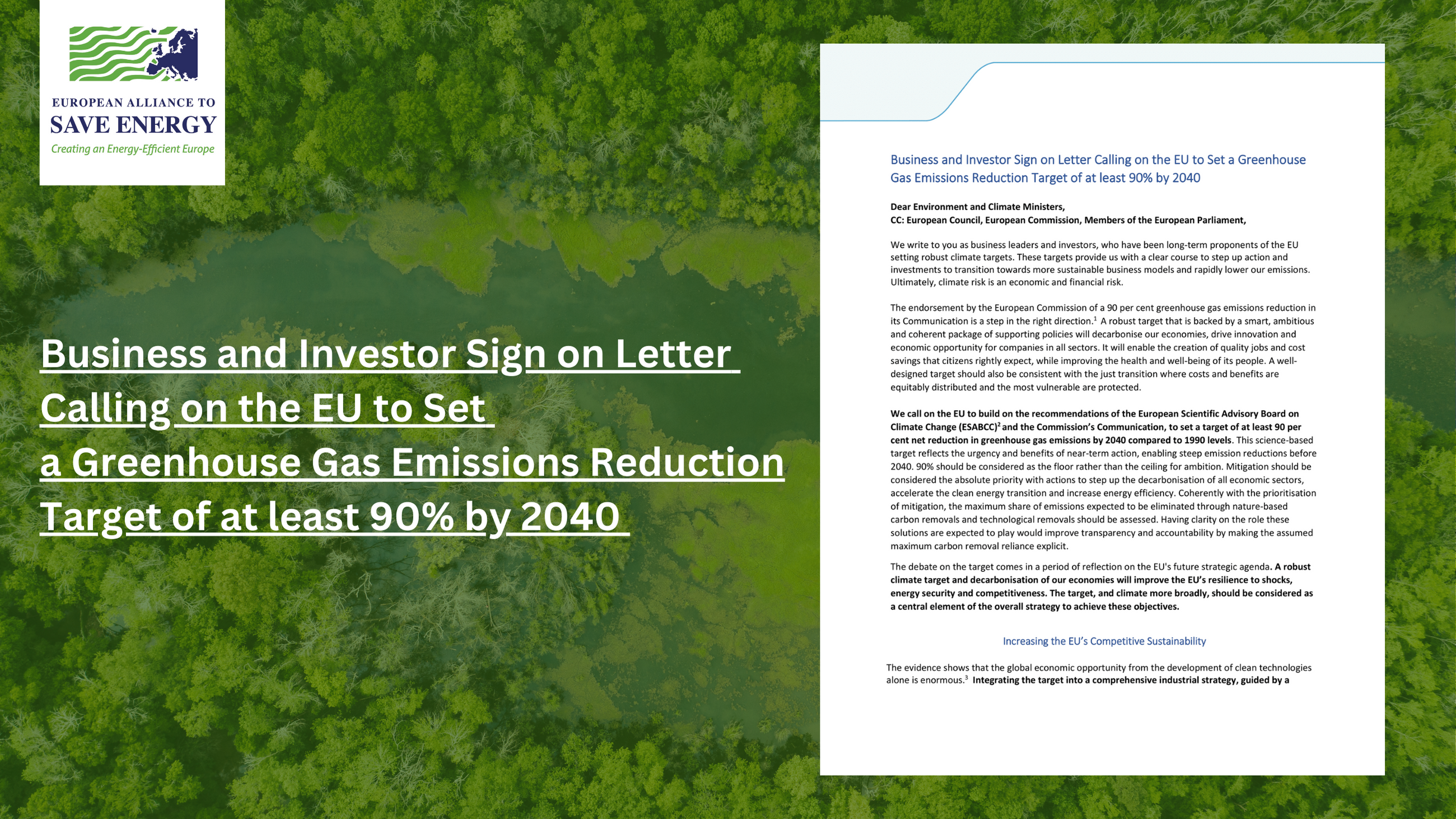
EU-ASE co-signs Letter Calling on the EU to Set a Greenhouse Gas Emissions Reduction Target of at least 90% by 2040

CEOs, business leaders and investors from over 100 organisations have signed a joint letter calling on the EU to set a greenhouse emissions reduction target of at least 90% by 2040. Signatories stress that a robust target will bring economic opportunities and competitiveness benefits while increasing energy security for citizens and businesses. We argue that the target, and climate more broadly, should be considered as a central element of the EU’s overall strategy to achieve these objectives.

21 March 2024 – This month, a new report by the European Environment Agency (EEA) highlighted that climate risks have reached critical levels and 2023 is now the hottest year since records began. On 25 March, Environment and Climate Ministers are set to discuss the EU’s 2040 climate target at the Council. As a result, over 90 businesses and investors from across the EU, representing more than a million employees and managing trillions of euros in assets, have joined forces to call for an ambitious target. At least 90% of greenhouse gas emissions must be cut by this date, to reflect the urgency of the climate crisis.

Signatories emphasise that a robust target, backed by a smart coherent package of supporting policies will decarbonise our economies. It will also ensure that we drive innovation and economic opportunities. This target will enable the creation of high quality jobs and cost savings that citizens rightly expect, while improving the health and well-being of its people.

The letter establishes principles for the economic transformation that will be necessary to achieve the target – and for a climate neutral EU in the longer term. These principles include developing a comprehensive industrial strategy, guided by a ‘competitive sustainability’ approach, accelerating the clean energy transition and efficiency, phasing out fossil fuels, nature-positive investment and harnessing the decarbonisation potential of the circular economy. 


Read the full letter here.

Follow us


Privacy Policy

© All right reserved