Implementing EED: not just a legal obligation, but a strategic opportunity for Europe.
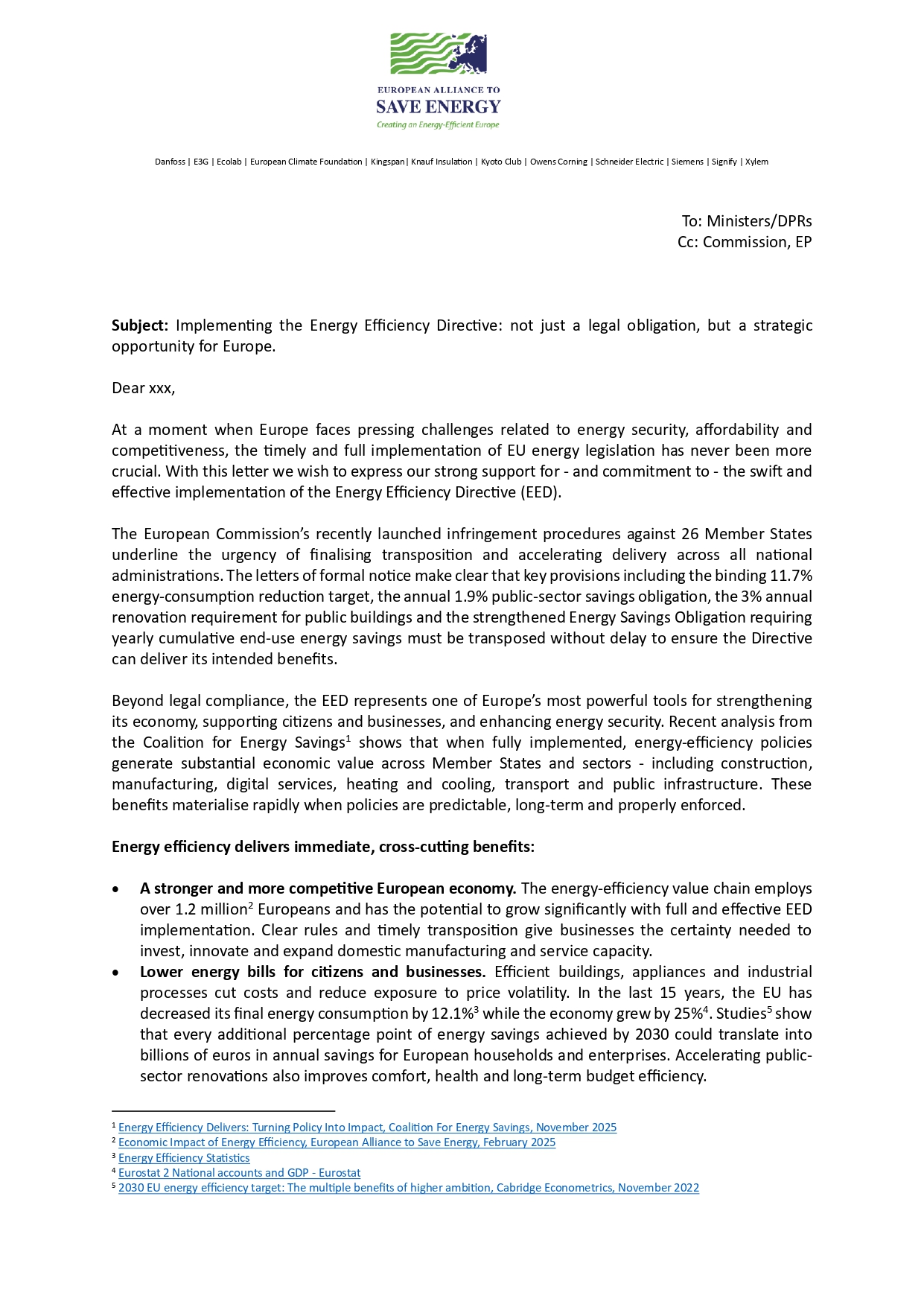
EU-ASE has sent an open letter urging EU member states to accelerate implementation of the Energy Efficiency Directive. The energy efficiency sector already employs 1.2 million people in Europe and effective, timely transposition of the EED will unlock even more investment, innovation and domestic manufacturing.

Implementing energy efficiency measures, among other things:
• Lowers bills for citizens and businesses, with the EU already cutting energy use by 12% while growing its economy by 25%.
• Reduces system costs, alleviating pressure on grids and making electrification more affordable.
• Leads to energy security, with every 1% efficiency improvement cutting gas imports by 2.6%.
• Drives progress toward climate neutrality

We stand ready to support member states with any technical challenges in delivering the directive.

Read the full letter here


Follow us


Privacy Policy

© All right reserved

In a fast-changing political and economic environment, 2025 was a year of continued efforts to strengthen security, stability, and competitiveness for European businesses.

Throughout the year, our work demonstrated that energy efficiency is not only essential to achieving climate goals, but also a key driver of innovation, energy independence and sustainable long-term growth across Europe.

Strong engagement with policymakers, combined with the successful organisation of the 4th European Energy Efficiency Day, highlighted the importance of collaboration and dialogue in advancing shared objectives. Partnerships across sectors and institutions remained central to delivering impact and shaping effective energy policies.

Looking ahead to 2026, we will intensify our efforts to secure the regulatory certainty that can accelerate the energy transition, while providing businesses with the investment confidence they need and strengthening Europe’s  competitiveness.

Read the full Activity Report here

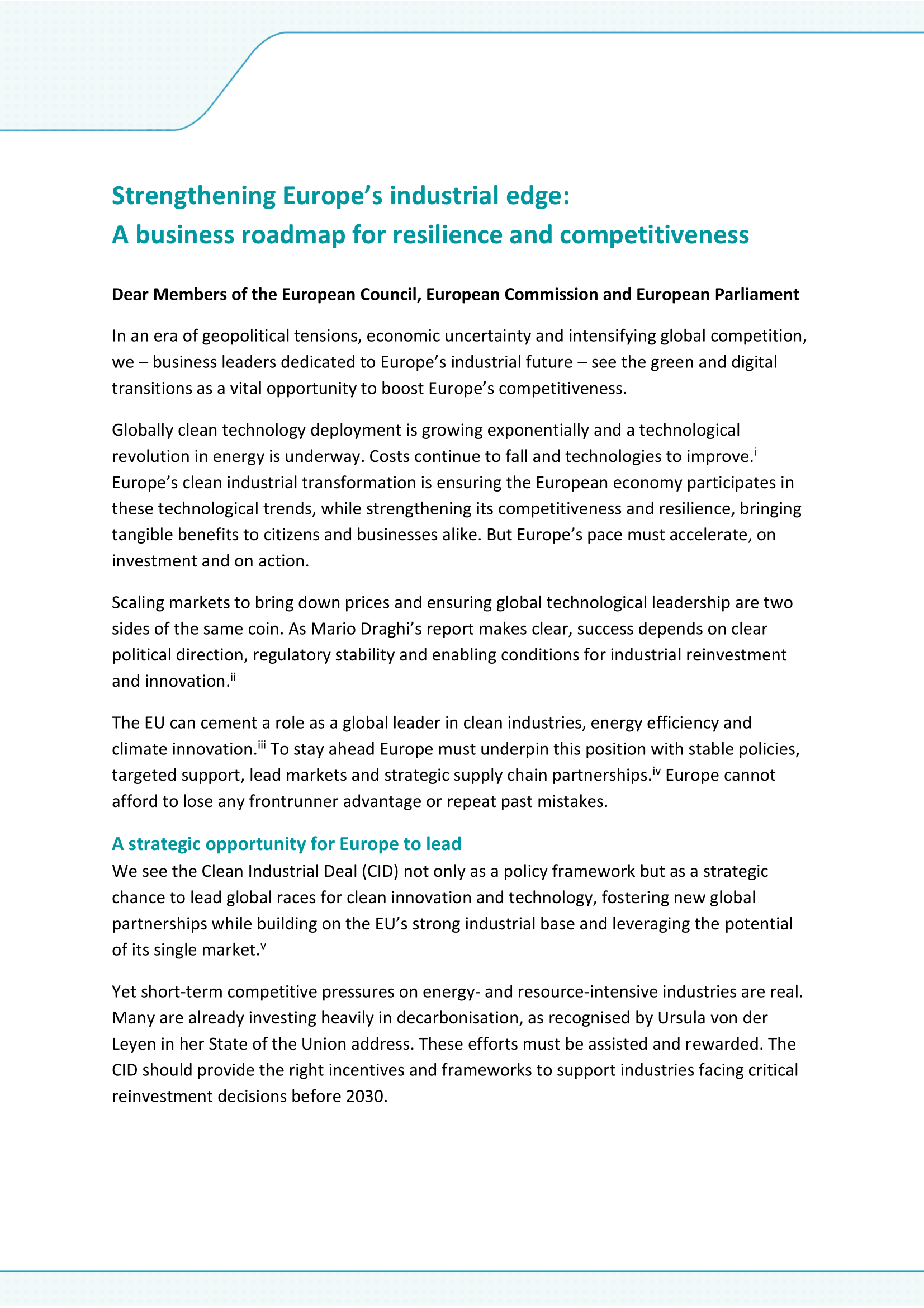
Strengthening Europe’s industrial edge

We’ve joined over 130 businesses and investors in an open letter calling for the effective implementation of the Clean Industrial Deal to keep Europe competitive in the global clean tech race.

Ahead of the European Council meeting, we urge EU leaders to provide clear direction, stable regulation, and strategic investment to drive a fair and ambitious transition.

Our priorities:

  • 90% climate target by 2040
  • Affordable clean energy and electrification
  • Lead markets for low-carbon products
  • Accelerated cleantech deployment and investment
  • Circular economy as a strategic asset
  • A just and inclusive transition for all Europeans

Together, we can power a cleaner, more competitive Europe.

Read the full letter here.


Follow us


Privacy Policy

© All right reserved

In a fast-changing political and economic environment, 2025 was a year of continued efforts to strengthen security, stability, and competitiveness for European businesses.

Throughout the year, our work demonstrated that energy efficiency is not only essential to achieving climate goals, but also a key driver of innovation, energy independence and sustainable long-term growth across Europe.

Strong engagement with policymakers, combined with the successful organisation of the 4th European Energy Efficiency Day, highlighted the importance of collaboration and dialogue in advancing shared objectives. Partnerships across sectors and institutions remained central to delivering impact and shaping effective energy policies.

Looking ahead to 2026, we will intensify our efforts to secure the regulatory certainty that can accelerate the energy transition, while providing businesses with the investment confidence they need and strengthening Europe’s  competitiveness.

Read the full Activity Report here

The Flexible Demand Accelerator Pledge

Together with a coalition of 13 European business associations and civil society organisations, we have signed the Flexible Demand Accelerator Pledge.

The pledge calls on the European Commission to:

  • Embed National Tripartite Dialogues on Flexible Demand in every Member State.
  • Ensure all demand-side resources, from homes to factories, can access energy markets on equal terms.
  • Align tariffs and incentives with real-time price signals.
  • Monitor Member State progress through annual reporting to the Energy Council.

By making demand more flexible, Europe can cut energy waste, reduce costly peak generation and improve grid performance. This is essential to build an energy system that is not only more resilient and affordable but also more energy-efficient and competitive

Read the full pledge here.


Follow us


Privacy Policy

© All right reserved

In a fast-changing political and economic environment, 2025 was a year of continued efforts to strengthen security, stability, and competitiveness for European businesses.

Throughout the year, our work demonstrated that energy efficiency is not only essential to achieving climate goals, but also a key driver of innovation, energy independence and sustainable long-term growth across Europe.

Strong engagement with policymakers, combined with the successful organisation of the 4th European Energy Efficiency Day, highlighted the importance of collaboration and dialogue in advancing shared objectives. Partnerships across sectors and institutions remained central to delivering impact and shaping effective energy policies.

Looking ahead to 2026, we will intensify our efforts to secure the regulatory certainty that can accelerate the energy transition, while providing businesses with the investment confidence they need and strengthening Europe’s  competitiveness.

Read the full Activity Report here

Energy Efficiency First at the heart of the EU Climate Law

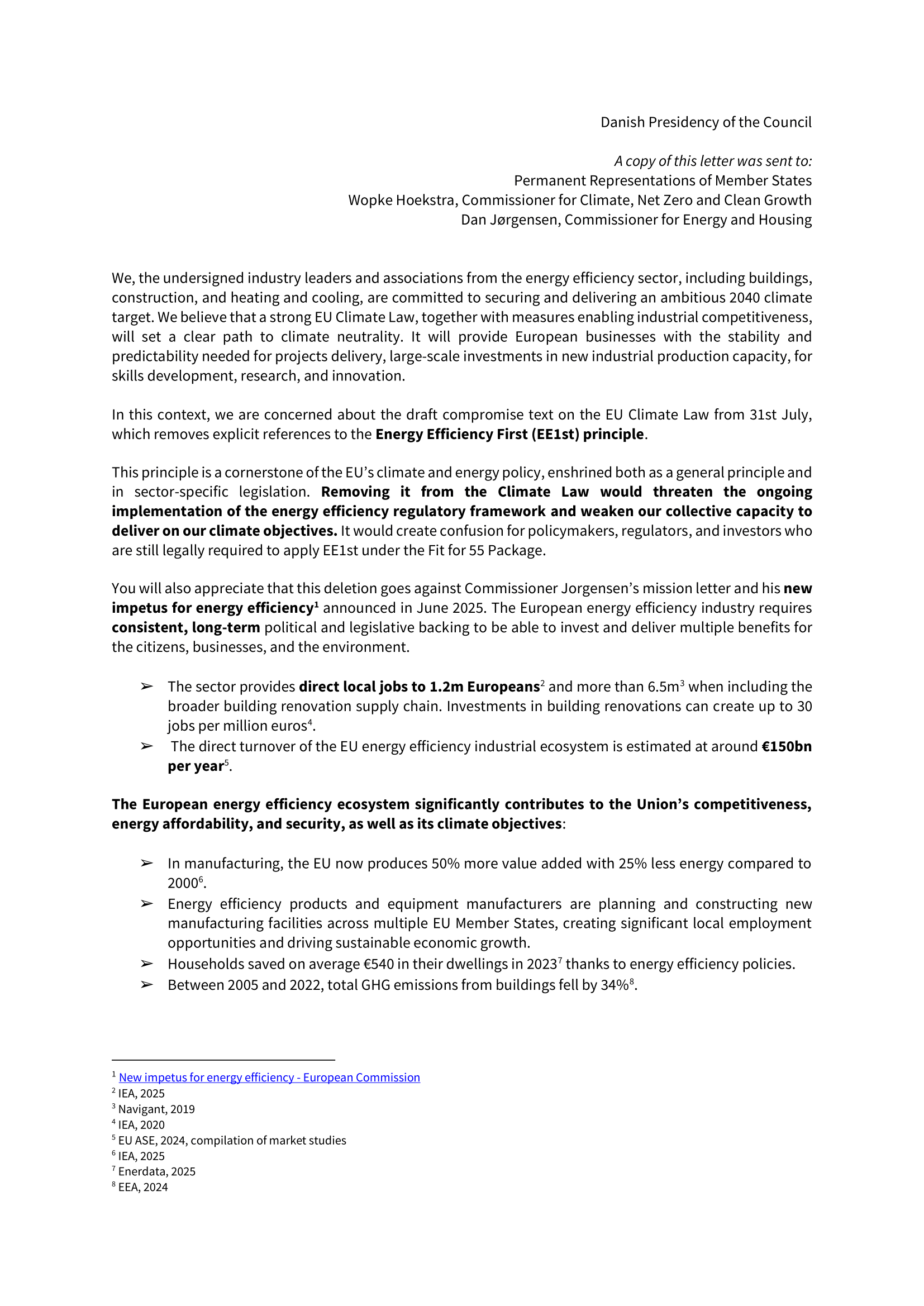
Nearly 100 businesses and associations have urged the Danish Presidency to safeguard the ambition and integrity of the EU Climate Law by keeping explicit references to the Energy Efficiency First (EE1st) principle in the Presidency’s compromise text.

EE1st is a cornerstone for building a secure, affordable, and fully decarbonised EU energy system. Removing it from the Climate Law would:

  • Undermine implementation of the EU’s energy efficiency framework
  • Create uncertainty for policymakers, regulators, and investors still legally bound by the Fit for 55 Package
  • Weaken Europe’s collective capacity to deliver on its climate objectives

The energy efficiency industry already supports 1.2 million local jobs across Europe, generates €150 billion in direct annual turnover, cuts energy imports and strengthens European competitiveness

To unlock these benefits, the sector needs consistent, long-term political and legislative support. Weakening or removing EE1st would take us backwards – depriving European businesses of the stability and predictability needed for project delivery, large-scale industrial investments, skills development, research, and innovation.

Read the full letter here.


Follow us


Privacy Policy

© All right reserved

In a fast-changing political and economic environment, 2025 was a year of continued efforts to strengthen security, stability, and competitiveness for European businesses.

Throughout the year, our work demonstrated that energy efficiency is not only essential to achieving climate goals, but also a key driver of innovation, energy independence and sustainable long-term growth across Europe.

Strong engagement with policymakers, combined with the successful organisation of the 4th European Energy Efficiency Day, highlighted the importance of collaboration and dialogue in advancing shared objectives. Partnerships across sectors and institutions remained central to delivering impact and shaping effective energy policies.

Looking ahead to 2026, we will intensify our efforts to secure the regulatory certainty that can accelerate the energy transition, while providing businesses with the investment confidence they need and strengthening Europe’s  competitiveness.

Read the full Activity Report here

Support of an ambitious EU 2040 domestic emissions reduction target

As part of the Coalition for Higher Ambition, EU-ASE calls for an
ambitious EU 2040 domestic emissions reduction target and an ambitious Nationally Determined Contribution (NDC). 

Among various stakeholders, we urge the rapid phase-out of fossil fuels, accompanied by investments in clean technologies and a circular economy to drive innovation, job creation and long-term competitiveness. There is an urgent need for binding post-2030 targets for energy efficiency and renewable energy, reinforcing Europe’s energy security while reducing reliance on fossil fuel imports.

As the world prepares for COP30, the EU must step up its global leadership by presenting a bold and credible NDC, demonstrating its commitment to climate action.

Monica Frassoni, President of EU-ASE stated: A varied and broad group of actors, including industry and civil society organizations, calls for a science-based climate target of at least 90% emissions reduction by 2040. Energy efficiency is essential to achieving this while driving competitiveness and energy security. A stronger and decarbonized Europe starts with using energy smarter and more efficiently through technologies and solutions that are manufactured in Europe.”

The coalition calls on EU policymakers to take decisive action now to secure Europe’s economic future and lead the way toward a climate-neutral world.

Read the full letter here.


Follow us


Privacy Policy

© All right reserved

In a fast-changing political and economic environment, 2025 was a year of continued efforts to strengthen security, stability, and competitiveness for European businesses.

Throughout the year, our work demonstrated that energy efficiency is not only essential to achieving climate goals, but also a key driver of innovation, energy independence and sustainable long-term growth across Europe.

Strong engagement with policymakers, combined with the successful organisation of the 4th European Energy Efficiency Day, highlighted the importance of collaboration and dialogue in advancing shared objectives. Partnerships across sectors and institutions remained central to delivering impact and shaping effective energy policies.

Looking ahead to 2026, we will intensify our efforts to secure the regulatory certainty that can accelerate the energy transition, while providing businesses with the investment confidence they need and strengthening Europe’s  competitiveness.

Read the full Activity Report here