
Energy Efficiency First at the heart of the EU Climate Law
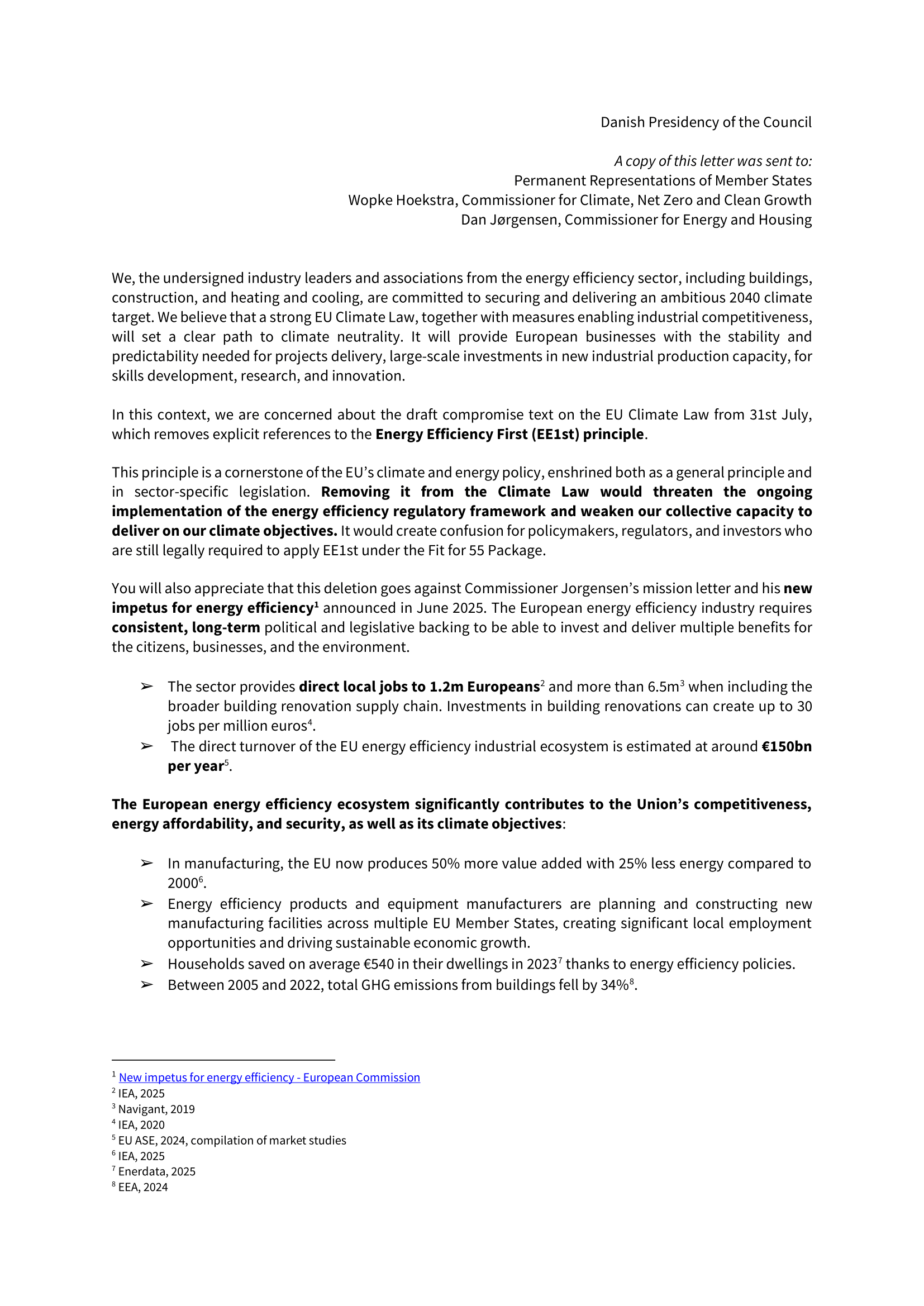
Nearly 100 businesses and associations have urged the Danish Presidency to safeguard the ambition and integrity of the EU Climate Law by keeping explicit references to the Energy Efficiency First (EE1st) principle in the Presidency’s compromise text.

EE1st is a cornerstone for building a secure, affordable, and fully decarbonised EU energy system. Removing it from the Climate Law would:

  • Undermine implementation of the EU’s energy efficiency framework
  • Create uncertainty for policymakers, regulators, and investors still legally bound by the Fit for 55 Package
  • Weaken Europe’s collective capacity to deliver on its climate objectives

The energy efficiency industry already supports 1.2 million local jobs across Europe, generates €150 billion in direct annual turnover, cuts energy imports and strengthens European competitiveness

To unlock these benefits, the sector needs consistent, long-term political and legislative support. Weakening or removing EE1st would take us backwards – depriving European businesses of the stability and predictability needed for project delivery, large-scale industrial investments, skills development, research, and innovation.

Read the full letter here.


Follow us


Privacy Policy

© All right reserved

EU-ASE at IEA’s 10th Annual Energy Efficiency Conference

The International Energy Agency (IEA) Annual Global Conference on Energy Efficiency brought together key stakeholders from around the world, including members of the European Energy Efficiency community.

During the Conference, Monica Frassoni met with Paula Glover, President of the Alliance to Save Energy, our sister organization based in the United States. Monica and Paula exchanged views on global challenges and opportunities in advancing energy efficiency.

They explored potential areas for collaboration to drive greater impact and accelerate progress toward a more sustainable and energy efficient future.

Watch Paula and Monica’s exchange here.

Follow us


Privacy Policy

© All right reserved

EU-ASE Calls for energy and climate stability towards 2040

EU-ASE and over 300 companies and associations urge Europe’s leaders to secure long-term investment certainty by adopting a strong industrial, energy and climate framework for 2040.

Energy efficiency must be at the heart of this framework. It is the most cost-effective way to cut emissions, reduce dependency on energy imports and boost competitiveness. Setting ambitious energy efficiency targets will drive innovation, strengthen the cleantech sector and ensure a just and resilient energy transition.


Read the full joint statement here.


Follow us


Privacy Policy

© All right reserved

Call to Set a Greenhouse Gas Emissions Reduction Target of at least 90% by 2040

The EU should set a greenhouse gas emissions reduction target of at least 90% by 2040. This is not only a critical milestone on the path to climate neutrality, it’s also a powerful driver of the EU’s competitiveness, economic growth, energy security and resilience.

By accelerating the clean energy transition and improving energy efficiency, this target will directly support the EU’s strategy to strengthen energy security for both citizens and businesses, while stimulating the investments and innovations needed for a competitive and prosperous future.

We’re proud to stand with over 150 leading businesses and investors calling on EU policymakers to set a bold, clear course that empowers business action and long-term growth.

Read the full letter here. 


Follow us


Privacy Policy

© All right reserved

Gender Equality Index 2024

Education and training are essential for gender equality and for everyone’s ability to adapt to labour market changes fuelled by the green and digital transitions. Tertiary education is vital for good quality job opportunities, while lifelong learning enhances social mobility and helps women and men in all their diversity to adapt to workplace transformation. The domain of knowledge is marked by
women slightly surpassing men in both educational attainment and participation in adult learning.

Persistent gender segregation in education – with women significantly outnumbering men in studying education, health and welfare, and humanities and the arts – remains a major challenge.

EU policy developments in the domain of knowledge focus on bringing more women into STEM study fields and on upskilling and reskilling to enable citizens and the economy to adapt to the twin transitions.  The digital education action plan is a key enabler of the European education area and aims to make better use of digital technology for teaching and learning and to develop relevant digital skills and competencies for digital transformation.

Read the full report here

Follow us


Privacy Policy

© All right reserved