Think Efficiency first to address the energy and climate crisis

More than 20 organisations join EU-ASE in an open letter addressed to the EU negotiators revising the Energy Efficiency Directive. It calls for an effective implementation of the Energy Efficiency First principle in all of the EU, national and local policy, planning and investment projects regardless of the size of investments.

With the revision of the Energy Efficiency Directive (EED), the EU Institutions are due to agree in trialogue negotiations on provisions that introduce in the regulatory framework the implementation of the “Energy Efficiency First” Principle.

This letter, co-signed by European business organisations, housing associations and NGOs, calls on the EED negotiators to agree on applying the principle without monetary thresholds that could rule out its application in many local projects having an impact on the energy system, therefore missing the potential energy efficiency can have for the economy, society and the climate. 

Read the full letter here

Follow us


Privacy Policy

© All right reserved

Interview: To shave peak demand, EU states should impose ‘flexibility’ on industry

“The EU’s high gas dependency can be reduced through both electriciation and energy efficiency,” Francesco Venturini of Enel X Global Retail told Frédéric Simon of Euractiv ahead of European Energy Efficiency Day 2022.

The biggest potential for short-term energy demand reduction lies with industrial consumers, says Francesco Venturini. Those savings can be tapped with programmes that reward businesses who adapt their demand to energy supply, he argues.

Interview highlights:

  • Big industrial loads offer the biggest opportunity to efficiently manage peak electricity consumption
  • EU countries should introduce forms of mandatory flexibility, rewarding businesses that are able to adapt their demand to electricity supply
  • Europe has sufficient gas storage to get through this winter without rationing. Potential shortages could especially affect the winter 2023-2024 and the following ones
  • Today’s high gas prices are driven mostly by speculation. This should be reined in with the introduction of a temporary price cap on European gas
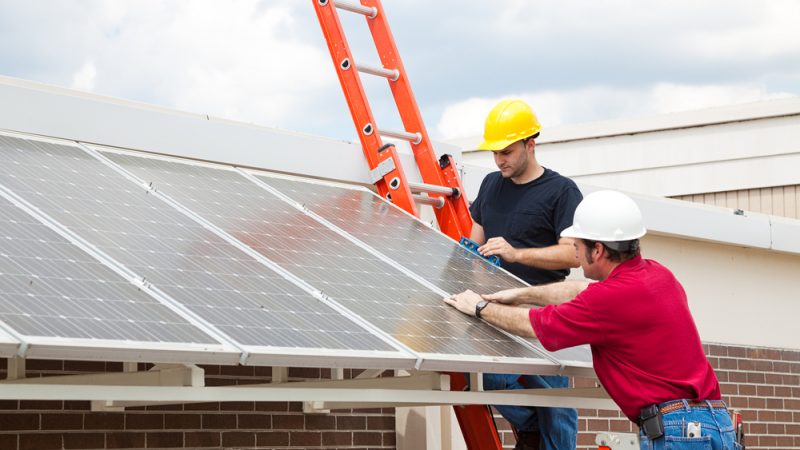
  • For private consumers, regulations should be adjusted to encourage energy self-consumption, like solar panels and batteries. Other examples include citizen-led Energy Communities, tax deductions for heat pumps, removing subsidies for gas boilers, and a ‘right to plug-in’ for consumers
  • When it comes to public spending, Enel believes policies that promote energy savings from direct fossil fuel combustion must be excluded from eligible measures to achieve EU members states’ energy savings obligations

Read the full interview in Euractiv.

More information on Energy Efficiency Day here.

Follow us


Privacy Policy

© All right reserved

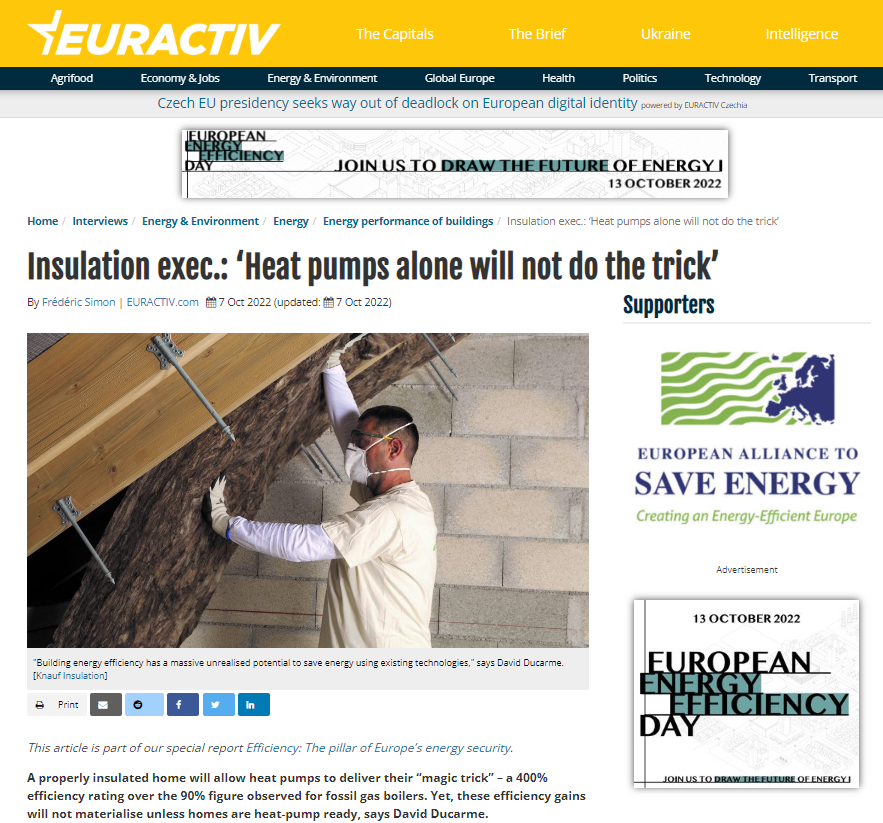
Insulation exec.: ‘Heat pumps alone will not do the trick’

Energy efficiency has a huge role to play to deliver renewable energy to households whilst limiting costly investments into energy capacity for society, David Ducarme, Group chief operating officer at Knauf Insulation told Frédéric Simon of Euractiv.

A properly insulated home will allow heat pumps to deliver their “magic trick” – a 400% efficiency rating over the 90% figure observed for fossil gas boilers. Yet, these efficiency gains will not materialise unless homes are heat-pump ready, says David Ducarme.

Interview highlights:

  • Long-term measures to reduce energy demand are essential to address the root causes of the energy crisis Europe is facing.
  • Buildings remain Europe’s year-round weak spot in the energy transition. Drastically improving the energy performance of buildings envelopes would decrease by 45% the energy demand for heating and cooling from buildings.
  • Heat pumps alone will not do the trick. A properly insulated home will allow heat pumps to deliver their “magic trick” – pulling four units of heat out of each kilowatt-hour (kWh) of electricity. Otherwise, they will not deliver as much.
  • Heat pumps will also pose challenges to the electricity grid, with demand for electric heating set to increase by 356 Terawatt hours per year (TWh/y). Without insulation, the additional generation capacity needed to meet peak winter demand would need to be 2,129 TWh/year, almost five times more.
  • The revised Energy Performance of Buildings Directive (EPBD) and Energy Efficiency Directive (EED) will be the backbone of resilient and decarbonised building stock.
  • Long-term decarbonisation of the building stock also entails setting long-term trajectories on whole-life carbon reduction.


Read the full interview in Euractiv.

More information on Energy Efficiency Day here.

Follow us


Privacy Policy

© All right reserved

Investing in energy efficiency: if not now when?

As the cheapest & cleanest energy is the one we don’t need, rapidly increasing energy savings is of outmost importance to address the current crises, says Monica Frassoni in Euractiv, ahead of the first edition of the European Energy Efficiency Day conference.

More than two hundred days have passed since Russia launched a full-scale invasion of Ukraine, starting a tragic conflict in Europe with no clear end in sight. The use of energy as a weapon by Vladimir Putin shows that by delaying plans for a clean energy transition the EU is more vulnerable and insecure.

While emergency plans are underway to respond to the crisis, skyrocketing prices of wholesale fossil gas and electricity pose a real challenge to struggling citizens and businesses and put at great risk the post-pandemic recovery.

Today, the pressing question everyone is asking is: how can we make it through the next winter and how can we reduce quickly energy prices? But the real question should be: how can we make it through the next four-five winters and burning summers, and at the same time accelerate carbon emissions reduction.

Because the cheapest and cleanest energy is the one we do not need, rapidly increasing energy savings is of outmost importance. By mainly focusing on diversification of gas supply many governments are underestimating the massive savings potential that is currently untapped at end-use and system levels via retrofitting, demand-side flexibility and by accelerating the digital transition.


Read the full article by Monica Frassoni on Euractiv

More information on Energy Efficiency Day here & Register here.

Follow us


Privacy Policy

© All right reserved

It’s time to act to address Europe’s buildings issue

As we are drifting towards winter, I am struck by the gap between the urgency to protect European citizens from the consequences of poorly performing homes, and the reluctance of our leaders to decisively act on it. We are witnessing intense debates on the energy efficiency files under the Fit for 55 Package, and this is not nearly the end of it.

Asking citizens to adapt their behavior to mitigate the risk of gas shortages and subsidizing their bills seem to be the only political answer. Yet, we all know that solutions addressing only the symptoms will not help in the long run.

The solution to the cause is the EU Renovation Wave, however we cannot overlook the challenges to this. We need an additional 275 billion euros to finance it (1), and the acceleration of the rate and depth of renovation calls for coordination and new business models.

We have been sleepwalking on the issue for too long, hypnotized by cheap fossil energy hiding the leaks and waste of our buildings. It is not too late to change that.

It is our responsibility to help politicians join the dots between short- and long-term concerns. The equivalent of 1,7% of EU GDP was spent to mitigate the impact of the energy crisis so far (2). By contrast, financing the Renovation Wave would represent 1,5% of the GDP. Add to that jobs, health and productivity benefits, and a boost to our climate agenda.

It is also our responsibility to explain what renovation market actors need to be able to invest, train, and innovate. Building owners, manufacturers, banks, real estate and building professionals need visibility. This visibility is at the heart of the MEPS (Minimum Energy Performance Standards) proposal, a true renovation accelerator.

The best energy will always be the energy we do not need, thanks to the efficiency of our buildings.

We can help make this a reality.

by Céline Carré
Head of Public Affairs
Saint-Gobain

Sources:
1. Question 5 in FAQ on the Renovation Wave: https://ec.europa.eu/commission/presscorner/detail/en/qanda_20_1836
2.  Bruegel, 21/09/2022 and Europe’s Deepening Energy Crisis Pushes Bill to $500 Billion

Follow us


Privacy Policy

© All right reserved