
EPBD recast: EU Commission proposal shows good intentions but low ambition

The recast of the Energy Performance of Buildings Directive is a key element to complete the “Fit for 55” package. The Commission’s proposal introduces better measures and tools to increase the rate and depth of building renovations. However, the overall ambition is not sufficient to tap the economic and environmental potential of the full decarbonisation of the EU building stock.

On Wednesday, the European Commission presented its proposal to revise the Energy Performance of Buildings Directive (EPBD). The EPBD is one of the elements of the broad “Fit for 55” legislative package which aims to help the Union cut by at least 55% its GHG emissions by 2030 and reach climate neutrality by 2050. Improving buildings’ energy performance is essential to achieve these objectives. According to the EU Renovation Wave communication buildings’ GHG emissions should be reduced by at least 60% by 2030: a gigantic social, economic and environmental challenge.

The European Alliance to Save Energy (EU-ASE) welcomes the intention of the Commission to address this challenge: the measures and tools proposed improve the current situation. The proposal, for example, introduces a pathway for buildings to become “Zero Emission” by 2050 and innovative requirements that can help trigger building renovations, like mandatory Minimum Energy Performance Standards (MEPS) for public and private residential and non-residential buildings.

On the other hand, the Commission has been too cautious when setting the level of ambition of the measures proposed and thus runs the risk that the multiple benefits of energy renovations, in terms of cost savings, increased property value, enhanced comfort and emission reductions, will remain largely untapped.

Monica Frassoni, President of the European Alliance to Save Energy, said: “The EPBD proposal is indisputably giving us better measures and tools to increase the rate and depth of building renovations. However, some key measures remain too weak in terms of proposed deadlines and scope and too much flexibility is given to Member states without a clear idea about what will happen if they are not fully implemented. All this makes the goal to fully decarbonize the building stock by 2050 even more challenging.

We will work over the next months to show to the European Parliament and Member States that it is necessary and worthwhile to step up the ambition, starting from revising the energy performance classes to be achieved via MEPS. Comprehensive renovations make economic and environmental sense. In the short-medium term, they are a rational, cost-effective and systemic solution to tackle rising energy prices. An ambitious EPBD must support this positive agenda, no ifs, and, or buts.”

Download the Pdf version


Media contact:
Antoan Montignier
Policy and Advocacy Advisor
antoan.montignier@euase.eu
+32 499 84 97 28

About us
The European Alliance to Save Energy (EU-ASE) aims to advance the energy efficiency agenda in the European Union. The Alliance allows world’s leading multinational companies to join environmental campaigners and a cross-party group of Members of the European Parliament. EU-ASE business members have operations across the 27 Member States of the European Union, employ over 340.000 people in Europe and have an aggregated annual turnover of €115 billion.

Follow us


Privacy Policy

© All right reserved

EU-ASE at CAN Europe’s high level event on Fit for 55

On 14 October, the president of the European Alliance to Save Energy, Monica Frassoni, participated in the high-level event “Accelerating climate action in the EU and Member States through the Fit for 55 package and National Planning Processes”, organised by Climate Action Network Europe.

Monica Frassoni took the floor during the first panel discussion “Enhancing EU’s climate ambition through the Fit for 55 package”. Speakers included Diederik Samsom, Head of Cabinet of European Commission First Vice-President Frans Timmermans; Ursula Woodburn, Corporate Leaders Group Europe; Benjamin Denis, IndustriAll Europe; Marcin Kowalczyk, WWF Poland and Wendel Trio, CAN Europe.

The recording of the panel can be found here.

Follow us


Privacy Policy

© All right reserved

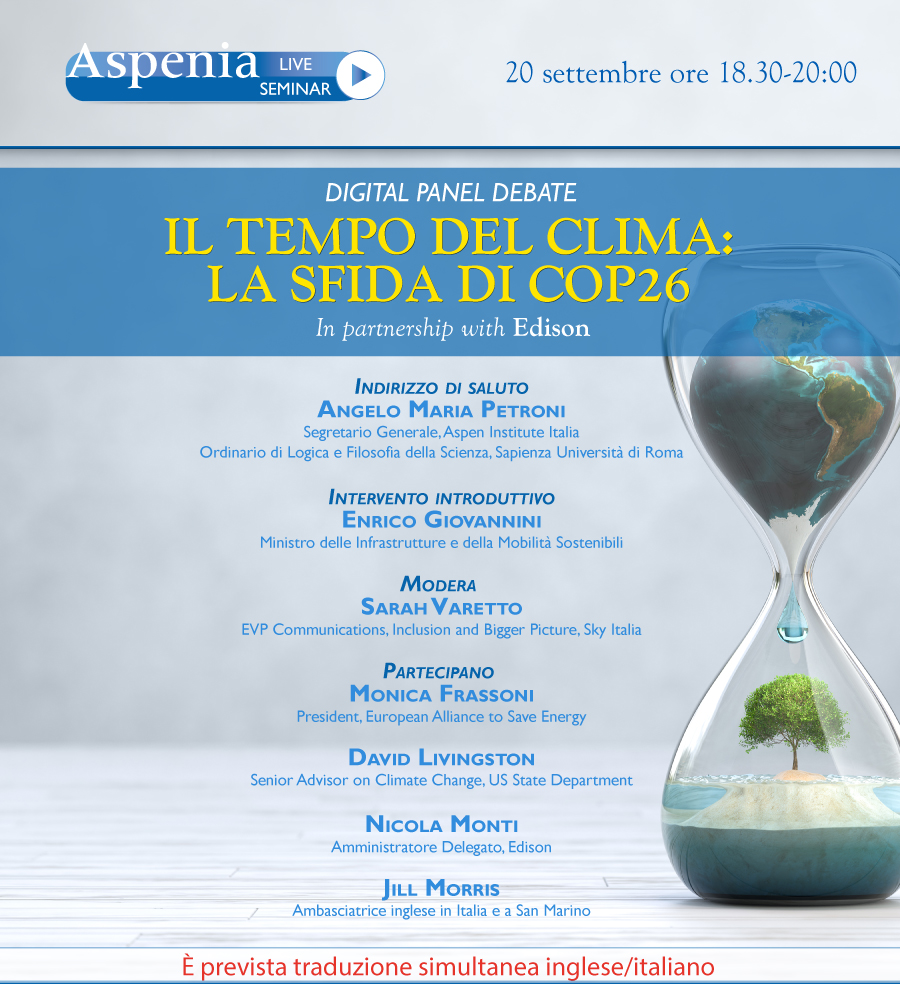
EU-ASE at Il tempo del clima. La sfida di COP26

On 20 September, the president of the European Alliance to Save Energy, Monica Frassoni, participated in the high-level webinar “Il tempo del clima. La sfida di COP26”, organised by Aspen Institute Italia and Edison.

Speakers included: Enrico Giovannini, Italian Minister of Sustainable Infrastructure and Mobility; Nicola Monti, Ceo Edison; Jill Morris, British Ambassador to Italy and San Marino; and David Livingston, Senior Advisor on Climate, US Department of State.


The recording of the panel can be found 
here

Follow us


Privacy Policy

© All right reserved

Commission strengthens EU energy efficiency rules, lacks ambition on targets

The European Commission unveiled today its “Fit for 55” package to adapt the EU’s energy and climate legislation to the new goals of reducing emissions by at least 55% by 2030 and reach climate neutrality by 2050. The package includes the key proposal to revise the Energy Efficiency Directive (EED).

The EED proposal contains a number of positive elements. First of all, it enshrines the Energy Efficiency First principle (EE1st) in the Directive, introducing the much-needed obligation to apply the principle in the decision making of energy and non-energy sectors.

Other important elements are the extension of the public owned building renovation obligation to all public bodies, as well as the introduction of a new obligation to cut energy consumption of public bodies by at least 1.7% annually until 2030.

The revised Directive reinforces the annual energy savings obligations target after 2024 by 1.5%, almost doubling the current obligation. It also excludes the accountability of direct fossil fuel combustion technologies and clarifies that a reduction of the energy use through measures under the ETS cannot count towards the fulfilment of the energy savings obligation.

The European Alliance to Save Energy (EU-ASE) welcomes the Commission’s proposal to level up its ambition on the EU energy efficiency rules. By acknowledging the Energy Efficiency First principle, the Commission recognises its crucial role to drive a fast and fair transition in energy and non-energy sectors. However, we regret that the Commission chose not to propose binding national targets on energy efficiency; furthermore, we are critical of the Commission’s decision to propose an EU wide energy efficiency target that, even if mandatory, is not aligned with the EU decarbonisation pathway. The Commission introduces a 36% target for final energy consumption, which does not catch the cost-effective opportunities stemming of at least 40% energy efficiency target by 2030.

Monica Frassoni, President of the European Alliance to Save Energy said:
The latest extreme weather events around the world and the ongoing Covid-19 pandemic show that there is no time left for half measures on climate and on economic recovery. The EU Energy Efficiency Directive must be fit for Europe’s decarbonisation goals as well as foster economic activities aiming at increasing efficiency in buildings, industry, and transport. In this sense, we think that the proposed targets should have been more ambitious. We will be working over the next months to demonstrate to the co-legislators that delivering on ambitious energy efficiency targets and fully applying the Energy Efficiency First principle is essential if the EU wants to be credible about reaching climate neutrality in time and avoid the worst effects of climate change. We hope that the European Parliament and the Council will further improve the current proposal”.

Harry Verhaar, Chair of the board of the European Alliance to Save Energy and Head of Public and Government Affairs at Signify said:
“To be able to fully unlock the multiple benefits of energy efficiency across the continent we need an ambitious EU legal framework. We welcome the revision of the Energy Efficiency Directive, which comes at a timely moment for Europe’s green recovery and clean energy transition. In particular, we praise the Commission for strengthening the provisions on the Energy Efficiency First principle. The principle needs to guide policymakers and investors in all energy planning, policy, and investment decisions. Energy efficiency is a powerful driver of sustainable economic growth and it is key to speed up our journey to a decarbonised Europe”.

Bertrand Deprez, Vice-Chair of the board of the European Alliance to Save Energy and Vice-President EU government affairs at Schneider Electric said:
“Energy efficiency is the indisputable driver to reach at least a -55% GHG emissions cut in the next decade. The European Commission proposal goes in the right direction, with very promising measures to accelerate energy efficiency efforts at end-use level, including the extension of renovation obligations to all public buildings. Yet, achieving the EU ambition for 2030 without tackling the renovation of the entire existing stock is ‘Mission: Impossible’: we need to extend it to all non-residential buildings.”

Bonnie Brook, Vice-Chair of the board of the European Alliance to Save Energy and Senior Manager Industry Affairs Building Automation at Siemens said:
“Enhanced criteria for energy audits and energy management systems are very encouraging. They should leverage the opportunities brought by the current advanced level of digitalisation. Smart technologies should be widely deployed to enable monitoring, analysis and evaluation of the energy performance as well as the progress to the carbon-free future”.

Ahead of the publication of the proposal, the European Alliance to Save Energy provided to the European Commission its recommendations on how to make the EED “fit for 55%”. The Alliance looks forward to working together with the European Parliament and the Council during the co-legislation period to ensure that the Directive is ambitious and comprehensible.

According to the International Energy Agency’s Global Net Zero Roadmap for the Energy sector, the path to global net zero emissions implies a global push in energy efficiency gains resulting in the annual rate of energy intensity improvements averaging 4% to 2030 – about three times the average over the last two decades.

Download the Pdf version

Media contact:
Antoan Montignier
Policy and Advocacy Advisor
antoan.montignier@euase.eu
+32 499 84 97 28

About us
The European Alliance to Save Energy (EU-ASE) aims to advance the energy efficiency agenda in the European Union. The Alliance allows world’s leading multinational companies to join environmental campaigners and a cross-party group of Members of the European Parliament. EU-ASE business members have operations across the 27 Member States of the European Union, employ over 340.000 people in Europe and have an aggregated annual turnover of €115 billion.
Follow us


Privacy Policy

© All right reserved

EU’s climate action does not need fossil distractions

Climate is high on the agenda of this week’s meeting with European Union heads of states and governments. What is not really certain is if the Council will manage to keep a united and determined front ahead of COP26 in Glasgow.

by Monica Frassoni, President of the European Alliance to Save Energy (EU-ASE)

The problem the EU faces, as most other developed economies, is that behind climate ambitions and political declarations, the numbers do not add up. Too much time and resources are lost in the attempt to go around a basic reality that only a few days ago was clearly stated with no possibility of misunderstanding in the International Energy Agency’s new report, Net Zero by 2050 Roadmap: we need to stop investing in fossil fuels now.

That includes new gas pipelines, as well as grey and blue hydrogen. We must stop hiding behind the magic word ‘transition’ to prolong our still enormous dependence on natural gas, coal and oil. We need to invest and dedicate the massive amount of public resources that are available at all levels to help all of us to go green: this is no ethical issue. It is a sound economic, social and environmental choice, as it gives a real perspective to our industries and workers to stay competitive and to look to the future with trust. In other words, accelerating the green transformation is a very good news for Europe’s citizens, businesses and the environment.

In December 2020, in light of the EU’s commitment to increase its climate ambition in line with the Paris Agreement, EU leaders endorsed a common target to reduce the bloc’s net greenhouse gas emissions by at least 55% compared to 1990-levels by 2030 and confirmed the goal to become the first climate neutral region by 2050. This was a substantial step up from the previous 2030 target of cutting emissions by 40% and can be considered a result of pressure from scientific communities, public opinion and media to raise awareness and the sense of urgency on the major global risk represented by climate change.


Read the full article on Friends of Europe

Follow us


Privacy Policy

© All right reserved