EU-ASE response to the Inception Impact Assessment on the 2030 Climate Target Plan
As European businesses and investors having energy efficiency and energy demand reduction at the heart of our activities, we strongly support President Ursula von der Leyen’s commitment to set the EU on a path to becoming the world’s first climate neutral continent by 2050 at the latest.

In view of this goal, we believe that the 2030 greenhouse gas emissions reduction target must be increased from the current 40% to at least 55% because a more ambitious target will put the EU on a more gradual and sustainable pathway to climate neutrality by 2050. An increased 2030 target is also critical because it reflects the absolute urgency, underlined by the IPCC latest Special Report on the impacts of global warming, to address climate change and reduce to minimum GHG emissions in the next ten years.

A growing number of Member States are already committed to increasing their climate ambition. A target of at least 55% by 2030 at the EU level is also feasible from both technical and economic point of view and, according to the European Commission’s own analysis, it is likely to lead to a net increase in GDP of 2%, a surge in employment and a reduction in costs linked to fossil fuel imports and health damages.

We believe that increasing the 2030 GHG target to at least 55% requires a comprehensive assessment which will consider the impact of such policy decision both in terms of direct benefits (e.g. employment, reduced energy costs and import dependency, competitiveness) as well as avoided costs (e.g. environmental damages, health costs, fossil fuel subsidies). We are also convinced that such assessment should be based on the analysis of the European energy infrastructure needs and must fully apply the energy efficiency first principle to prevent lock-in into carbon-intensive future pathways.
 

Download the full response

Follow us


Privacy Policy

© All right reserved

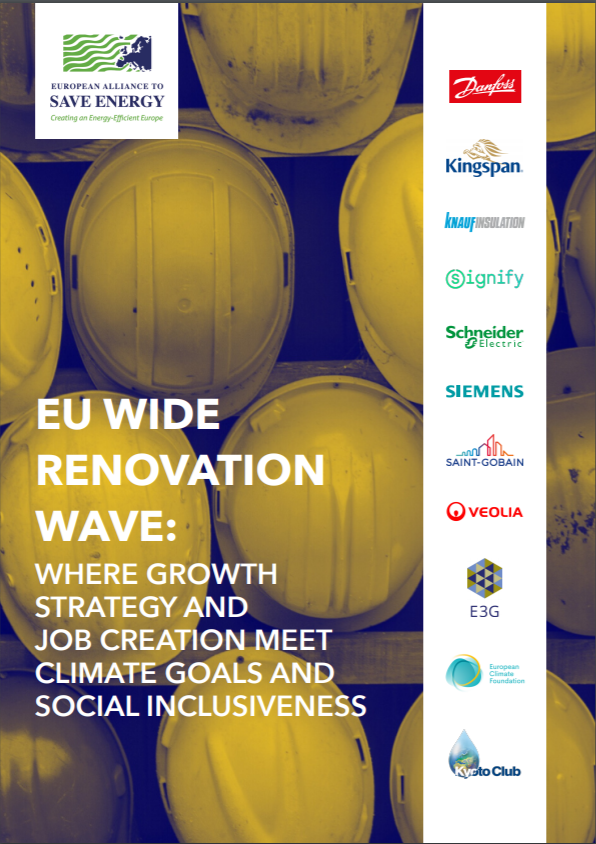
EU wide Renovation Wave: where growth strategy and job creation meet climate goals and social inclusiveness

Unlocking the potential for energy efficiency and carbon footprint reduction that lies in the EU buildings stock is a top priority for the European Alliance to Save Energy.


As businesses and investors having energy efficiency and energy demand reduction at the heart of our activities, we look forward to seeing Europe’s global climate leadership translated in green measures which will lead to a sustainable recovery through stimulus packages. We strongly believe that the Renovation Wave as part of the EU Green Deal is a great opportunity to promote a European based industry, with technologies and expertise able to serve the renovation demand locally. This will help to maintain the competitive advantage of the European industry and will contribute to the European green recovery and local job creation while lifting millions of Europeans out of energy poverty.

We support a system-wide approach that puts highly energy efficient, renewable-based, smart and flexible buildings at the center of a fast-changing decentralized energy system.

With this in mind, we envisage an EU wide building Renovation Wave which revolves around the swift implementation of the Energy Efficiency First principle as the fastest and most cost-effective way to reduce emissions and stimulate sustainable economic recovery.

We are convinced that highly energy efficient and smart buildings are the first and indispensable step to:

  • Accelerate the deployment of renewable energy sources
  • Foster sector integration of buildings with other sectors, including industry,
    transport and energy sectors
  • Catalyse energy system decentralization and enhance overall system efficiency
  • Stimulate a sustainable economic recovery, and boost local employment

For this to happen Europe must back an ambitious and impactful Renovation Wave which aims to increase the energy efficiency of buildings by reducing their energy consumption and by fostering the greater quality, the rate, and the depth of comprehensive renovations encompassing envelopes and technical buildings systems. Concretely, and to stay on track with the EPBD goal of decarbonizing the EU building stock by 2050, the Renovation Wave should be designed to reach a minimum of a 3% renovation rate per year combined with an average energy efficiency improvement of 75%.

The social impact of an EU wide energy efficient Renovation Wave would be tremendous. Improved comfort, cleaner indoor and outdoor air quality, reduced energy bills, the emerging role of prosumers with the possibility to optimise and monetise their energy resources on a peer-topeer market place, better and more qualified local jobs are just a few concrete examples of the multiple benefits that Energy Efficiency First in buildings would deliver to those who need them the most, i.e. live in energy poverty.


Download the full publication

Follow us


Privacy Policy

© All right reserved

The Industrial Emissions Directive review and the European Green Deal: fully realise water and energy savings in industry and related emission reduction

We welcome the review of the Industrial Emissions Directive (IED). While we believe the Directive has been responsible for solid progress against identified air and water pollutants, and the BREF process has contributed to identifying Best Available Techniques, in its current form the Directive is not able to contribute toward EU ambitions for climate neutrality.

Follow us


Privacy Policy

© All right reserved

EU-ASE response to European Commission consultation on climate law

According to the Commission LTS, the EU must halve its energy consumption by 2050. Energy efficiency therefore must play a central role in achieving net-zero GHG emissions by 2050. Considering that the world economy will triple by 2050 and that global population will increase by nearly 2.3 billion by 2050, energy efficiency is the most cost-effective way to decouple economic growth from emissions. Significant reductions in overall energy demand will come from energy use in buildings. Residential and commercial buildings currently account for 40 % of EU energy consumption – with 75 % of these buildings being built before energy performance standards existed – 36% of emissions and 50% of the total mineral resources extracted from the planet. Most of the housing stock of 2050 already exists and will need to be renovated. Our building stock needs to become net zero carbon, which involves ramping up the rate and depth of renovation and ensuring efficient and decarbonised energy supply in the building sector. The “Renovation Wave” needs to build from the implementation of the Long Term Renovation Strategies, but also explore new drivers and triggers, including regulation, in order to scale up what has worked well in some countries.  
Full text available via the link below
 

EU-ASE contributes to Coalition’s Energy Efficiency package for the European Green Deal

The EU and its Member States have committed to achieving a significant reduction of their overall energy demand by agreeing on 20% and 32.5% energy efficiency targets for 2020 and 2030 respectively. Those targets set by the Energy Efficiency Directive (EED) are minimum targets for which the Member States have to pledge indicative national contributions. In order to secure the achievement of these targets, the EU provides binding measures, including:

  • the energy savings obligation (EED Article 7), requiring each Member State to put in place policies and measures to deliver a minimum amount of new and additional energy savings per year until 2050;
  • Ecodesign, Energy Performance of Buildings Directive (EPBD) and CO2 emission standards for vehicles to ensure that CO2 emissions are reduced, and energy performance is significantly improved.

Although the current policy architecture (EU headline target, indicative national contributions and binding measures) has led to improvements, it is still not delivering enough. Energy consumption has been growing over the last years, and the European Commission does not expect the 2020 target to be achieved. Furthermore, the national 2030 energy efficiency national contributions put forward by Member States in their draft national energy and climate plans (NECPs) bring the EU only halfway to its 2030 energy savings target compared to the baseline.

In this context, the Coalition for Energy Savings notes that the Commission intends to reinforce the existing policy framework. Not delivering the minimum energy efficiency target is not an option. On the contrary, the 2030 target will need
to be revised to get on a path to net-zero emissions and to tap the cost-effective energy efficiency potential of at least 40%.

The Coalition for Energy Savings calls on the Commission to strongly support full implementation and enforcement of existing legislation and, in parallel, to put in place new measures to increase the ambition.

The Coalition proposes the following Energy Efficiency Package as an enabler to deliver the European Green Deal.