The Net Zero Industry Act: The clean tech race is one Europe can win if it invests in Energy Efficiency First

The European Alliance to Save Energy (EU-ASE) recognizes the need for a systemic change in Europe’s industrial policy to address the climate and energy challenge while keeping Europe’s economies more competitive. In it’s urgency the Commission has overlooked a sector that is truly crucial for Europe to reach net-zero by 2050: the energy efficiency sector.

On 16 March, the European Commission tabled its Net Zero Industry Act (NZIA), outlining a plan to scale up manufacturing of clean technologies in the EU to make sure the Union is well-equipped for the clean energy transition.  

In the words of European Commission President, Ursula von der Leyen: “It will create the best conditions for those sectors that are crucial for us to reach net zero by 2050: technologies like wind turbines, heat pumps, solar panels, renewable hydrogen as well as CO2 storage” (1).

As the representatives of some of Europe’s leading manufacturers of energy efficiency solutions and services, the European Alliance to Save Energy (EU-ASE) fully recognizes the need for a systemic change in Europe’s industrial policy to address the climate and energy challenge while keeping Europe’s economies more competitive. 

Our members have a solid and growing manufacturing footprint in Europe – they want and need to be able to rely on a future industrial framework that is accessible, stable and competitive and that drives innovation and new sustainable business models. The Net Zero Industry Act is a necessary and welcome initiative. We also recognize the urgency of the challenge, as well as the need for proposals from the European Commission.

However, in its urgency the Commission has overlooked a sector that is truly crucial for Europe to reach net-zero by 2050: the energy efficiency sector.

Read our full statement here.


Bibliography: (1) Net-Zero Industry Act: Making the EU the home of clean technologies manufacturing and green jobs: https://ec.europa.eu/commission/

Follow us


Privacy Policy

© All right reserved

Digital Twin of buildings: a way to enhance energy efficiency and net zero commitments

Buildings in the EU are responsible for 40% of energy consumption and 36% of greenhouse gas emissions that includes construction, usage, renovation and demolition phases (1). Legislation such as the European Energy Performance of Buildings Directive (EPBD) is progressively addressing these challenges by establishing concepts of zero emission and nearly zero emission buildings. The EU Energy Efficiency Directive (EED) established the “how” by universal deployment of smart meters and high-efficiency drives. The EU Renewable Energy Directive (RED) paved the way for renewables and waste heat recovery in the urban environment. Digitalization brings it all together.

Digital Twins are a representation of real-world physical assets that serves for simulation, integration, testing, monitoring, and maintenance purposes.

In the context of buildings, Digital Twins bring numerous benefits. First, it connects the smart building to the smart city so that a building is no longer managed as an isolated entity but as an active cell in a larger organism with which it interacts at many levels: people, goods, utilities and data.

Second, it leverages AI to build complex models, forecast, reduce risk and send early warnings on any areas of interest: from building occupancy and comfort temperature to biological risks and cyber attacks.

Third, it makes sustainability and carbon footprint visible real-time and therefore actionable. It also reinforces District Heating and Cooling’s advantages for heat delivery, sustainability and affordability.

Last but not least, it is easy to implement without disrupting current building infrastructure, ideal for building renovations as well it is technology agnostic, it leverages all utilities and sensors already installed (telecoms, water, power, surveillance, HVAC).

In conclusion, digital twins of buildings are a good way forward to drive an ambitious energy efficiency and net zero agenda in the future that should be considered by policy-makers, local authorities and stakeholders.

Victor Ferre
Senior Director Vertical Marketing – Building Services Europe
Xylem

Source: 1. In focus: Energy efficiency in buildings. European Commission

Follow us


Privacy Policy

© All right reserved

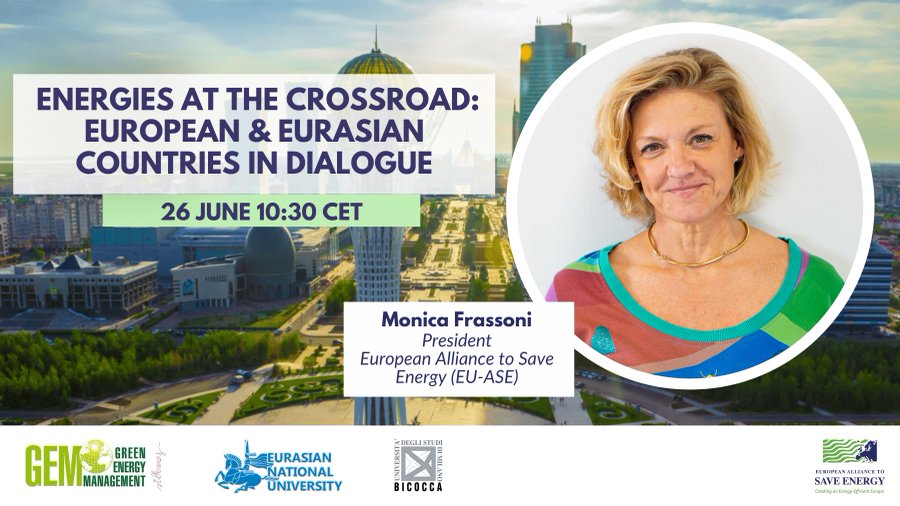
EU-ASE at Energies at the crossroad: EU and Eurasian Countries in Dialogue

On Monday 26 June 2023, EU-ASE President Monica Frassoni spoke at “Energies at the crossroad: EU and Eurasian Countries in Dialogue.”

Organised by Green Energy Management (GEM) – Silkway Summer School, the event aimed to draw reflections on the energy transition, which is a topic of public concern that affects cultures and societies at the global level.

The aim of GEM-SILKWAY CENTRA ASIA is to adopt a cross-cultural perspective in analysing the meaning of concepts like sustainability and human development.

EU-ASE President Monica Frassoni discussed the green transition and energy efficiency legislation in the EU.

View the full programme here.

Find more information about the event here.


Follow us


Privacy Policy

© All right reserved

EU-ASE at EUSEW 2023: The role of competitive clean energy technologies to implement climate targets for 2030.

On Thursday 22 June 2023, EU-ASE President Monica Frassoni spoke at the European Sustainable Energy Week 2023 (EUSEW) event titled “The role of competitive clean energy technologies to implement climate targets for 2030”.

Discussion revolved around the significance of energy efficiency for the EU`s climate goals, industrial and economic competitiveness and resilience to polycrises.

Monica stated: “The proposal for a Net-Zero Industry Act, unfortunately, has a very insufficient attention to Energy Efficiency First principle and the need to reduce energy demand.”

Find more information about EUSEW here.


Follow us


Privacy Policy

© All right reserved

EU-ASE at High Sustainability – Goals for sustainable development in the new world disorder

On Monday 19 June 2023, EU-ASE President Monica Frassoni spoke at Radio Radicle’s podcast: “High Sustainability – Goals for sustainable development in the new world disorder”.

The episode titled “High Sustainability – Goals for Sustainable Development in the New World Disorder” was hosted by Valeria Manieri and included the following speakers:

  • Michele Governatori (Head of Power & Gas at ECCO)
  • Ilaria Bertini (Director of ENEA National Agency for Energy Efficiency)
  • Monica Frassoni (President of the European Alliance to Save Energy)

The topics of discussion included: Environment, Car, Home, China, Climate, Competition, Consumption, Ecology, Economy, Building, Electricity, Energy, Renewable Sources, Photovoltaic, Gas, Globalization, War, Business, Industry, Pollution, Investment, Italy, Market, Saving, Russia, Health, Sustainability, Development, Technology, Ukraine, European Union.

The video recording of this episode is available here.


Follow us


Privacy Policy

© All right reserved