
EU-ASE featured in Energy Efficiency Magazine 2020 – EE and Economic Recovery
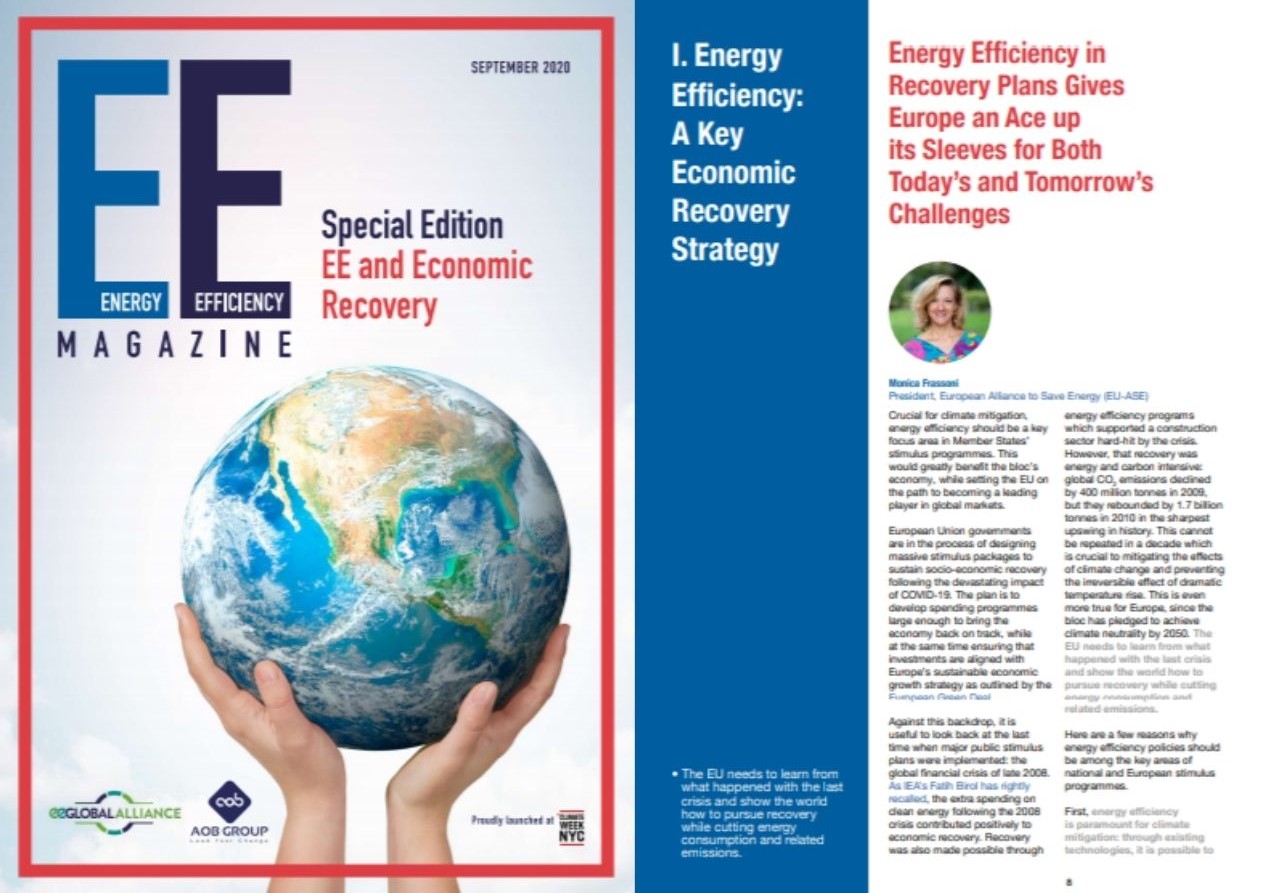
Energy Efficiency in Recovery Plans gives Europe an ace up its sleeves for both today’s and tomorrow’s challenges

by Monica Frassoni, President of the European Alliance to Save Energy (EU-ASE)

Crucial for climate mitigation, energy efficiency should be a key focus area in Member States’ stimulus programmes. This would greatly benefit the bloc’s economy, while setting the EU on the path to becoming a leading player in global markets.

European Union governments are in the process of designing massive stimulus packages to sustain socio-economic recovery following the devastating impact of COVID-19. The plan is to develop spending programmes large enough to bring the economy back on track, while at the same time ensuring that investments are aligned with Europe’s sustainable economic growth strategy as outlined by the European Green Deal.

Against this backdrop, it is useful to look back at the last time when major public stimulus plans were implemented: the global financial crisis of late 2008. As IEA’s Fatih Birol has rightly recalled, the extra spending on clean energy following the 2008 crisis contributed positively to economic recovery. Recovery was also made possible through energy efficiency programs which supported a construction sector hard-hit by the crisis. However, that recovery was energy and carbon intensive: global CO2 emissions declined by 400 million tonnes in 2009, but they rebounded by 1.7 billion tonnes in 2010 in the sharpest upswing in history. This cannot be repeated in a decade which is crucial to mitigating the effects of climate change and preventing the irreversible effect of dramatic temperature rise. This is even more true for Europe, since the bloc has pledged to achieve climate neutrality by 2050. The EU needs to learn from what happened with the last crisis and show the world how to pursue recovery while cutting energy consumption and related emissions.

Here are a few reasons why energy efficiency policies should be among the key areas of national and European stimulus programmes.

First, energy efficiency is paramount for climate mitigation: through existing technologies, it is possible to reduce energy consumption, increase the efficiency of the entire energy system and accelerate the integration of renewables. According to the IEA, 76% of the European greenhouse gas emission reductions required to keep temperature increases below 1.5°C must come from energy efficiency.

Secondly, from an industrial point of view, energy efficiency has great added value as its value chain is deeply European. In fact, Europe hosts some of the most innovative and successful energy efficiency companies in the world. The members of the European Alliance to Save Energy are global “champions” that export technologies and drive innovation. Hundreds of other players, especially small and medium-size enterprises (SMEs), also operate in this field locally across the continent.

Investing in energy efficiency also means investing in European innovation, especially when it comes to the construction sector. According to data from the European Patent Office, green construction-related patent filings have tripled in a little over a decade. These include technologies for energy-efficient insulation, “green” lighting, and incorporating renewable energies in buildings.

If Europe develops a technological leadership in energy efficiency, it will have a strong competitive advantage helping with access to global markets. Indeed, innovations developed in Europe and investments in more efficient and ecologically friendly buildings will pay back quickly with dividends and millions of well-paying, local jobs.

This explains why energy efficiency is a ‘must have’ in government stimulus programmes. EU Heads of State and Government have agreed to provide the Union with the necessary means to address the challenges posed by the COVID-19 pandemic and decided to mobilize 750 billion EUR to be committed by end of 2023. Member States should seize this opportunity and invest without hesitation in efficiency projects at national and local levels.

While the 30% climate target for the expenditure of these resources is a step in the right direction, EU governments should agree on clearer rules and stringent green conditionalities for qualitative use of recovery funds. Additionally, resources should be earmarked for investments in sectors with high potential, like construction.

It is time for Member States to fully implement the energy efficiency first principle to avoid new costly energy infrastructure that would jeopardise EU efforts to reach climate neutrality by 2050. Finally, Members should modernize their economies to increase resilience and tackle climate change impacts without delay

This would bring great economic and social benefits in the short term and contribute to protecting the environment in the long term.


About the magazine

The EE Magazine promotes energy efficiency by compiling short articles from renowned international energy experts, showcasing the latest innovations and achievements in this sector.

This year special edition, which focuses on the role of energy efficiency in COVID-19 economic stimulus programs, as well as the climate benefits of efficiency, was launched by the EE Global Alliance (EEGA) during a Climate Week NYC webinar organised by the Alliance to Save Energy and the Business Council for Sustainable Development.

Access the full EE Magazine Special Edition on EE and Economic Recovery

View a recording of the launch webinar here.

Follow us


Privacy Policy

© All right reserved

The great potential of non-residential buildings and how to tap into it

Decarbonising non-residential buildings is crucial to meet Europe’s carbon neutrality goal by 2050. To do so, and in view of the upcoming Renovation Wave, Member States should focus on the ambitious implementation of the EPBD and produce renovation strategies targeted also to this sector.

There are many reasons why making also non-residential buildings energy efficient should be among the priorities for the European Union and its Member States. The share of non-residential buildings in the total EU building stock is just 25%, but they require in average 55% more energy than residential buildings. Take Germany, for example, non-residential buildings (excluding industry and trade) are the smallest group in terms of numbers, at around 2.7 million units. However, due to their larger area per building they represent the second largest group in terms of building energy consumption (36%).

Decarbonising non-residential buildings is advantageous because, due to their nature, ownership structure and the high energy demand schools, hospitals and offices are ideally suited to help shape important paths for a future-oriented energy system based on energy efficiency, digitalisation, and an increasing role of “prosumers”.

Indeed, in 90% of cases, the energy efficiency potential of those buildings can be realized economically within their life cycle. The technologies required for this have been available for a long time and are constantly being enhanced by the industry. These include systems for energy-efficient management of indoor air quality, thermal comfort, integration of renewable energies, electromobility, as well as for workplace management. 

In addition to the energy-efficient renovation of the building envelop, investments in building automation technologies offer savings in energy and cost of around 30%, with payback periods between 6 months and 3 years. 

To achieve these figures, all technical systems in a non-residential building should be coordinated to go beyond their individual functions in order to optimize the energy productivity. This can be done through the harmonization of demand and supply energy flows, and the proactive management of thermal and electrical storage. Doing so would enable the integration of renewables even on a small scale as well as the application of various demand side management strategies.

In this perspective, a coherent modernization and digitalisation of the energy infrastructure of non-residential buildings will support the transformation of the energy system and the active implementation of the EU’s climate protection policy. The advancing digitalisation in the building sector will be the determining pathfinder for more energy efficiency in the future and will pave the way for grid-interactive efficient intelligent buildings. 

Smart buildings integrate technology and equipment to proactively predict faults, monitor performance in real time, and provide predictive insights regarding building systems and facilities, including power management, energy usage, and occupant comfort.

The revised EPBD set out a clear path towards achieving a stock of low and zero-emission buildings in the Union by 2050. This path is based on national roadmaps with intermediate targets and progress indicators, with public and private funding and investment. An ambitious EPBD implementation and financially sound renovation strategies for non-residential buildings are needed to kick-start the Renovation Wave. 

In this context, buildings should no longer be considered as pure energy consumers but as active players and dynamic assets in the future, climate-neutral energy system.


This article was written by Bonnie Brook, Vice-chair of the Board of the European Alliance to Save Energy and Senior Manager Industry Affairs at Siemens, and Volker Dragon, Senior Manager Industry Affairs at Siemens.

Follow us


Privacy Policy

© All right reserved

Recover Europe? Renovate buildings!

by Peter Robl, Public Affairs Manager Eastern Europe at Knauf Insulation & Martin Hojsík, Member of the European Parliament

This op-ed was published on CEEnergyNews


Building renovation needs the EU’s support and will help recover the economy in return. European leaders need to deliver efficient incentives soon.

Building renovation is a key element of achieving Europe’s 2030 and 2050 decarbonisation targets. The COVID-19 related quarantine and the current summer heatwaves across Europe have underlined the importance of quality and energy-efficient buildings to deliver safe and healthy housing and workplaces. Europe needs to increase the generally low renovation rate, yet the economic impacts of the COVID-19 crisis will further push the rate down.

The slowdown in renovation activity will result from a decline in investor confidence. Who would not delay insulation of their home by a year or two, when they had lived without insulation for the last ten? Who would provide a loan for renovation if repayments are not secured?

Construction output tends to suffer from economic hick-ups longer and harder than the rest of the economy. After the crisis in 2008, GDP and industrial production returned to growth as early as 2010 in many countries, while construction output continued to fall year after year until 2014 (as illustrated by the Slovak case – see chart below).


European leaders have the power to help economic recovery, decarbonisation and housing quality of EU citizens at the same time. Delivering efficient incentive mechanisms aimed at building renovation and delivering them soon is required.

They have plenty of opportunities. Many countries struggle to manage spending from the current cohesion programs (2014 – 2020) in a number of areas. Re-allocating the funds to building renovation programs where demand is high is a sensible solution and an alternative to leaving the money on the ground. Swift finalisation of the MFF discussions will enable Member States to seal Partnership Agreements and launch new Cohesion funding (2021 – 2027) without much delay. The Next Generation EU fund intends to help Europe with green and digital transitions and should, therefore, include programs aimed at building renovation.

Lessons learned from previous periods need to be taken on board to ensure good results. Visegrad experts have pulled their 15 recommendations on more efficient use of the 2021-27 Cohesion Funds that apply to any other EU or national funding, too. Experts call, among other things, for a better reflection between allocation and investment need. They also say that “more developed regions” need access to the funding, too – building owners, both public and private, need to be motivated to perform a renovation and to perform it with higher ambition and quality, regardless of how developed their region is. Moreover, they suggest excluding renovation from state aid rules and streamlining public procurement to a lean and effective process as this would increase the renovation uptake.

But are the Central and Eastern European Member States actually ready to deliver building renovation? In fact, and contrary to their climate policy attitudes, they are. Just a few examples. Romania is just about to launch subsidy programs for both single-family homes and public buildings. Bulgaria has a successful track record with a program for a multi-apartment building renovation that is now on hold due to budget issues. In Slovakia, renovation projects of municipal buildings worth more than 100 million euros are ready as they have applied but not received subsidies from an EU Fund program. Poland is starting a Clean Air Program aimed to combat air pollution. The Czech Republic has a positive experience with their New Green Savings, a program delivering quality renovation of 8,000 single-family homes a year. Croatia seeking funding for multi-apartment and public building renovation programs, as well as for buildings in Zagreb damaged by the March 2020 earthquake.

Supporting the quality renovation of buildings delivers several benefits. It goes directly to builders, the citizens. Not only does it control the damage to the decline of construction output, but also helps recover the economy. It turns private savings into investments and economic activity. It triggers domestic demand that is catered to by small local construction companies across all regions of Europe evenly. Therefore, renovating buildings is a key tool to support the EU’s socio-economic recovery after this crisis, and leaders and governments should act to make this happen.


Follow us


Privacy Policy

© All right reserved

EUSEW 2020 blog | Renovation Wave: the immediate and powerful recovery button at the fingertips of EU policymakers

by Bertrand Deprez, Vice President EU Government Affairs at Schneider Electric & Céline Carré, Head of European Public Affairs at Saint Gobain, members of the European Alliance to Save Energy (EU-ASE)

This article was published in the blog of the EU Sustainable Energy Week 2020


There is one clear reboot button at the fingertips of European policy-makers, the label underneath carries the tag ‘Renovation Wave’. Rather than causing a re-start, bringing back an older configuration, pressing this button would put Europe on a new path to sustainable growth, with its citizens at the heart.

The European Union should therefore set aside any hesitation and reply with a straight ‘Yes’ to the question ‘Are you sure?’ that we usually get when rebooting our devices. ‘Yes’, because with 36% of CO2 emissions and 40% of energy consumption, buildings represent a major potential for Europe’s climate neutrality pathway. ‘Yes’, as fuelling renovation activities across Europe will translate into an immediate economic stimulus for the whole construction value chain, the biggest industrial employer in Europe. ‘Yes’, because the Renovation Wave will deliver comfortable and smart buildings that our citizens desire. Finally, ‘Yes’, as it will significantly contribute to the EU’s climate and energy targets and help to restore social cohesion in societies affected by the crisis.

Alongside the first push, political willingness will still be needed to give this wave the right shape and reap its promised benefits:

  • Firstly, the overarching goal: a clear strategy built on the long term goal of reaching a net zero-carbon building stock by 2050, should act as a catalyst to coordinate the efforts of the value chain and reach sufficient depth of renovation. Decarbonizing the existing stock will only happen with the right combination of making our buildings ultra-efficient (based on energy efficiency first) and relying on local renewable generation.
  • Secondly, the rate of renovation: political impetus such as the use of trigger points, minimum energy performance standards and the phase out of the worst performing buildings should be deployed to bring the renovation rate across Europe to 3% per year.
  • Thirdly, the scalability, which will come from simple and stable renovation programmes and related financing, e.g. via the setting of a dedicated Renovation Fund for All Europeans, stable tax incentives for renovation and leveraging of private finance. At the same time, there is a need to make full use of the potential of digitalization to improve buildings’ design and optimize their performance. It is time to tailor such initiatives in a segment-specific approach, encompassing both building renovation and retrofit of the technical building systems. With the current COVID-19 outbreak, Europe should seize the opportunity to renovate the less occupied public and non-residential buildings as well as homes. Citizens who spend more time indoors want to enjoy comfortable and healthy spaces.

A high impact renovation wave will be the key to creating hundreds of thousands of jobs across the continent. Research, innovation, industries: Europe already has all the ingredients to power this motor for the recovery. It just needs to press that button.


Follow us


Privacy Policy

© All right reserved

EUSEW 2020 blog | Smart and the city: energy efficiency and sector integration for a #carbonneutralEU

by Julie Kjestrup, Interim Head of Group Public Affairs and Sustainability at Danfoss and Board Member of the European Alliance to Save Energy.

This article was published in the blog of the EU Sustainable Energy Week 2020


In the next few years, policy makers will have to rethink urban planning and market designs. For the cities of tomorrow to be sustainable, sector integration and energy efficiency must be at the heart of the policy framework.

The COVID-19 pandemic has increased the urgency of a Green Deal framework that delivers, to ensure that we do not go back to where we were but forward to where we want to be: to a sustainable society, protecting our climate and creating future-proof jobs and growth.

Leveraging urban efficiency is essential to getting there. Cities provide unique opportunities for energy and resource efficiency, using synergies between the elements of the urban energy system. This makes them ideal frontrunners to showcase new technologies and create attractive, future-proof places to live and work.

The key is to be smart in the way we use our (future) energy: this means smart about how much energy we consume in the first place. In other words: energy efficiency first. Capturing the full potential of energy efficiency will allow a faster roll-out of renewables and lead us on the most cost-efficient path to carbon neutrality. In fact, recent research from Denmark shows that the extra costs for reaching Denmark’s new and ambitious 70% CO2 reduction by 2030-target can be significantly reduced by investing in existing energy efficiency technology in buildings and industries.

It also means smart about how we use, re-use and store our energy: through interconnections, integration and managing demand and supply in an efficient way we can stabilise our grid. We can use the excess heat from a nearby factory, data centre or supermarket to warm or cool houses, or to charge an electric vehicle. By creating synergies between sectors like buildings, industry, power generators and transport, sector integration is integral to reach decarbonisation.

According to a forthcoming research from Navigant, implementation of existing technology solutions for sector integration, energy efficient heating and cooling of buildings and electrified transport can bridge about half of the gap needed to reach the 1.5°C target in urban areas. At the same time, these reductions will contribute with more than one-third of total needed national emissions reductions in Europe. It can also save money. The Heat Roadmap Europe studies show that utilising energy system synergies and exploiting energy efficiency can save Europe 13% of primary energy use and reduce total energy-system costs by approximately 70 billion euros per year compared to other decarbonisation scenarios.

The future is here already: EnergyLab Nordhavn is an important part of Copenhagen’s overall goal of being climate neutral by 2025. A ‘living lab’ on efficient and smart sector integration, it will house 40,000 residents and 40,000 workplaces when done. Going forward, projects like this must become norm, and that means integrating our own thinking in terms of levers of the future energy policy framework.

The Green Deal framework enables that by putting a holistic vision forward that can create a more resilient, efficient and consumer-based system, and add jobs and growth along the way. To make this happen, policy makers will have to rethink urban planning and market designs. For the cities of tomorrow to be sustainable, sector integration must sit at the heart of the policy framework.

Additional information:

https://www.danfoss.com/en/about-danfoss/insights-for-tomorrow/energy-efficiency/

https://www.danfoss.com/en/about-danfoss/insights-for-tomorrow/district-energy/

Follow us


Privacy Policy

© All right reserved