The need for speed | EUSEW 2021

by Harry Verhaar Head of Global Public & Government Affairs and Chairman of the board of the European Alliance to Save Energy.

In this climate-critical decade, Europe is faced with the extraordinary task of drastically improving our environmental impact, while also repairing economies left shaken by the effects of COVID-19. Now is not the time to split our priorities: the actions we take to mitigate climate change and those we take to accelerate economic recovery must work both in harmony and at pace.

Both effectively and economically, energy efficiency improvements are the best strategy at our disposal for a swift reduction in carbon emissions. With buildings accounting for 40% of energy consumed and 36% of energy-related greenhouse gas (GHG) emissions, the European Commission’s Renovation Wave strategy gives us an excellent foundation on which to start.

Everything that can be done to improve the footprint of our buildings, should be done: insulation, modern heating, ventilation, and air conditioning (HVAC) technology, and digital solutions like building management systems that can monitor and optimise energy expenditure. Among these key improvements, we should not forget one of the quickest wins: lighting. Two-thirds of installed lighting is legacy technology, with 1.3 billion conventional light points across Europe that could be switched to LED. Through this alone, the EU could save around EUR 40 billion and eliminate 100 million tonnes of CO2 emissions a year. This quick, simple, and low-cost intervention comes with relatively little disruption to the building’s occupiers, and the payback is fast.

Increasing renovation rate and depth will positively impact economic growth, investments, innovation and competitiveness, and lead to a reduced reliance on fossil fuels, in turn improving Europe’s energy security. And economically, the impact of building renovation will most benefit the local SMEs who make up more than 90% of companies in the building sector. Accelerated activity on this level creates jobs for those with displaced incomes due to the global pandemic.

Read the full article on the EUSEW 2021 blog

Follow us


Privacy Policy

© All right reserved

Carbon pricing and buildings: A new trigger for the Renovation Wave?

Buildings are responsible for around 40% of CO2 emissions in the EU. To decarbonise this sector, the European Commission is considering introducing a carbon price. The workshop looked into the opportunities and challenges of a carbon pricing for buildings, starting from the lessons of Germany as a first mover in Europe.  

According to the Renovation Wave Communication, to achieve the 55% GHG emissions reduction target by 2030, the EU should reduce buildings’ greenhouse gas emissions by 60%. This can only be achieved by at least doubling the renovation rate as soon as possible. In addition to a substantial revision of the Energy Performance of Buildings Directive (EPBD), the European Commission is considering to include in its upcoming “Fit for 55” package a proposal to cover sectors such as buildings and road transport by an emissions trading scheme. However, the particularities of the building sector, such as the low price-elasticity of energy demand, the ownership structure of buildings and the split incentives dilemma, would require caution and a thorough assessment of the consequences of introducing such policy.

What should be the contribution of a carbon price in the policy mix for a decarbonised building sector? Can it trigger a Renovation Wave and a switch to fully-renewable heating? What needs to be kept in mind when designing a new carbon pricing scheme for buildings?

This workshop, co-organised with the the German Business Initiative for Energy Efficiency (DENEFF), dived into the subject of carbon pricing in buildings by looking at lessons from Germany, where a recently launched carbon pricing scheme for buildings is hotly debated.


View the agenda
Watch the recording here
More about our considerations on carbon pricing


Follow us


Privacy Policy

© All right reserved

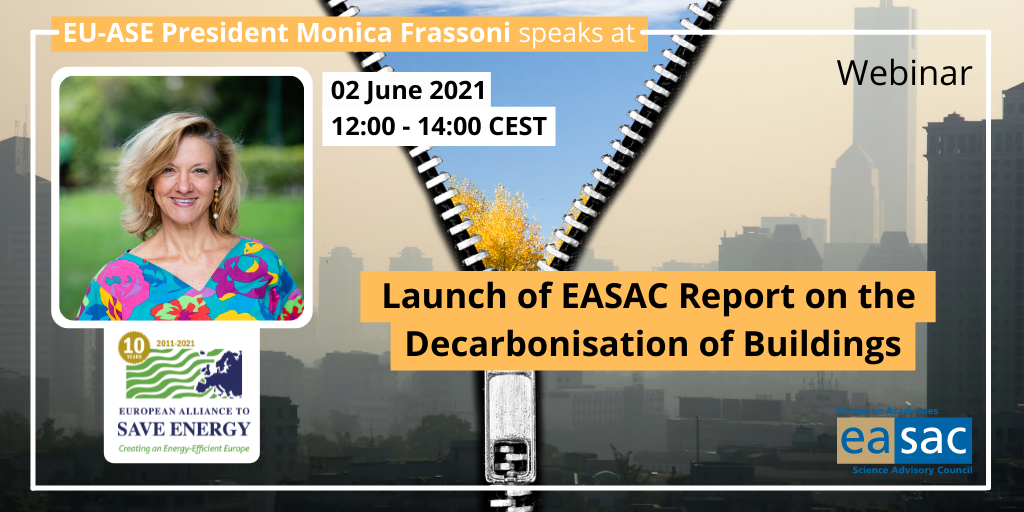
Monica Frassoni’s speech at launch of EASAC report “Decarbonisation of buildings for climate, health and jobs”

On 2 June 2021, the president of the European Alliance to Save Energy Monica Frassoni participated in the panel discussion for the launch of the report “Decarbonisation of buildings: for climate, health and jobs” by the European Academies Science Advisory Council (EASAC). 

Here are some excerpts from her speech:

  • The holistic approach of the study is great. There is no silver bullet for the decarbonization of buildings. We need several approaches and to enhance the use of existing technologies There is no time to invest in uncertain technologies. Efficiency measures in industry, buildings, appliances and transport already exist and can be put into effect and scaled up very quickly.
  • Energy Efficiency is an existing and certain technology. Energy Efficiency, intended as reducing energy demand and optimising consumption, is recognized but we didn’t notice anywhere in the report the specific reference to make “Energy Efficiency First” principle (EE1) a pillar of the EU future energy system.
  • The EE1 is needed to get all the non-energy related benefits of decarbonizing buildings, to alleviate energy poverty, to correctly size the RES supply required to match buildings residual energy demand, to improve the flexibility of buildings and their capacity to store energy, to phase out fossil fuels and avoid stranded assets as well as increase our energy security); The EE1 is instrumental to energy system integration and finally the principle is a driver for energy, resource/material efficiency and full application of circularity principle.


Read the full excerpts

Follow us


Privacy Policy

© All right reserved

EU-ASE at launch of EASAC Report on the Decarbonisation of Buildings

On 2 June 2021, the president of the European Alliance to Save Energy Monica Frassoni participated in the panel discussion for the launch of the report “Decarbonisation of buildings: for climate, health and jobs” by the European Academies Science Advisory Council (EASAC). The webinar gathered policy-makers, researchers and stakeholders to discuss the main findings of the report, offering recommendations for the EU, Member States and local authorities to activate the wave of buildings renovations. 

Among the panelists were representatives of the European Commission and the European Parliament, as well as of the European Investment Bank, the Buildings Performance Institute Europe and Housing Europe.

Read experts of Monica’s speech at this event

Follow us


Privacy Policy

© All right reserved

Decarbonising the building and heating sectors: considerations on carbon pricing

Energy efficiency should be the starting point for all decarbonisation efforts. Carbon pricing can play a role in this, as it can provide incentives for the fuel switch and to some extent for energy efficiency investments. Yet, it should not replace impactful regulatory measures in the building sector driving the energy savings necessary to meet climate neutrality.


We believe carbon pricing in the building sector can only work effectively and efficiently if:

  • Its modalities are thoroughly assessed to gauge its potential benefits for the building sector
  • It is part of a well-designed broader policy mix
  • It includes a resilient mechanism for reinvesting its revenues to prevent and reduce energy poverty


Read the full paper

More about our webinar on carbon pricing and buildings

Follow us


Privacy Policy

© All right reserved