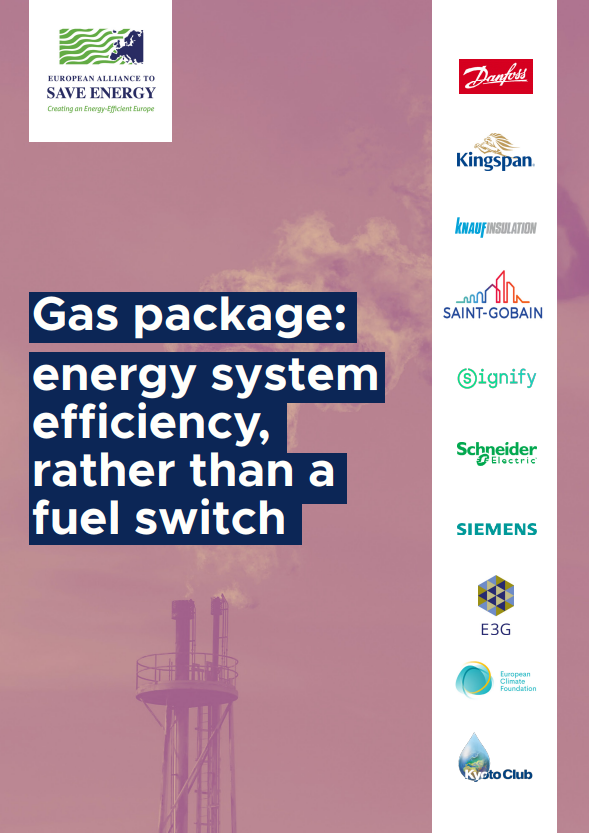
Gas package: energy system efficiency, rather than a fuel switch

In December 2021, the European Commission issued two proposals, the Gas Directive 2009/73/EC and the Gas Regulation (EC) No 715/2009, laying down the foundation for a European low-carbon gas industry, the so-called “Gas Package”. The Commission’s approach should depart from this old paradigm and uphold the commitment to the Energy Efficiency First Principle (EE1st) to avoid possible stranded assets.

Although urgent action is needed, the proposal focuses exclusively on source diversification. It misses the opportunity to implement the Energy Efficiency First (EE1) principle at the system level and fails to consider the broad socio-economic benefits of energy efficiency and system efficiency.

In current times energy efficiency should be more of a priority than ever, which is being increasingly reflected in the EU’s response to rid Europe of Russian gas imports. The old paradigm needs to be updated accordingly.

The paper highlights gaps and suggests improvements pertaining the following axes:

1. Need for speed
2. Hydrogen for harder-to-abate sectors
3. Benefits of energy efficiency
4. Gas Package and Fit for 55
5. Infrastructure and governance: prioritize climate
6. Conclusion: go beyond 1-1 fuel switch and think energy efficient

Read the full paper here


Follow us


Privacy Policy

© All right reserved

It’s time to act to address Europe’s buildings issue

As we are drifting towards winter, I am struck by the gap between the urgency to protect European citizens from the consequences of poorly performing homes, and the reluctance of our leaders to decisively act on it. We are witnessing intense debates on the energy efficiency files under the Fit for 55 Package, and this is not nearly the end of it.

Asking citizens to adapt their behavior to mitigate the risk of gas shortages and subsidizing their bills seem to be the only political answer. Yet, we all know that solutions addressing only the symptoms will not help in the long run.

The solution to the cause is the EU Renovation Wave, however we cannot overlook the challenges to this. We need an additional 275 billion euros to finance it (1), and the acceleration of the rate and depth of renovation calls for coordination and new business models.

We have been sleepwalking on the issue for too long, hypnotized by cheap fossil energy hiding the leaks and waste of our buildings. It is not too late to change that.

It is our responsibility to help politicians join the dots between short- and long-term concerns. The equivalent of 1,7% of EU GDP was spent to mitigate the impact of the energy crisis so far (2). By contrast, financing the Renovation Wave would represent 1,5% of the GDP. Add to that jobs, health and productivity benefits, and a boost to our climate agenda.

It is also our responsibility to explain what renovation market actors need to be able to invest, train, and innovate. Building owners, manufacturers, banks, real estate and building professionals need visibility. This visibility is at the heart of the MEPS (Minimum Energy Performance Standards) proposal, a true renovation accelerator.

The best energy will always be the energy we do not need, thanks to the efficiency of our buildings.

We can help make this a reality.

by Céline Carré
Head of Public Affairs
Saint-Gobain

Sources:
1. Question 5 in FAQ on the Renovation Wave: https://ec.europa.eu/commission/presscorner/detail/en/qanda_20_1836
2.  Bruegel, 21/09/2022 and Europe’s Deepening Energy Crisis Pushes Bill to $500 Billion

Follow us


Privacy Policy

© All right reserved

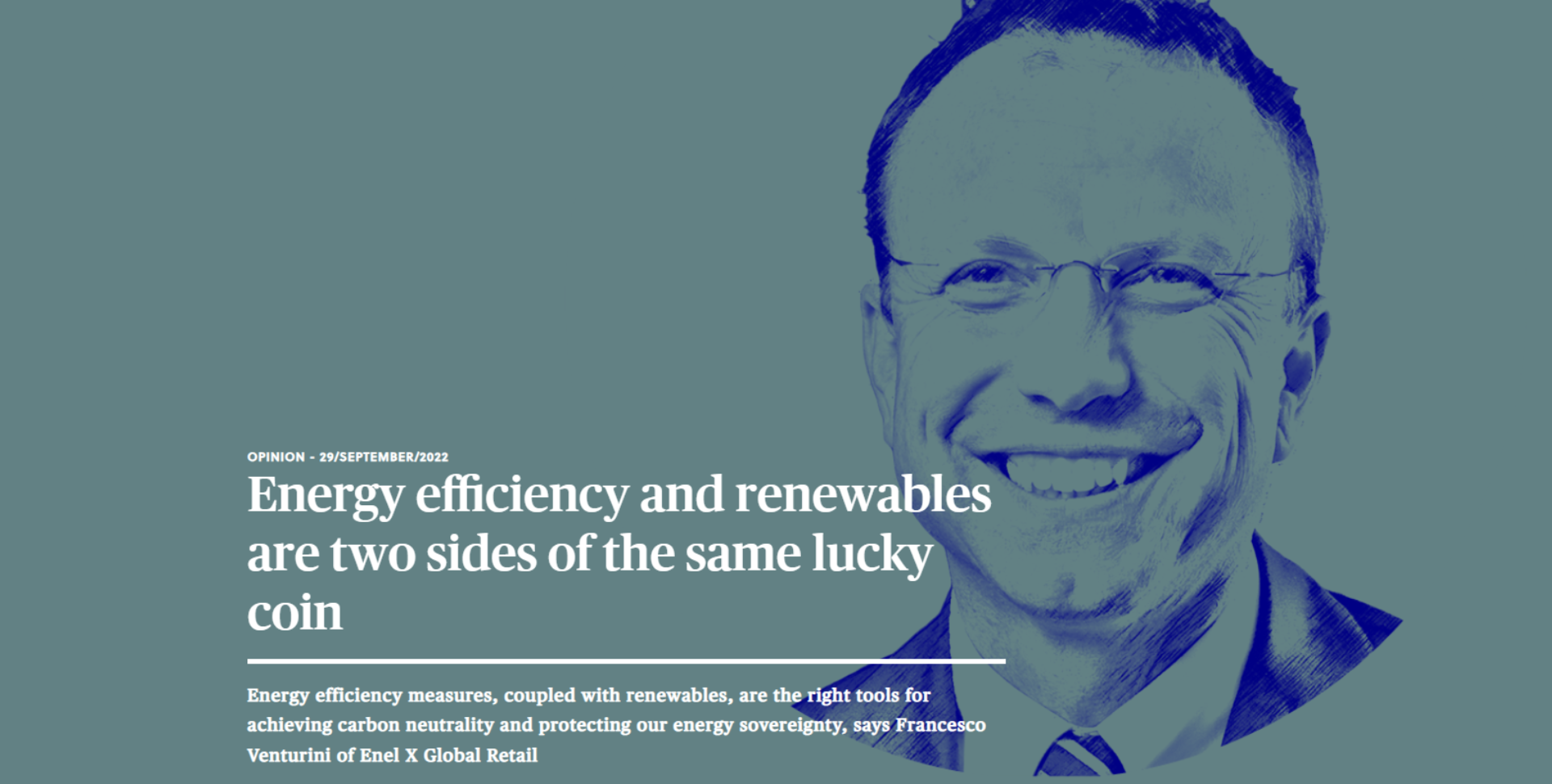
Energy Efficiency and renewables are two sides of the same lucky coin

Energy efficiency measures, coupled with renewables, are the right tools for achieving carbon neutrality and protecting our energy sovereignty, says Francesco Venturini of Enel X Global Retail ahead of the first edition of the European Energy Efficiency Day.


Citizens, businesses and local governments must join forces to equip themselves with facilities for the production and self-consumption of energy from renewable sources by promoting virtuous behaviours.

Today, market transformation is happening in a very disruptive way. The historical events of the past six months demand an impressive acceleration of the trajectory outlined by the European Green Deal in 2019. Looking back at the past eight years, global investments in clean energies have blossomed to $371 billion, an increase of approximately $60 billion compared to 2014 levels.

Is there enough to go around? The answer for most of us is simple: no.

The Ukraine conflict and its consequent war on prices are proving that our society does not have access to abundant, reliable, cheap and clean energy—placing its economic and social progress at stake. 

But we still have a lucky coin in our pocket: energy efficiency measures can substantially reduce Europe’s carbon footprint if combined with consistent investments in renewable energy.

Read the full article here

More information on European Energy Efficiency Day here & Register here.

Follow us


Privacy Policy

© All right reserved

A battle for the climate inside buildings

Amidst the climate and energy crisis, Europe’s ageing building stock provides a challenge—and an opportunity, says Julie Kjestrup of the VELUX Group ahead of the first edition of the European Energy Efficiency Day.

There are more benefits to energy efficiency measures than simply saving money. Climate change is happening rapidly and so are the consequences of not fighting it adequately, intentionally and consistently. Despite scientists showing us the marked impact of climate change as well as what we need to do to mitigate it, we are not currently on the right path towards meeting the Paris Agreement and the EU’s 2050 climate neutrality goal. Add to that the recent hike in energy prices and fast action is essential. We can still get on track if we all play our part by taking responsibility and acting now. 


Read the full article here

More information on Energy Efficiency Day here & Register here.

Follow us


Privacy Policy

© All right reserved

EU-ASE welcomes the adoption of the Parliament’s position to revise the Energy Efficiency Directive

Earlier today, the European Parliament adopted the report revising the Energy Efficiency Directive (EED), one of the key legislative files of the “Fit for 55” package. Members of the European Parliament (overwhelmingly) supported the agreement found in the ITRE committee earlier on 13 July and rejected all plenary amendments that would have undermined the agreement.

The European Parliament decided to strengthen most of the European Commission’s proposal to revise the Directive. Most importantly, it sets a 2030 binding energy efficiency target of at least 40% in final energy consumption and 42.5% in primary energy consumption, based on the 2007 Reference Scenario. 1 While this is a much higher target than the one proposed in the Commission’s REPowerEU plan, it is still lower than today’s technical and economic potential for energy savings, especially considering today’s energy price crisis. 

“We welcome the work done by the Parliament to improve the proposal of the Commission; these improvements open the way to a more ambitious mandate in view of the difficult negotiations with the Council, whose common position is well below what is needed for an effective revision of the EED,” said Monica Frassoni, President of EU-ASE. “We are still missing a real sense of urgency and of the exceptional actions and resources needed to implement the Energy Efficiency First principle. This is proven by the fact that energy efficiency was barely mentioned from President Von Der Leyen’s address to the Parliament in her SOTEU speech.”

Therefore, we call on the EU institutions to seize this historic opportunity and to swiftly enter interinstitutional negotiations to reach a final agreement that puts energy efficiency first. To address the climate and energy crisis, the EU can count on energy efficiency measures that are made in Europe, easy to implement and can cost-effectively phase out the EU’s need for Russian fossil fuels.

Check our catalogue with all measures here.

Read the full press release here.


Media contact:
Antoan Montignier
+32 499 84 97 28
antoan.montignier@euase.eu

About us
The European Alliance to Save Energy (EU-ASE) is a cross-sectoral, business-led organisation that ensures that the voice of energy efficiency is heard across Europe. EU-ASE members have operations across the 27 Member States of the European Union, employ over 340.000 people in Europe and have an aggregated annual turnover of €115 billion.

Follow us


Privacy Policy

© All right reserved