
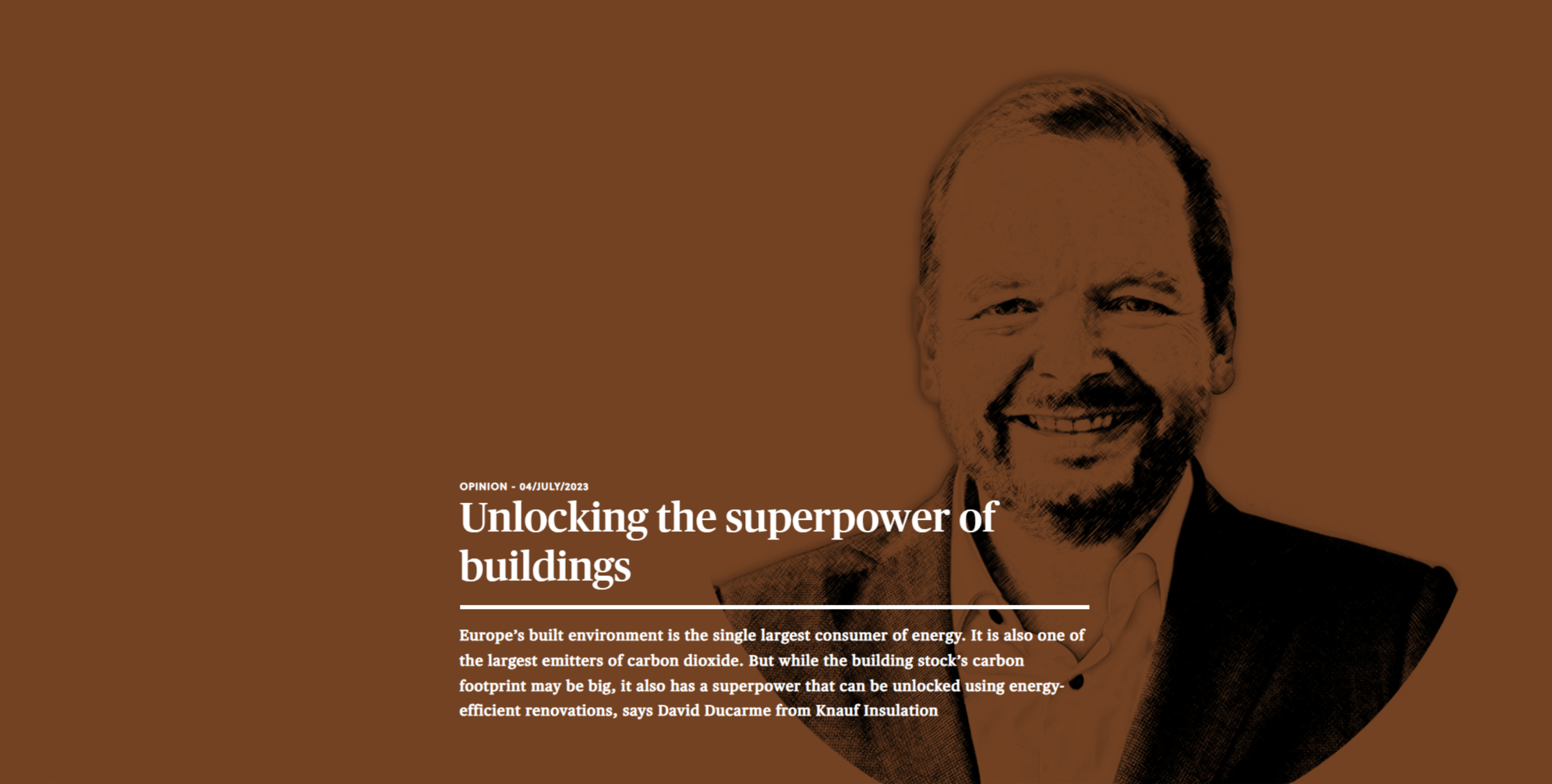
“The relatively simple act of renovating residential homes with proper insulation would result in a 44% reduction in the amount of natural gas used for heating. This is not only a substantial decrease in energy consumption, it is also a big decrease in associated carbon emissions — This is the superpower of buildings” says David Ducarme of Knauf Insulation in Foresight Climate & Energy, ahead of the second edition of European Energy Efficiency Day.
Europe’s built environment is the single largest consumer of energy. It is also one of the largest emitters of carbon dioxide (CO2). But while the building stock’s carbon footprint may be big, it also has a superpower that can be unlocked using energy-efficient renovations.
For energy efficiency to be more than an after thought, it needs to be viewed as another element in the power mix. According to calculations by the Buildings Performance Institute of Europe (BPIE), the relatively simple act of renovating residential homes with proper insulation would result in a 44% reduction in the amount of natural gas used for heating.
This is not only a substantial decrease in energy consumption, it is also a big decrease in associated carbon emissions—a decrease that would help put Europe on track to becoming the world’s first climate-neutral continent.
This is the superpower of buildings.
But unlocking this power requires policies that deliver energy efficiency, which is why the revision of the Energy Performance of Buildings Directive (EPBD) could not be timelier.
Read the full article on Foresight Climate & Energy.
More information on Energy Efficiency Day here & Register here.