Short to mid-term measures in energy efficiency to reduce gas consumption in Europe
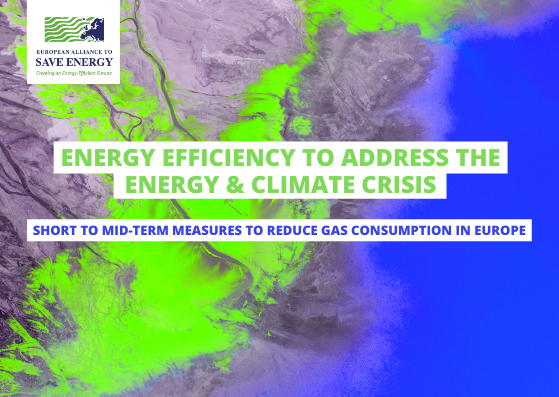
The European Union is set to reduce fossil gas imports from Russia by 2/3 by the end of 2022 and to become independent from all Russian fossil fuels well before 2030. This paper summarises the outstanding contributions that energy efficiency can play in the short to mid-term to greatly reduce Europe’s reliance on fossil fuels.

The Russian invasion of Ukraine has exacerbated the energy price crisis which is negatively affecting European citizens and businesses, threatening Europe’s energy security. The over-reliance on fossil fuels and the most recent IPCC report issued in April 2022 are a wakeup call that energy efficiency has never been more necessary.  There is tremendous potential for reducing energy demand and optimise consumption across sectors, including buildings, industry, water utilities and transport. What matters most is that these energy savings can be realised with existing technologies and solutions made in Europe. 

This paper is a non-exhaustive catalogue of short and mid-term actions to invite policymakers at EU, national and local level to apply the Energy Efficiency First principle and prioritise active and passive energy saving measures that can deliver simultaneously short-term benefits to alleviate the energy price crisis and longer term, systemic changes to tackle the devastating impact of climate change.

Read the full catalogue of measures here
Consult our infographic here


Follow us


Privacy Policy

© All right reserved

State Aid: Response to the public consultation on the CEEAG revision

The European Green Deal target to reach climate neutrality by 2050 calls for unprecedented levels of public and private investments accompanied by deep reforms. In this context, well-designed State Aid schemes will be key to unlock investments and make the best use of public funds.

As part of the ongoing revision of the Climate, Energy and Environmental Aid Guidelines (CEEAG) and the General Block Exemption Regulation (GBER), the Commission pledged to set simpler, clearer, and easier-to-apply State Aid rules for Buildings renovation programmes, in particular in the residential and social sectors. Additionally, aid to energy efficiency investments was to be simplified and enhanced, as announced in the Sustainable Europe Investment Plan and in the European Green Deal Investment Plan.

The European Alliance to Save Energy is happy to provide its feedback on the revised CEEAG. Energy efficiency is the bedrock of a decarbonised EU energy system: energy efficiency gains are essential to achieve the increased GHG emission target reduction of 55% by 2030 and full decarbonisation by 2050. In its current form, the CEEAG insufficiently supports the uptake of energy efficient measures and exposes the EU to the risk of missing its GHG reduction target for 2030 and 2050.

EU-ASE calls on the European Commission to:

1.  Assess all measures against the Energy Efficiency First principle
2. Level the playing field in aid intensity for energy efficiency measures (CEEAG Annex 1 and Art 38 GBER)
3. Simplify the definition and methodology to determine cost eligibility (para. 125 and Art 38 GBER)
4. Provide clear guidance on current State Aid rules with a practical approach

Download the full response
Read more in our paper: Boosting energy efficiency through the revision of State Aid rules

Follow us


Privacy Policy

© All right reserved

Wide coalition of stakeholders spells out expectations on “Fit for 55” package

Ahead of the European Council’s discussion on 25 May about the new climate and energy legislation (so called Fit for 55 Package), EU-ASE joined with European businesses, investor groups, local and regional authorities and NGOs calling upon EU decision makers to ensure that the upgraded climate and energy legislation increases the EU’s climate ambition to the highest possible level.

Signed by 50 organisations, the joint letter highlights that “If the European Green Deal is the EU’s growth strategy, the new climate and energy legislation should be its engine”. Based on this principle, the letter calls upon the EU Heads of State to further step up the EU’s climate action by expanding the scope of the EU 2030 target. It also urges EU decision makers to strengthen the Emission Trading System and to maintain and increase nationally binding targets under the Effort Sharing Regulation (ESR) covering emissions from road transport, buildings and agriculture and waste.

Finally, the letter reminds the importance of increasing targets for renewable energy and energy efficiency in line with higher climate ambition and ensuring that they are binding, and concludes by highlighting the need to have full synergy between climate and energy legislation and other EU targets, policies and measures.

Stakeholders representing over 2.700 cities, 330 regions, investors with over €37tn in assets, more than 1.100 companies and 390 NGOs, emphasise the importance of creating synergy between the “Fit for 55” Package and national, local and regional EU funding opportunities in order to send a strong signal that EU funds will support the implementation of the EU’s enhanced climate objectives.


Read the full letter


Follow us


Privacy Policy

© All right reserved

Unique gathering of organisations call for more ambitious climate targets

Ahead of the European Council’s discussion on the ambition level of the new 2030 climate target, a unique gathering of businesses, investor groups, local and regional authorities and NGOs published a joint letter calling on the EU leaders to agree on the most ambitious target level.

Signed by the European Alliance to Save Energy (EU-ASE) and other 46 organisations, representing over 2.700 cities, 330 regions, €62 trillion in investment portfolio, more than 800 companies and 330 NGOs, the joint letter clearly expresses the desire of European stakeholders to have the EU’s 2030 climate target substantially increased. Building on the recent proposal from the European Commission, the signatories hope European Member States will improve what is proposed, and in particular call for decisive action to remove emissions through Nature Based Solutions to come on top of the needed strong emission reductions in other sectors.

The letter welcomes the Commission’s proposal to substantially increase the EU’s 2030 climate target and states that the Member States should agree on at least -55% while some civil society organisations supporting the letter are already calling for at least -65% emission reductions. European stakeholders encourage Member States to achieve increased climate target both by strong emission reductions as well as decisive action to remove emissions through Nature Based Solutions in line with the need to protect Europe’s biodiversity.

European cities, regions, businesses, investors, NGOs and local communities, underline that only ambitious climate action can avert the most dire future costs of climate change impacts and provide a unique societal and economic opportunity to achieve a socially just transition for all European regions.


Download the full letter here

Follow us


Privacy Policy

© All right reserved

European Parliament push for 60% climate target is good news also for businesses

The European Parliament voted to increase the EU emissions reduction target by 2030 to at least 60% as part of the EU Climate Law.

By doing so, the Parliament adopted a position that is more ambitious than the Commission’s 55% reduction proposal.

This is good news for the EU’s climate ambition and international leadership in a decade which will be crucial in the fight against climate change.

It is also good news for businesses. Indeed, a higher EU climate ambition provides investors and businesses with a clear direction and more certainty to plan their investments and strategic choices, that have to be directed towards the goal of climate neutrality by 2050.

Monica Frassoni, president of the European Alliance to Save Energy commented:

“This is a major step in the right direction to achieve the EU carbon neutrality goal and a green economic recovery. MEPs showed to EU leaders the level of ambition that is needed. The path to meet this target is clear: focusing on energy efficiency and renewables is the best way to go for the Union and its Member States. This should be reflected in all upcoming investments and funds, starting from the MFF and national Recovery and Resilience Plans.”

EU leaders will start discussing the EU 2030 climate target next week at a European Council. An EU-wide agreement on the new target is expected at the December European Council.


Contact

Matteo Guidi, Communication Officer
matteo.guidi@euase.eu
+32493372142

The European Alliance to Save Energy (EU-ASE) was established in December 2010 by some of Europe’s leading multinational companies. The Alliance creates a platform from which companies can ensure that the voice of energy efficiency is heard from across the business and political community. EU-ASE members have operations across the 27 Member States of the European Union, employ over 340.000 people in Europe and have an aggregated annual turnover of €115 billion.


Follow us


Privacy Policy

© All right reserved