
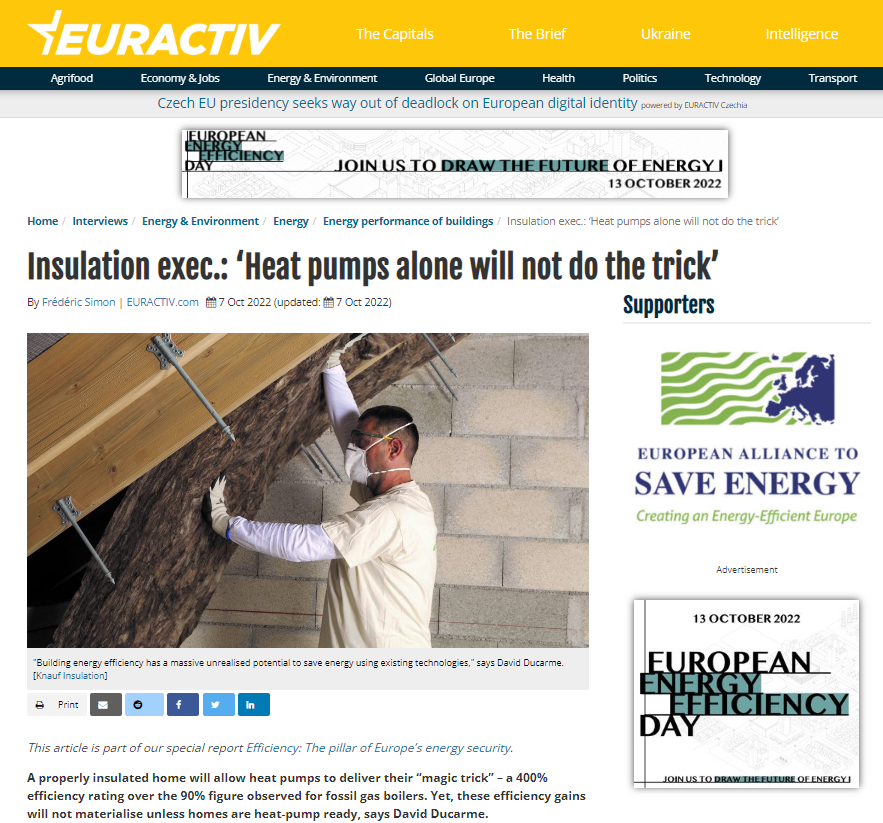
Energy efficiency has a huge role to play to deliver renewable energy to households whilst limiting costly investments into energy capacity for society, David Ducarme, Group chief operating officer at Knauf Insulation told Frédéric Simon of Euractiv.
A properly insulated home will allow heat pumps to deliver their “magic trick” – a 400% efficiency rating over the 90% figure observed for fossil gas boilers. Yet, these efficiency gains will not materialise unless homes are heat-pump ready, says David Ducarme.
Interview highlights:
- Long-term measures to reduce energy demand are essential to address the root causes of the energy crisis Europe is facing.
- Buildings remain Europe’s year-round weak spot in the energy transition. Drastically improving the energy performance of buildings envelopes would decrease by 45% the energy demand for heating and cooling from buildings.
- Heat pumps alone will not do the trick. A properly insulated home will allow heat pumps to deliver their “magic trick” – pulling four units of heat out of each kilowatt-hour (kWh) of electricity. Otherwise, they will not deliver as much.
- Heat pumps will also pose challenges to the electricity grid, with demand for electric heating set to increase by 356 Terawatt hours per year (TWh/y). Without insulation, the additional generation capacity needed to meet peak winter demand would need to be 2,129 TWh/year, almost five times more.
- The revised Energy Performance of Buildings Directive (EPBD) and Energy Efficiency Directive (EED) will be the backbone of resilient and decarbonised building stock.
- Long-term decarbonisation of the building stock also entails setting long-term trajectories on whole-life carbon reduction.