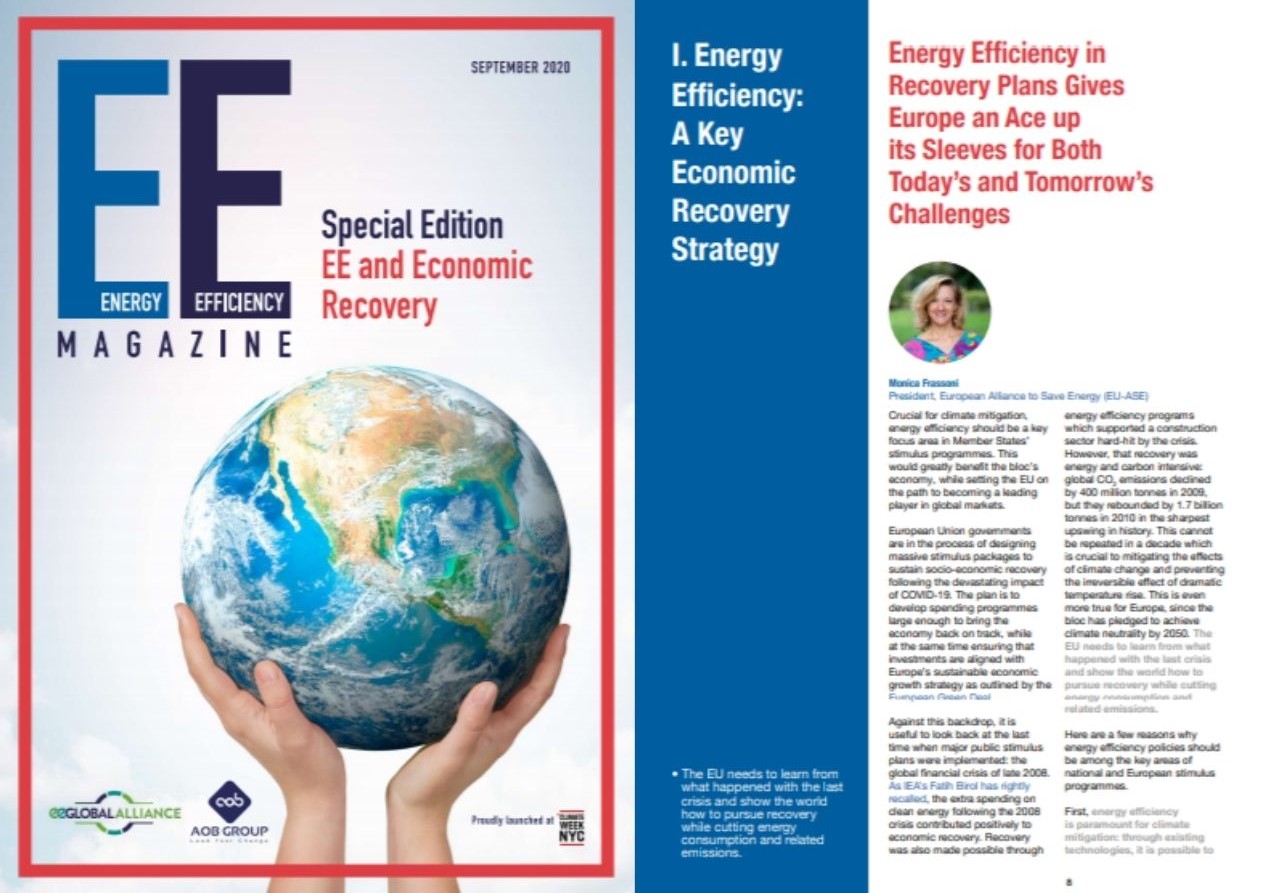
Energy Efficiency in Recovery Plans gives Europe an ace up its sleeves for both today’s and tomorrow’s challenges
by Monica Frassoni, President of the European Alliance to Save Energy (EU-ASE)
Crucial for climate mitigation, energy efficiency should be a key focus area in Member States’ stimulus programmes. This would greatly benefit the bloc’s economy, while setting the EU on the path to becoming a leading player in global markets.
European Union governments are in the process of designing massive stimulus packages to sustain socio-economic recovery following the devastating impact of COVID-19. The plan is to develop spending programmes large enough to bring the economy back on track, while at the same time ensuring that investments are aligned with Europe’s sustainable economic growth strategy as outlined by the European Green Deal.
Against this backdrop, it is useful to look back at the last time when major public stimulus plans were implemented: the global financial crisis of late 2008. As IEA’s Fatih Birol has rightly recalled, the extra spending on clean energy following the 2008 crisis contributed positively to economic recovery. Recovery was also made possible through energy efficiency programs which supported a construction sector hard-hit by the crisis. However, that recovery was energy and carbon intensive: global CO2 emissions declined by 400 million tonnes in 2009, but they rebounded by 1.7 billion tonnes in 2010 in the sharpest upswing in history. This cannot be repeated in a decade which is crucial to mitigating the effects of climate change and preventing the irreversible effect of dramatic temperature rise. This is even more true for Europe, since the bloc has pledged to achieve climate neutrality by 2050. The EU needs to learn from what happened with the last crisis and show the world how to pursue recovery while cutting energy consumption and related emissions.
Here are a few reasons why energy efficiency policies should be among the key areas of national and European stimulus programmes.
First, energy efficiency is paramount for climate mitigation: through existing technologies, it is possible to reduce energy consumption, increase the efficiency of the entire energy system and accelerate the integration of renewables. According to the IEA, 76% of the European greenhouse gas emission reductions required to keep temperature increases below 1.5°C must come from energy efficiency.
Secondly, from an industrial point of view, energy efficiency has great added value as its value chain is deeply European. In fact, Europe hosts some of the most innovative and successful energy efficiency companies in the world. The members of the European Alliance to Save Energy are global “champions” that export technologies and drive innovation. Hundreds of other players, especially small and medium-size enterprises (SMEs), also operate in this field locally across the continent.
Investing in energy efficiency also means investing in European innovation, especially when it comes to the construction sector. According to data from the European Patent Office, green construction-related patent filings have tripled in a little over a decade. These include technologies for energy-efficient insulation, “green” lighting, and incorporating renewable energies in buildings.
If Europe develops a technological leadership in energy efficiency, it will have a strong competitive advantage helping with access to global markets. Indeed, innovations developed in Europe and investments in more efficient and ecologically friendly buildings will pay back quickly with dividends and millions of well-paying, local jobs.
This explains why energy efficiency is a ‘must have’ in government stimulus programmes. EU Heads of State and Government have agreed to provide the Union with the necessary means to address the challenges posed by the COVID-19 pandemic and decided to mobilize 750 billion EUR to be committed by end of 2023. Member States should seize this opportunity and invest without hesitation in efficiency projects at national and local levels.
While the 30% climate target for the expenditure of these resources is a step in the right direction, EU governments should agree on clearer rules and stringent green conditionalities for qualitative use of recovery funds. Additionally, resources should be earmarked for investments in sectors with high potential, like construction.
It is time for Member States to fully implement the energy efficiency first principle to avoid new costly energy infrastructure that would jeopardise EU efforts to reach climate neutrality by 2050. Finally, Members should modernize their economies to increase resilience and tackle climate change impacts without delay
This would bring great economic and social benefits in the short term and contribute to protecting the environment in the long term.
About the magazine
The EE Magazine promotes energy efficiency by compiling short articles from renowned international energy experts, showcasing the latest innovations and achievements in this sector.
This year special edition, which focuses on the role of energy efficiency in COVID-19 economic stimulus programs, as well as the climate benefits of efficiency, was launched by the EE Global Alliance (EEGA) during a Climate Week NYC webinar organised by the Alliance to Save Energy and the Business Council for Sustainable Development.
Access the full EE Magazine Special Edition on EE and Economic Recovery
View a recording of the launch webinar here.