WGBC: A guide to healthier homes and a healthier planet
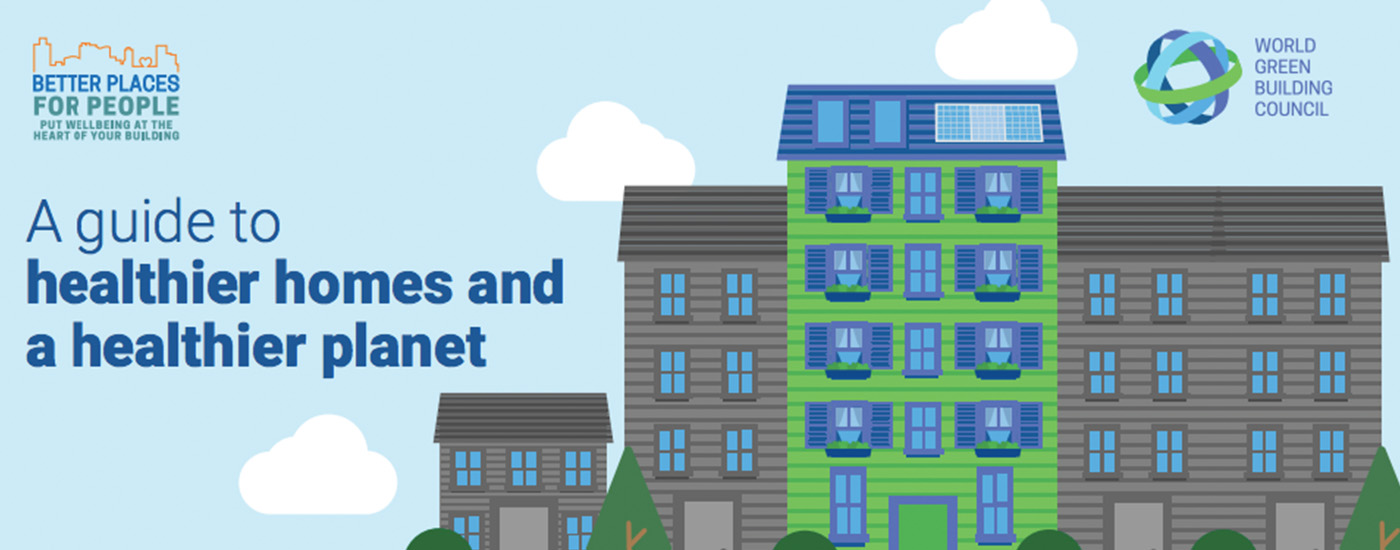
The World Green Building Council launched a new guide to creating healthier homes that in turn, are healthier for the planet. The guide takes a combination of the latest research into air quality, thermal and acoustic comfort and lighting and translates it into simple, low-cost and practical strategies to make the home environment healthier for both people and planet. The world’s buildings have a direct impact both on the environment and on personal health and wellbeing, as well as having huge financial implications to owners and occupiers.
On average we spend 90% of our time indoors1, so the quality of the air we breathe can make a big impact on our health. More than half of the body’s air intake during a lifetime is inhaled in the home2. However, for 92% of us, the air around our homes is not safe to breathe3 and is linked to a range of health hazards.
Poor insulation and construction of buildings is often the cause of low energy efficiency and can compromise the occupant’s comfort and health. Around 65% of Europeans living in major urban areas are exposed to dangerously high levels of noise pollution4. This can lead to health issues such as stress, high blood pressure, hypertension and strokes4.
One study about living in a dark home found health worsened by 50% with headaches, insomnia and depression amongst other reported negative health impacts5. Therefore, good quality light, daylight when possible, is essential for a healthy life. Natural lighting is also an important energy reduction strategy in the home.
Patty Fong, Director for Buildings and Urban Systems, European Climate Foundation said: “This guide makes an important contribution to raising awareness around how the quality of our homes can negatively affect our health and productivity. By making the recommended improvements, we can make our living space healthier while also contributing to climate change mitigation.”
References
- Klepeis, N, Nelson, W, Ott, W et al. 2001. ‘The National Human Activity Pattern Survey (NHAPS). A Resource for Assessing Exposure to Environmental Pollutants’ Lawrence Berkeley National Laboratory.https://indoor.lbl.gov/sites/all/files/lbnl-47713.pdf.
- Sundell, J. 2014. ‘On the history of indoor air quality and health’ Indoor Air. 2004;14 Suppl 7:51-8. https://www.ncbi.nlm.nih.gov/pubmed/15330772.
- World Health Organisation. Public Health, Environmental and Social Determinants of Health. http://www.who.int/phe/infographics/breathe-life/en/Health issues such as stress
- Münzel, T., Gori, T., Babisch, W. and Basner, M. (2014) Cardiovascular effects of environmental noise exposure. European Heart Journal. DOI:10.1093/eurheartj/ehu030) from European Commission study ‘Science for Environment Policy’ Thematic Issue: Noise impacts on Health January 2015, Issue 47. https://www.ncbi.nlm.nih.gov/pmc/articles/PMC3971384/.
- Velux. 2017. Healthy Homes Barometer. https://www.velux.com/health/healthy-homes-barometer-201