IEA: Energy Efficiency 2020 Report
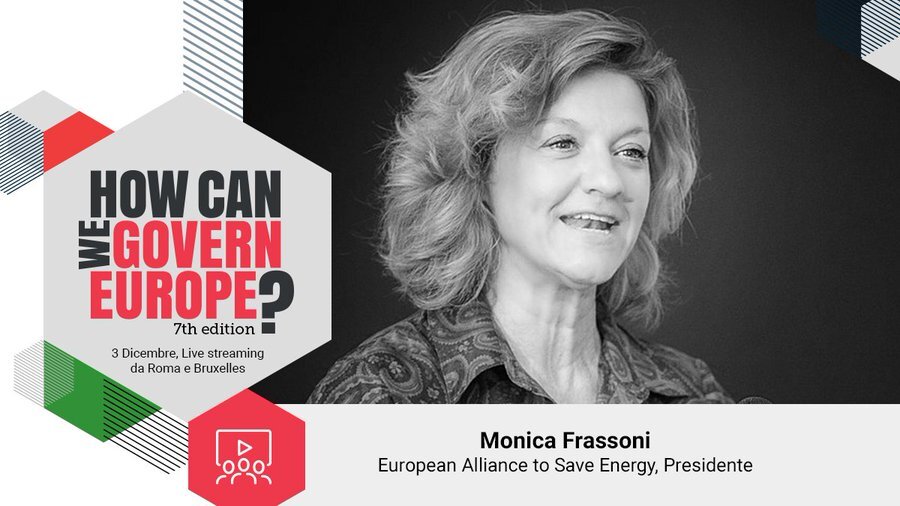
On 3 December 2020 EU-ASE president Monica Frassoni participated in the 7th edition of How can we govern Europe?, the annual conference hosted by the Italian EU affairs media Eunews. This years’ edition was held as an online discussion.
In her intervention, Monica Frassoni discussed how to advance energy efficiency as a key tool to achieve climate neutrality both at European and national level, as well as how Italy can boost a green recovery from the Covid-19 pandemic through its Recovery and Resiliency Plan.
Speakers included representatives of the Italian government, the European Commission and the European Parliament.
The recording of the webinar is available here (in Italian)
This paper showcases concrete examples of water and energy saving projects across sectors and European countries. These feature some of the most advanced environmental technologies currently available on the market, allowing to deliver environmental, economic and social benefits.
Water and energy are deeply entwined. The water-energy nexus refers to the relationship between how much energy is needed for abstracting, moving, heating, cooling, storing, treating and disposing water and how much water is used for generation and transmission of energy.
This nexus is expected to intensify in the coming years. So far, Member States have notified a limited set of water-related measures in the framework of Article 7 of the Energy Efficiency Directive (EED). The most frequently notified measure is the production of hot water by solar collectors or more efficient gas water heaters. However, these measures rather relate to heat generation than water production, distribution, use, and wastewater treatment.
Raising awareness about the energy-water nexus can help:
Achieving a higher 2030 climate target requires intensified action in the building sector, according to a new analysis from BPIE – the Buildings Performance Institute Europe.
BPIE’s study demonstrates that deep renovation should increase to minimum 3% per year until 2030 to deliver the desired GHG reduction. This is in contradiction to the European Commission’s goal to double the annual overall energy renovation rate of 1%, as cited in its Renovation Wave.
The current deep renovation rate of 0.2%/a needs to grow by at least a factor 10 to 2% and should approach 3% as quickly as possible. The report describes how the share of fossil fuels in the energy mix in 2030 will decrease by 57% compared to 2015, while the renewable heat and electricity share will grow to 53% of the final energy demand.
This transformation will be possible with effective policies and support instruments. The Renovation Wave is opening the way to measures that will transform the building sector, but the implementation of policies and support instruments must become faster and more ambitious.
On 27 November EU-ASE president Monica Frassoni participated in the 20th edition of the annual Inter-Parliamentary Meeting on Renewable Energy and Energy Efficiency of the European Forum for Renewable Energy Sources (EUFORES). The conference was held as a Pan-European Parliamentary Webinar.
President Frassoni took the floor during the session “EU Energy Efficiency Policy Update and New Narratives to drive Energy Efficiency“, moderated by Daniel Becker, Director Energy at Guidehouse. Speakers included Carlos Sanchez Rivero, Team Leader Energy Efficiency Finance, European Commission DG Energy; Members of the European Parliament Ciaran Cuffe, Katalin Cseh and Nicolas Gonzalez Casares; Christiane Egger, Deputy Manager, Upper Austria Energy Agency; Adrian Joyce, Secretary General, EuroACE.