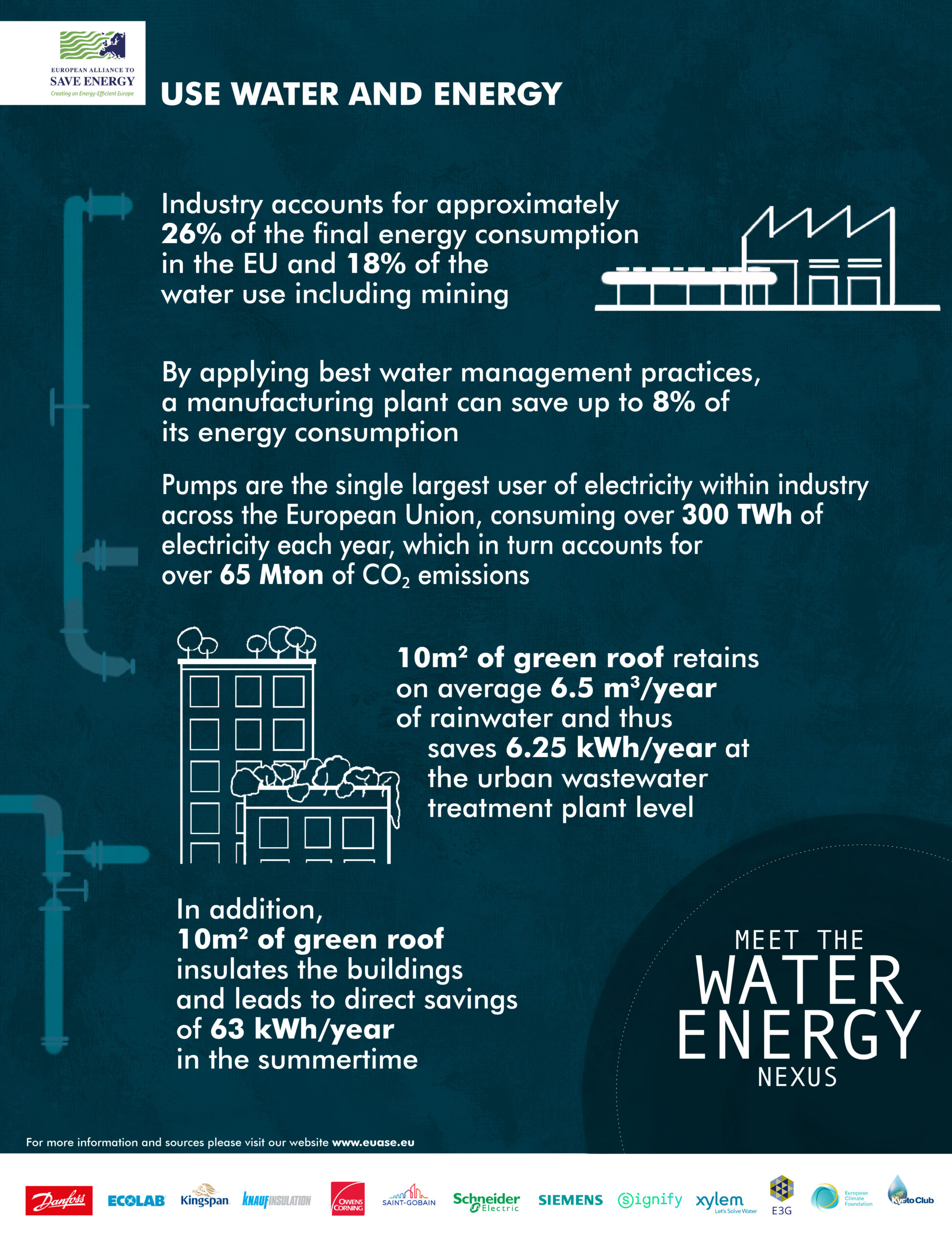
Meet the Water-Energy Nexus

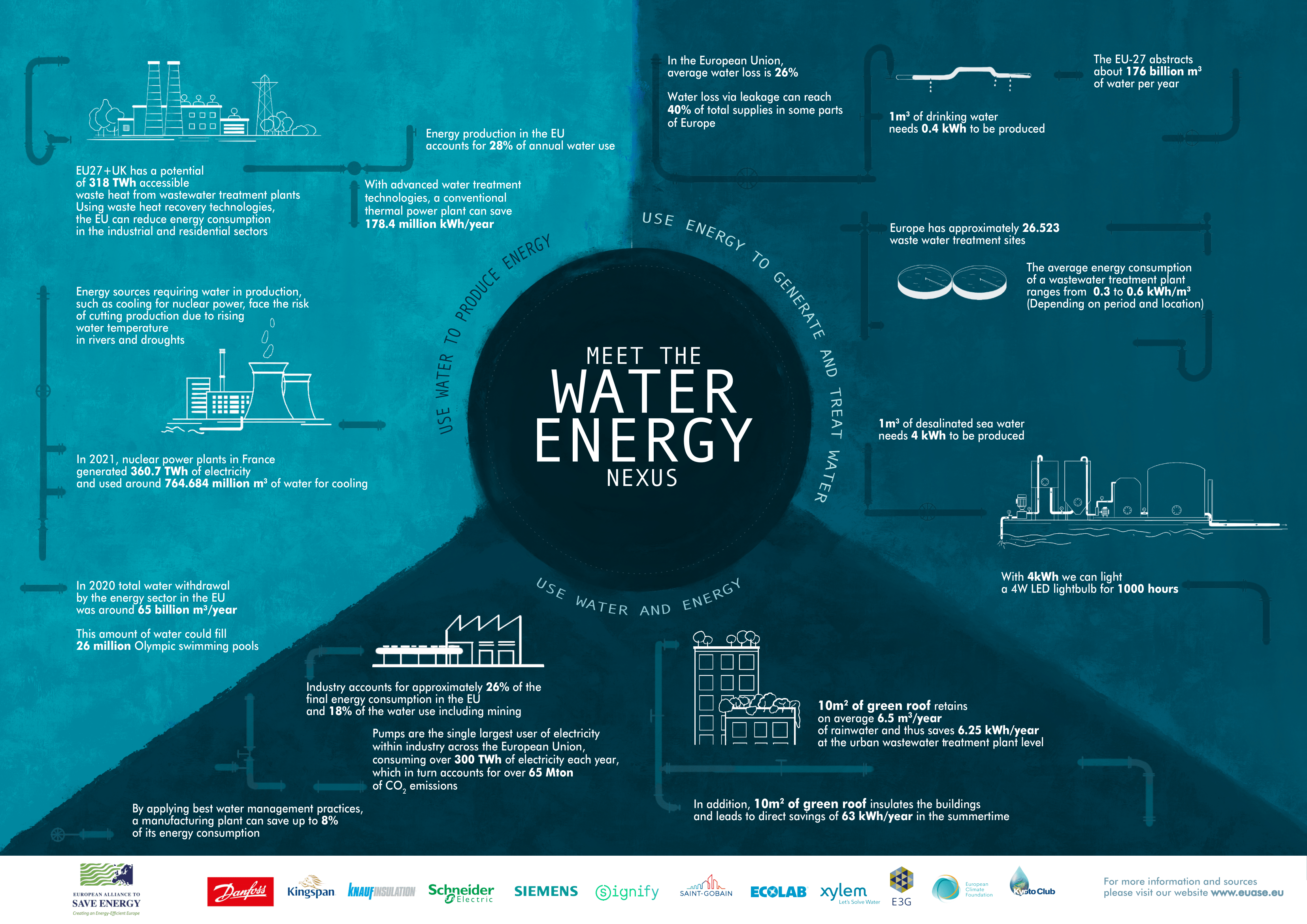
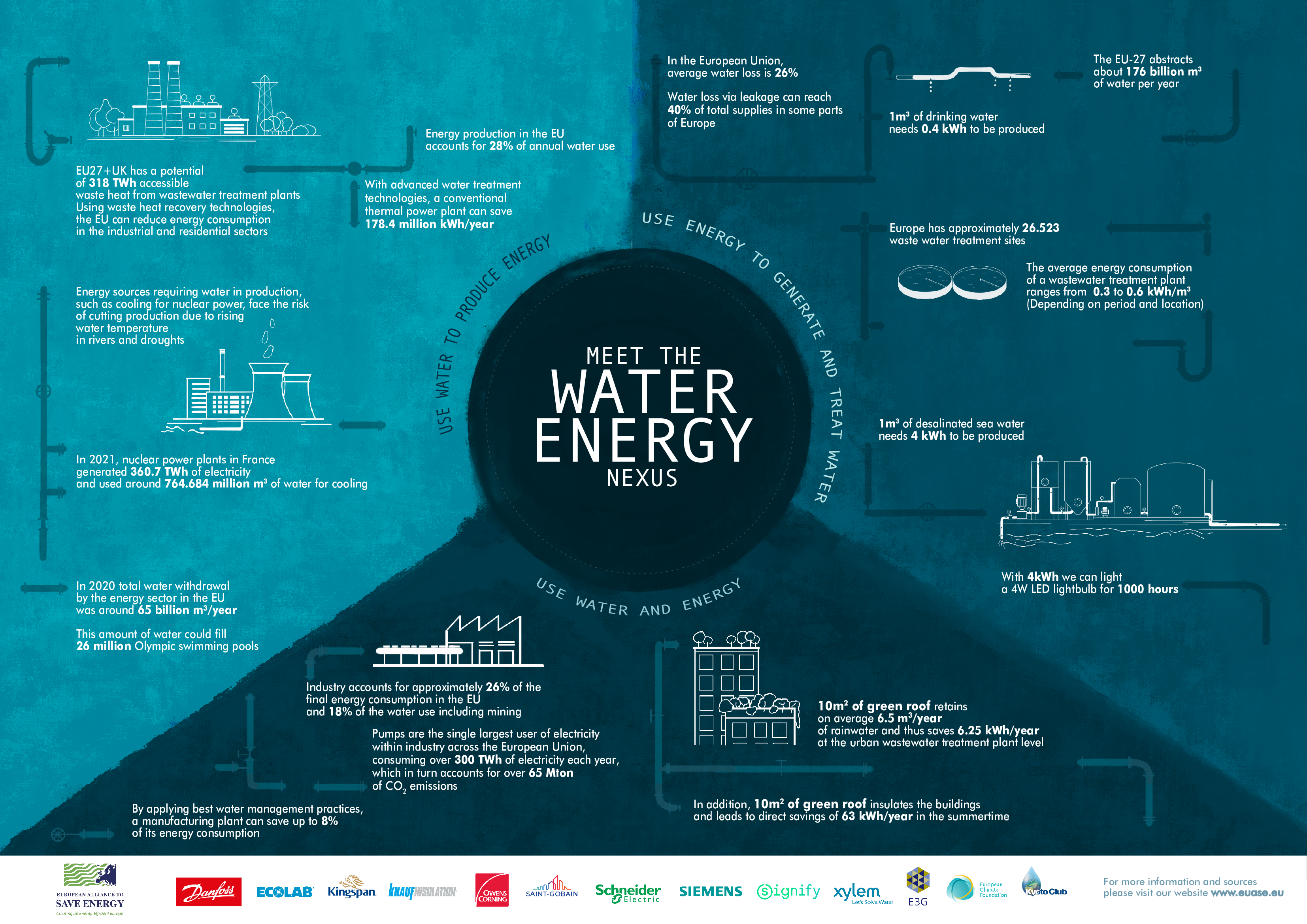
We are thrilled to share our latest publication, an informative infographic highlighting the Water-Energy Nexus. In today’s climate and energy crisis, understanding the water-energy nexus is crucial for driving substantial savings in both resources while reducing emissions and enhancing European industry competitiveness.

Meet the Water-Energy Nexus infographic, developed by The European Alliance to Save Energy with the support of our members. 

Understanding the interdependent relationship between water and energy is crucial as we strive for sustainability and to combat the challenges of climate change. In these times of multiple crises, Europe is currently facing both energy and water crises. It is imperative that we join forces to address these challenges collectively. Recognizing the significance of the water-energy nexus, it is crucial for Europe to take decisive action and prioritize these issues without delay.

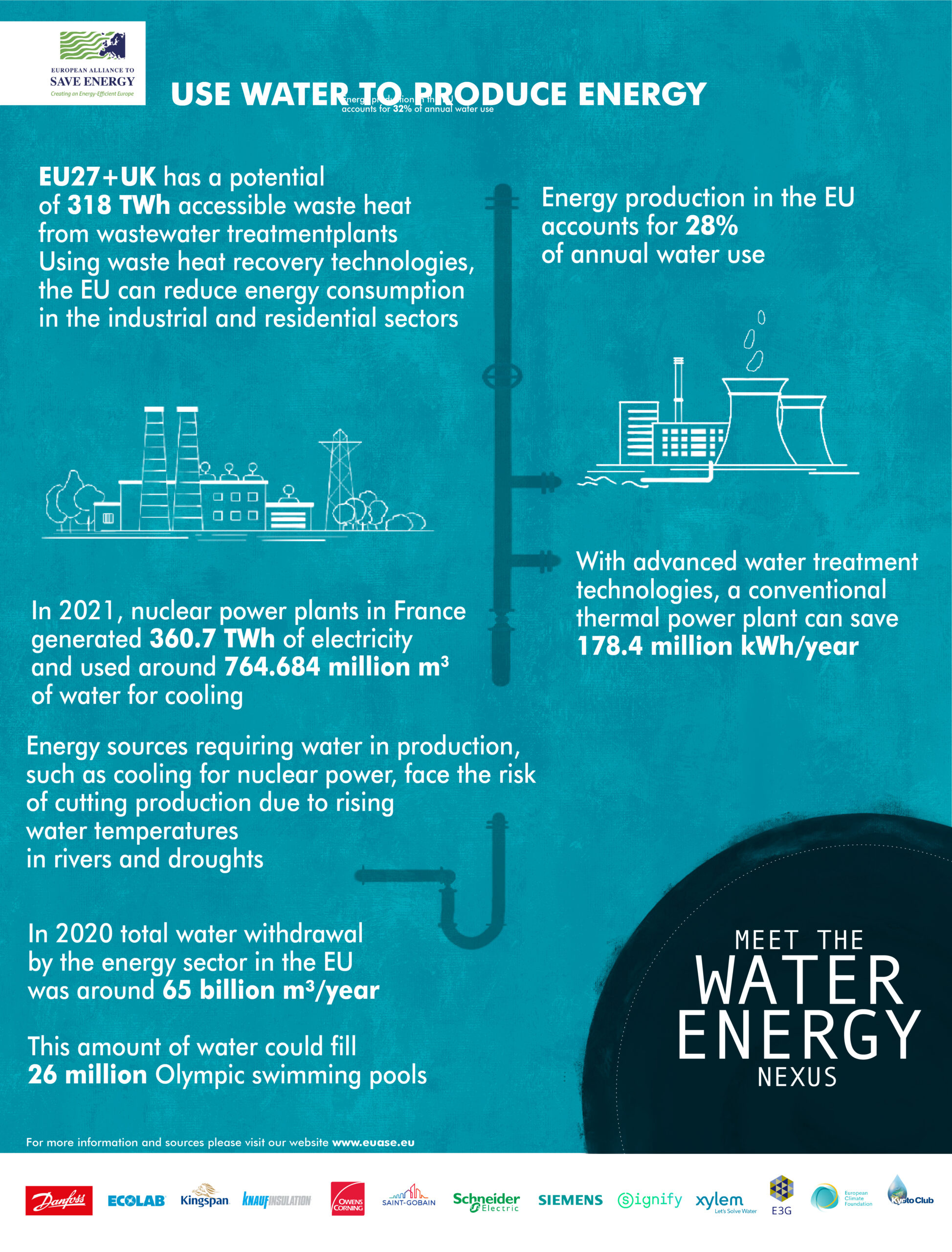
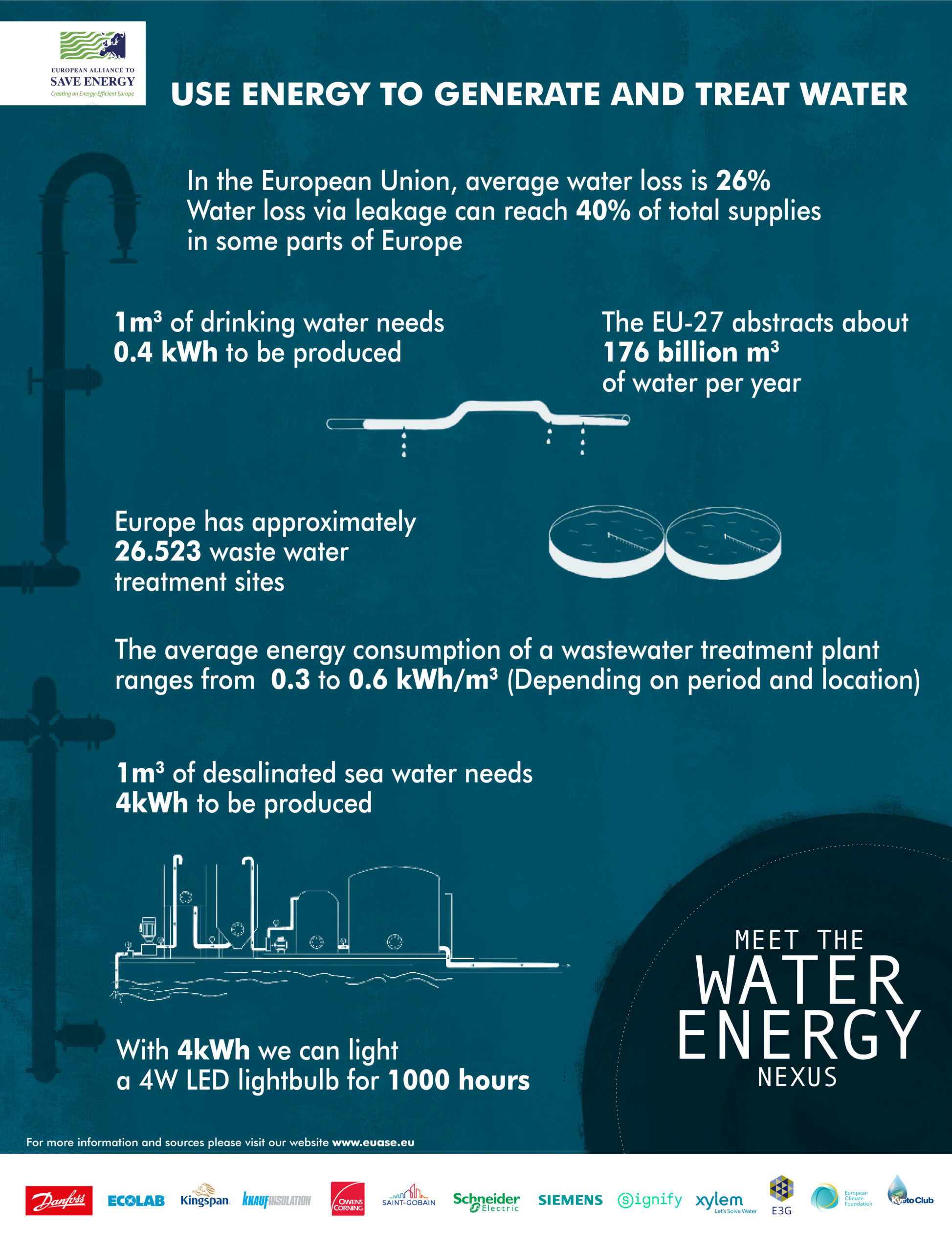
The infographic highlights:

– the connection between water consumption and produce energy

– the energy used to abstract and treat water

– the interlink between energy and water in sectors such as buildings and industry

This visual is a great tool to raise awareness about the water-energy nexus in relation to upcoming key moments of the ordinary legislative procedure related to:

Industrial Emissions Directive (IED)
Urban Wastewater Treatment Directive (UWWTD)
Nature Restoration Law (NRL)

View the full infographic here

View section 1 in detail
View section 2 in detail
View section 3 in detail


Follow us


Privacy Policy

© All right reserved

Saving Water and Energy By Restoring Nature In Urban Areas: Statement on Nature Restoration Law

European Alliance to Save Energy (EU-ASE) welcomes the European Commission’s proposal for a Nature Restoration Law and supports the ambition presented by the ENVI rapporteur in the European Parliament to increase the restoration objective and set higher targets for the restoration of terrestrial, coastal, freshwater, marine, and urban ecosystems.

Nature restoration, ecosystem degradation, and biodiversity loss are critical issues for the European Union due to their impact on the environment, human health, and the economy. It poses a significant challenge to the EU`s sustainability goals, promotion of green growth, and achievement of a climate-neutral society.

The proposal includes some provisions that can promote the realisation of the water-energy nexus i.e. the ability to simultaneously save water and energy.

EU-ASE supports Article 6 on the restoration of urban ecosystems. We also support Article 11 which proposes the introduction of National Restoration Plans.

Green urban infrastructure and permeable surfaces in cities, such as urban parks, green roofs, and green walls, can contribute to saving energy and restoring nature in cities while supporting biodiversity, improving air and water quality, and providing recreational opportunities for urban dwellers, especially in densely populated areas.

The Nature Restoration Law has a significant importance in achieving Union climate goals and should be considered as another element of the package of legislation aiming to promote the deployment of energy efficiency technologies.

Read our full statement on Nature Restoration Law here.


About us
The European Alliance to Save Energy (EU-ASE) is a cross-sectoral, business-led organisation that ensures that the voice of energy efficiency is heard across Europe. EU-ASE members have operations across the 27 Member States of the European Union, employ over 340.000 people in Europe and have an aggregated annual turnover of €115 billion.


Follow us


Privacy Policy

© All right reserved

Future of the Energy Union: bringing the transformative potential of energy efficiency in the National Energy and Climate Plans

As EU member states prepare to submit their revised National Energy and Climate Plans (NECPs) to the European Commission on 30 June, they must pay greater attention to energy efficiency, writes EU-ASE President Monica Frassoni in Euractiv.

A future energy system must be highly energy and resource efficient, based on renewables, secure, competitive, affordable and of course, safe. One that can respond to the climate, energy and water crises that increasingly perturb our economy and create social tensions.

Reducing energy needs and doing this through ready-to-use technologies and a system approach is key to success of Europe’s future energy union and the Green Deal. The Energy Efficiency community needs therefore to have a regular seat at the table.

This is not always the case.


Read the full article byMonica Frassoni in Euractiv.

Follow us


Privacy Policy

© All right reserved

EU-ASE at high-level conference: Looking at the future of the Energy Union, beyond the crisis

On Tuesday 20 April 2023, EU-ASE President Monica Frassoni participated in the Future of the Energy Union: Looking beyond the crisis, organised by Cabinet Kadri Simson.

Commissioner for energy, Kadri Simson, hosted this high-level conference on the future of the Energy Union, drawing lessons from the energy crisis and reflecting on the way forward for EU energy policy.

The aim of the event was to exchange on a future design of the governance of the Energy Union and the preparation of energy related elements in the upcoming updated National Energy and Climate Plans (NECPs). It was an occasion to take stock of the lessons learned from the energy crisis and to discuss how the increased need for energy security, a resilient EU energy system and ambitious energy targets can be reflected in the governance mechanism and the NECPs.

EU-ASE President Monica Frassoni highlighted the need for an energy system that is highly energy and resource efficient, based on renewables, that is secure, competitive, affordable and safe. A system that is able to respond to the climate, energy and water crisis that perturb our economy and create social unrest.

Overall, energy efficiency is one of our greatest tools to decarbonize our global economy and optimize our energy system, however we choose to design that system in the future.

We call member states to take energy efficiency in high consideration when preparing NECPs due by June 2023.

Thank you to Cabinet Simson for organising this timely initiative.

Find more information about the Future of the Energy Union: Looking beyond the crisis.


Follow us


Privacy Policy

© All right reserved

It’s time to unlock the demand side potential in accelerating the energy transition.

In recent months the term “polycrisis” has found its way into our vocabulary. This term captures the multiple crises (climate; energy; inflation; war in Ukraine; …) that are impacting society at large. A sobering reality is that all these crises were created by mankind, as we use the wrong energy and waste too much of it, thus paying far too much in powering our economies and living our lives. On the flipside this means that as mankind we are in the driver’s seat in tackling these challenges. The good news is that the solutions are also interrelated and have raised the relevance and awareness of the energy transition to efficient and clean technologies.

Much attention goes out to the “supply side” of the energy transition, both on the energy mix (with ongoing high use of coal; a search for alternative gas supplies; scaling renewables; investments in hydrogen and nuclear) and energy intensive industries with large stimuli programs in Europe and the US (the Green Deal Industrial Plan and the Inflation Reduction Act). Yet the structural changes to decarbonize our energy system at the supply side of the energy transition will need time to reach scale and impact.

As the world needs solutions on a much shorter term, the time is right to unlock the vast potential at the “demand side” of the energy transition. This largely comes down to stepping up our collective efforts on energy efficiency.

The electrification of heating, transport and other service systems require a massive amount of electricity. The average global electricity consumption of a household (3400 kWh) is almost exactly equal to the annual amount of electricity needed to charge an electric vehicle or to power a heat pump. Already the grid is close to a point where countries are at or near capacity.

For example, while the lighting sector is positively known for the transition to LED lighting, lighting alone still accounts for 13% of global electricity usage. Importantly around half of all light points in the US and EU are still conventional, offering an enormous opportunity for rapid reductions of lighting-related energy consumption. LED lighting retrofits are relatively fast and easy, with few invasive activities involved.

Through a complete switch to connected LEDs, the EU has the potential to save €65.1 billion in energy costs annually and mitigate 51 MTons of carbon emissions, while freeing up enough electricity to power 47 million heat pumps and thus keep a quarter of all households warm each year. The reduction in carbon dioxide would be equal to the sequestration capacity of a forest the size of Switzerland.

Like for lighting, many other solutions exist and Europe’s “demand side companies” operate at the cutting edge of active and passive energy efficiency technologies including lighting, building management systems, sensors, controls, insulation, windows and many others.

Energy efficiency technologies can generate savings often called “low-hanging fruit” waiting to be picked, so let us roll up our sleeves and pick those fruits for the benefit of Europe’s competitiveness and the well-being of its citizens.

Harry Verhaar
Head of Global Public and Government Affairs
Signify

Follow us


Privacy Policy

© All right reserved